


Asteroid Bennu Was Missing Just One Ingredient Needed To Kickstart Life – We just Found It
Asteroid Bennu Was Missing Just One Ingredient Needed To Kickstart Life – We just Found It
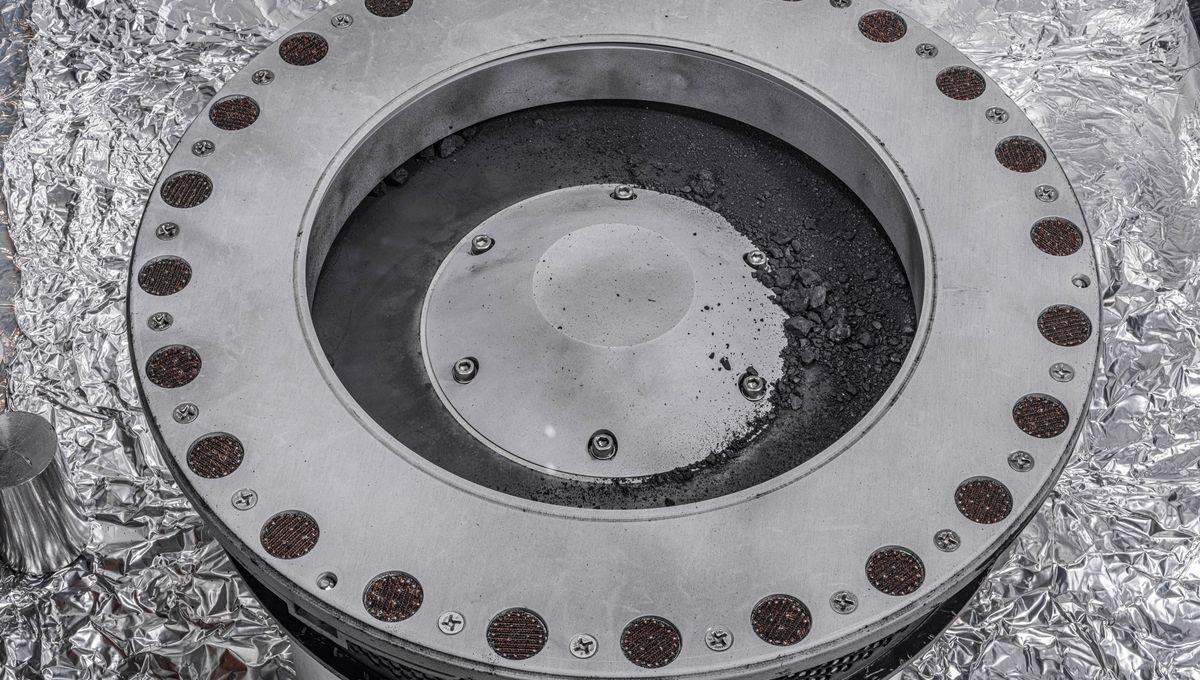
It has been just over two years since NASA’s OSIRIS-REx brought back to Earth 121 grams of precious samples collected from Asteroid Bennu. The material has already delivered incredible insights into what this space rock is made of, including all but one of the molecules needed to kickstart life as we know it on Earth. Now, scientists reveal they just found the missing ingredient.
The rest of this article is behind a paywall. Please sign in or subscribe to access the full content. In a series of new papers, researchers report the presence of sugars that are fundamental for life on Earth, as well as stardust and a polymer formed from a molecule called ammonium carbamate, which has been dubbed "space gum". These findings expand the already complex tapestry of what we know about the ancient parent body of Bennu. Scientists led by Yoshihiro Furukawa of Tohoku University have discovered five-carbon sugar ribose and, for the first time in an extraterrestrial sample, six-carbon glucose in Bennu’s sample. The discovery of all five nucleotides that make up DNA and RNA has been previously reported, as well as possibly 15 amino acids. With the presence of the sugar, the asteroid now has everything needed to make one of the fundamental life molecules. “All five nucleobases used to construct both DNA and RNA, along with phosphates, have already been found in the Bennu samples brought to Earth by OSIRIS-REx,” said Furukawa in a statement. “The new discovery of ribose means that all of the components to form the molecule RNA are present in Bennu.” Ribose has previously been found in meteorite samples on Earth, but it is important to find it in a pristine extraterrestrial sample, as meteorites are one theory of how life started on Earth. There is no evidence for deoxyribose, the D in DNA, in Bennu, though. Bennu and its parent body might not have been the right environment for deoxyribose to form, and the initial start of life might have been with RNA. “Present day life is based on a complex system organized primarily by three types of functional biopolymers: DNA, RNA, and proteins,” explains Furukawa. “However, early life may have been simpler. RNA is the leading candidate for the first functional biopolymer because it can store genetic information and catalyze many biological reactions.” Bennu is believed to have originated from the shards of a much larger world. Curiously, asteroid Ryugu, sampled by the Japanese probe Hayabusa2, might have also come from the same world. This protoplanet must have had water and heat, as several chemical discoveries have shown. The second paper, led by Scott Sandford at NASA’s Ames Research Center and Zack Gainsforth of the University of California, Berkeley, reports the presence of a polymer, originally soft and flexible, which then hardened over time. The team refers to it as a gum-like material. This ancient space gum is rich in nitrogen, carbon, and oxygen. A starting point is believed to be a compound called carbamate, which forms naturally under radiation from ammonia and carbon dioxide. Carbamate then polymerizes by reacting with itself and other molecules. “With this strange substance, we’re looking at, quite possibly, one of the earliest alterations of materials that occurred in this rock,” said Sandford. “On this primitive asteroid that formed in the early days of the solar system, we’re looking at events near the beginning of the beginning.” Bennu continues to be a cornucopia of new and important molecules; a treasure trove that has kept its haul for 4.5 billion years. The study announcing the sugars is published in Nature Geoscience. The study on the space gum is published in Nature Astronomy.

 English
 Arabic
 French
 Spanish
 Portuguese
 Deutsch
 Turkish
 Italiano
 Russian
 Romaian
 Portuguese (Brazil)
 Greek
Greek