


 PUBLISHED
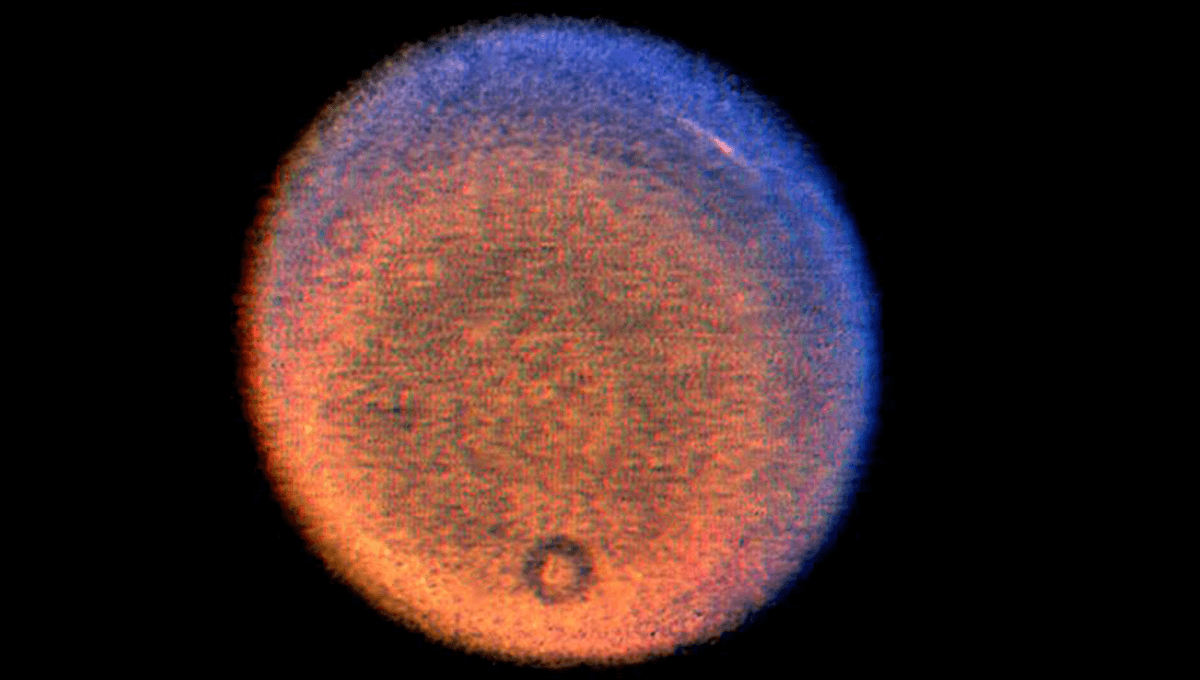
A new study may help to solve a 39-year-old mystery, suggesting that Uranus is not so bizarre after all; Voyager 2 just imaged it during an unusual gust of solar "wind".
The rest of this article is behind a paywall. Please sign in or subscribe to access the full content. The iconic Voyager 1 and 2 spacecraft, launched in 1977 and still going to this day, were sent with the primary objective of studying the gas giants Jupiter and Saturn. But on their way (eventually) out of the Solar System, due to a fortunate planetary alignment which only occurs every 175 years, Voyager 2 went on to be the only spacecraft to visit Uranus and Neptune, arriving January 24, 1986. The spacecraft became the first, and so far only, mission to take photographs of Uranus. As well as discovering a new moon, named "Puck", the spacecraft took the first measurements of the planet's magnetosphere – the protective region around a planet dominated by the planet's magnetic field, which shields planets from plasma in the solar wind. Here, it presented scientists with a new mystery. "Inside the planet’s magnetosphere were electron radiation belts with an intensity second only to Jupiter’s notoriously brutal radiation belts. But there was apparently no source of energized particles to feed those active belts; in fact, the rest of Uranus’ magnetosphere was almost devoid of plasma," NASA explains. "The missing plasma also puzzled scientists because they knew that the five major Uranian moons in the magnetic bubble should have produced water ions, as icy moons around other outer planets do. They concluded that the moons must be inert with no ongoing activity." That mystery is now very old, having puzzled scientists for four decades: How could Uranus support such an intense electron belt? "While the ion radiation belt intensity was below expectations, the electron belt intensities were significantly higher than anticipated, reaching the Kennel-Petschek limit for the system," the authors of the new study explain. "The Kennel-Petschek limit is the point at which runaway wave growth would subsequently scatter particles into the loss-cone, thereby limiting the maximum energetic particle intensity that could stably exist. As a result of this discrepancy between the ion and electron intensities compared to their Kennel-Petschek limits, studies have posed a seeming mystery regarding how the Uranian system could support such intense electron belt with a meager ion belt." Recently, a new idea has been suggested that Voyager 2 simply flew past the planet at an unfortunate time. "It was recently noted that a co-rotating interaction region (CIR), a large-scale solar wind structures that form at the boundary between high-speed streams from coronal holes and preceding slow solar wind streams, was passing over Uranus at the time of the Voyager 2 flyby," the team explains. "As noted in Jasinski et al. (2024), the passage of the CIR may have caused plasma in the inner magnetosphere to be vacated by the time of Voyager 2's passage through the system." Fortunately, in the intervening decades, we have had a much better look at the workings of our own magnetosphere. "Science has come a long way since the Voyager 2 flyby," Southwest Research Institute's Dr Robert Allen, lead author of the paper, explained in a statement. "We decided to take a comparative approach looking at the Voyager 2 data and compare it to Earth observations we've made in the decades since." Uranus traveling through the solar wind may explain Voyager's weird observations. Image credit: SwRI Comparing the data seen by Voyager 2 to observations of the Earth's magnetosphere, the team puts the unusual Uranus electron belt observations down to chorus waves. "Chorus waves are a class of frequency-chirping, whistler-mode plasma waves that are routinely observed in Earth’s near-space environment," NASA explains. "Chorus waves play a key role in various physical processes including the formation of the Earth’s Van Allen radiation belts, the pulsating aurora, and the deposition of particle energy into Earth’s upper atmosphere." At the time, scientists thought that chorus waves would scatter electrons, which would then be lost to Uranus's atmosphere. But since then, it has been found that under certain conditions, they can accelerate electrons and feed them with more energy. Comparing Earth and Uranus observations, they found this to be a reasonable explanation. "The Voyager 2 Uranus flyby and the 7.7 MeV electron event at Earth in 2019 share several similarities. Both occurred during solar minimum when CIRs are more prevalent in the heliosphere and during times when CIRs are seen to be repeatedly passing over the planetary magnetospheres," the team explains. "Also, both events are characterized by strong chorus emissions concurrent to high fluxes of relativistic electrons, which were potentially driven by convection and substorm activity observed for both Earth and Uranus, potentially seeding the inner magnetosphere." Unfortunately, Voyager only caught a brief glimpse of Uranus, and since then, no mission has returned to it. The team, along with many others, would like to take another look. "In 2019, Earth experienced one of these events, which caused an immense amount of radiation belt electron acceleration," Dr Sarah Vines, a co-author of the paper, added. "If a similar mechanism interacted with the Uranian system, it would explain why Voyager 2 saw all this unexpected additional energy." The team suggests that a new mission to the planet should take repeated measurements of it, to help our understanding of its magnetosphere under more usual conditions. "This is just one more reason to send a mission targeting Uranus," Allen added. "The findings have some important implications for similar systems, such as Neptune's." The study is published in Geophysical Research Letters.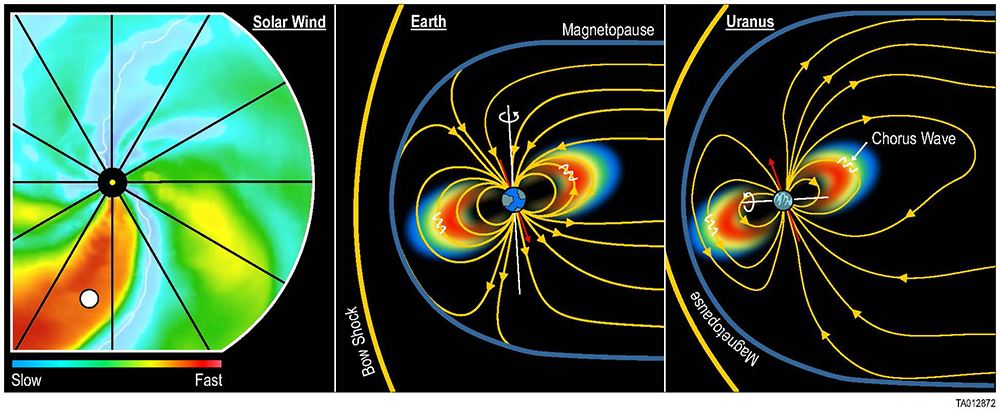



 English
 French
 Spanish
 Portuguese
 Deutsch
 Turkish
 Dutch
Dutch
 Italiano
 Russian
 Romaian
 Portuguese (Brazil)
 Greek
Greek