


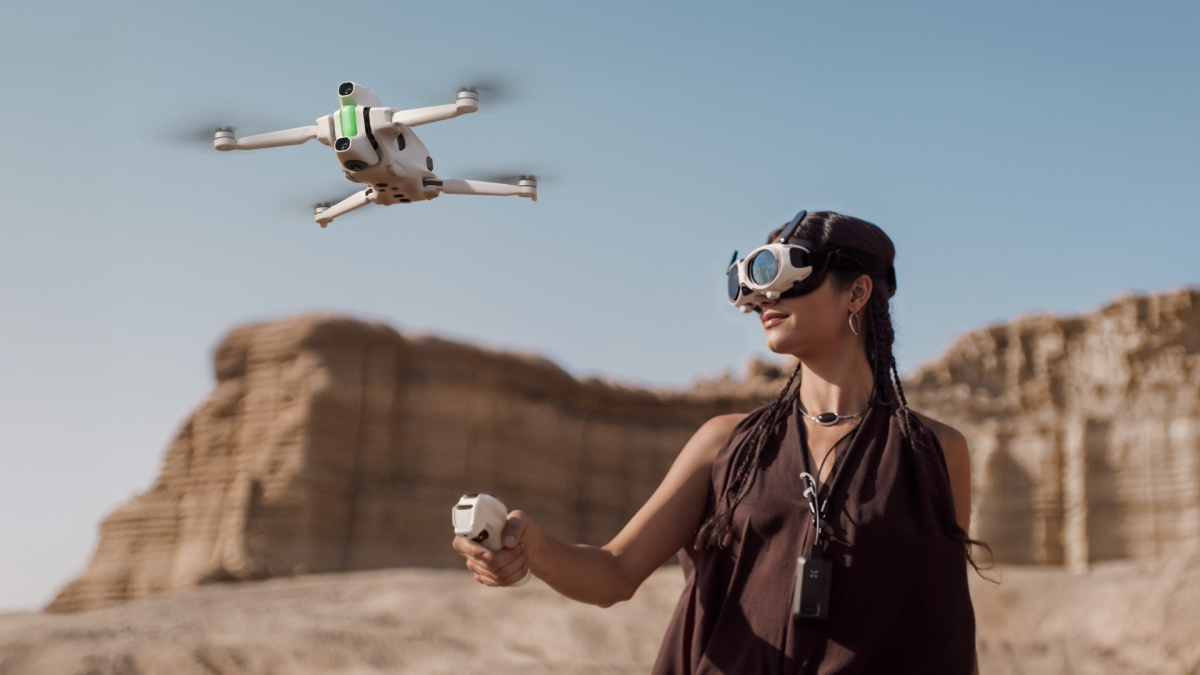
Antigravity has officially launched Antigravity A1, saying it's the "world's first" consumer aerial drone with inbuilt 360-degree video capture. The release comes a month earlier than its previously scheduled January 2026 release date. Having spent some time with the A1, it's the first gadget in a while that has reminded me that tech was once wondrous and fun — and can be again.
If you're still stumped about what to get your loved ones for Christmas, a hot new bombshell has entered the villa.
Action camera company Insta360 initially unveiled new drone brand Antigravity in July. At the time, the company teased that its first product would not only offer unprecedented 360-degree 8K aerial recording, but would be designed so that even amateurs could easily use it.
This debut drone was subsequently revealed to be the A1, with Antigravity stating that it is piloted using controls similar to that of virtual reality headsets. In a press release, the company said product is "for everyone who's ever wanted a drone, but felt it would be too big of an investment for something they may never be able to use to its full potential."
It's an ambitious goal, with drones often considered gadgets for enthusiasts. Nevertheless, having played around with the A1 drone myself, it seems as though Antigravity may have achieved it. Mashable can confirm the Antigravity A1 is indeed delightfully easy to fly, and the device makes it simple even for drone novices to capture spectacular, high quality aerial images.
Antigravity A1 first impressions: Intuitive and fun

Credit: Amanda Yeo / Mashable
My previous experience flying drones involved far more common twin stick controls, which I found difficult to navigate and left me fearful that I'd crash. In contrast, the Antigravity A1's controls are simple and intuitive enough that I was able to hand it over to someone else to pilot on the spot, only providing a quick run down of the controls.
The Antigravity A1 has three main components: the Vision goggles, the Grip controller, and the A1 drone itself. The lightweight white drone weighs just 249 grams, and is notably compact. Once its four arms are folded in, the drone fits neatly into a small protective case, which in turn fits into a padded camera bag along with its accessories. This makes the A1 easily portable to wherever you're taking aerial shots.
Antigravity A1's controls are simple and intuitive enough that I was able to hand it over to someone else to pilot on the spot.
The Vision goggles are also lightweight, helped by the fact that Antigravity doesn't incorporate its battery into the body of the gadget. Instead, users hang the battery from their neck like a pendant, with a wire running up to the goggles to keep it powered. It's no more annoying than wearing wired headphones, but even so, it wouldn't be surprising if Antigravity continues to refine this in the future.
Mashable Light Speed

Credit: Antigravity
The combination of the Vision goggles and the Grip controller make the A1 drone delightfully easy and intuitive to pilot. Simply press the trigger to accelerate and move the controller in the direction you want to go. Pointing the controller up will cause the A1 to climb higher, or you can slide a tab on the controller to adjust its elevation. Taking off is just a slide of the tab as well.
Landing is even simpler. When you're finished flying, simply use the Grip controller to open a menu on the Vision goggles and tell your A1 to go home. This will prompt the drone to return to its take-off location and autonomously deploy its landing gear. Not having to manually land the A1 relieves a lot of stress, particularly for nervous first-time pilots.
Factor in an inbuilt obstacle avoidance system which stops the drone before collisions, and the Antigravity A1 feels practically foolproof. Even so, the A1 does come with spare propellers, while its 360-degree camera lens can be replaced with a separately sold kit.

Credit: Antigravity
The Antigravity A1 is simple enough to operate that many less tech-savvy users should be able to pick it up and jump into flying with relative ease. A clear onboard tutorial quickly runs new users though most of the basics needed to get into the air, leaving the finer details for later discovery when digging through the Vision goggles' menu. This includes features such as the Virtual Cockpit, a slightly silly first-person view option which adds an animated dragon for you to "ride."
However, it's worth noting that Antigravity's faith in the A1's intuitive controls results in a fairly minimalist approach to its included print instructions. I had some difficulty figuring out how to turn the A1 off, leading to several long, confusing minutes pressing buttons and scouring through the manual for anything I'd missed. (Pro tip: You'll want to press the power button once, then press it a second time and hold it.)
Users should also bring a spotter with them when they take to the skies, so there's someone to keep an eye on both the drone and you. Though the Vision goggles are great for immersing yourself in the A1's point of view, they also cut off vision of everything around you, leaving you with no situational awareness. You can switch between the drone's view and a black and white passthrough view by double tapping a side button. However, there's currently no option to see both views at once. Hopefully this feature might be added in a future update.

Credit: Antigravity
When it came to image quality, the Antigravity A1 continued to impress, offering beautifully smooth, clear, and seamless 8K 360 video. This is unsurprising, as Antigravity previously confirmed that the A1's dual-lens camera system mirrors Insta360's tried and true X series of 360 cameras. Footage can be edited straight in the Antigravity app, though there's also an option to produce an AI-generated edit set to in-app music if you're feeling lazy or lacking in editing skills.
For those concerned about privacy, Antigravity states that there is no automatic upload of the drone's video recordings. Footage is solely stored onboard the A1, Vision goggles, and any SD card you might insert, which you can then transfer to your phone or computer. Antigravity told Mashable that it only collects crucial drone usage data such as activation details and flight safety information, and doesn't gather personal or location data unless users upload flight logs. Information it does gather is stored in nearby data centres, with U.S. users' data kept on servers within the country.
Where to buy the Antigravity A1 drone
The Antigravity A1 drone is available from today, and starts from $1,599 for the Standard Bundle. There's also a $1,899 Explorer Bundle and $1,999 Infinity Bundle, each of which include different accessories depending upon your needs.
U.S. drone pilots can pick up the Antigravity A1 from Best Buy or from the Antigravity Store online. As always, remember to check your local laws and airspace restrictions prior to flying any drone.

 English
 Arabic
 Spanish
 Portuguese
 Deutsch
 Turkish
 Dutch
Dutch
 Italiano
 Russian
 Romaian
 Portuguese (Brazil)
 Greek
Greek