


Interstellar Comet 3I/ATLAS Will Make Its Closest Approach To Earth This Month, Just 270 Million Kilometers Away
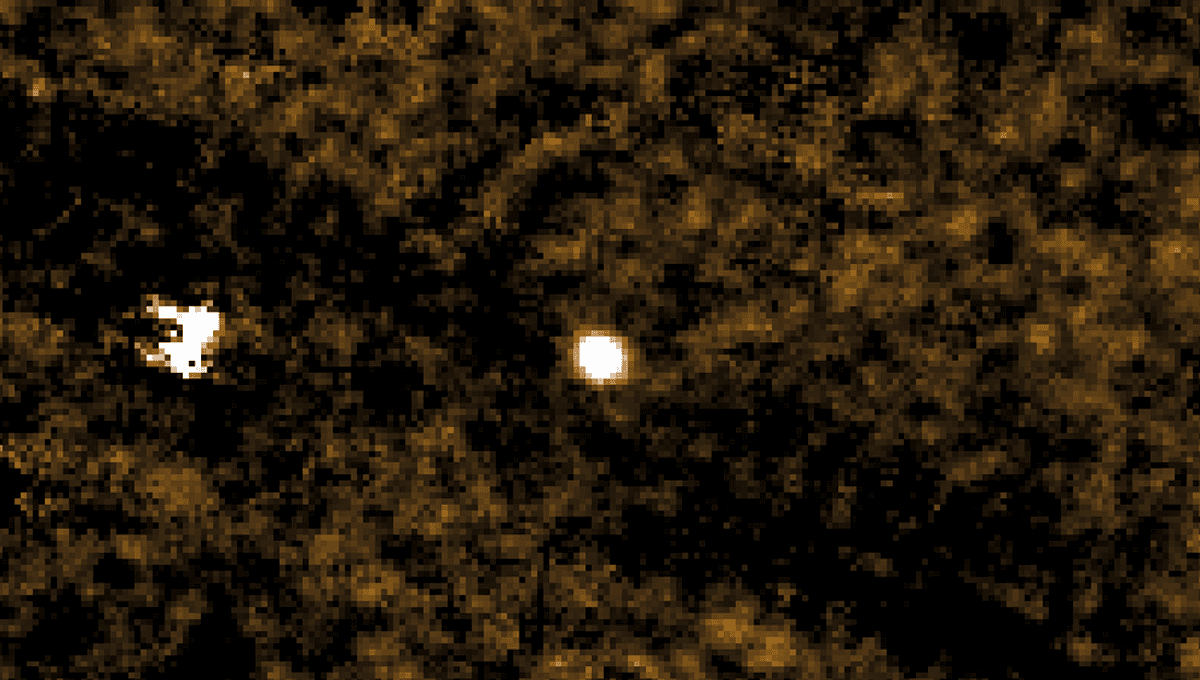
Interstellar Comet 3I/ATLAS Will Make Its Closest Approach To Earth This Month, Just 270 Million Kilometers Away
Interstellar comet 3I/ATLAS will make its closest approach to Earth this month, whizzing by at 270 million kilometers (168 million miles) away, putting on a show for anyone equipped even with a small telescope or binoculars.
The rest of this article is behind a paywall. Please sign in or subscribe to access the full content. By now, you have likely heard of our third confirmed interstellar visitor, but for those of you who aren't up to speed with the news (or wild conspiracy theories) about our interstellar comet, here is a brief recap. On July 1, the Asteroid Terrestrial-impact Last Alert System (ATLAS) spotted an object hurtling through our Solar System with unusual velocity. "When it was discovered, 3I/ATLAS was traveling at about 137,000 miles per hour (221,000 kilometers per hour). Pulled by the Sun's gravity, its speed increased to about 153,000 miles per hour (246,000 kilometers per hour) at its closest approach to the Sun, known as perihelion. When 3I/ATLAS leaves our Solar System, it will be at the same speed as it came in," NASA explains. "Based on observations from NASA's Hubble Space Telescope on Aug. 20, 2025, astronomers estimated the diameter of 3I/ATLAS' nucleus to be not less than 1,400 feet (440 meters) and not greater than 3.5 miles (5.6 kilometers)." The object was soon confirmed to be an interstellar comet, hurled our way by processes scientists would like to know more about. More recent observations have found it to be both unusual and distinct compared to Solar System comets, and in other ways surprisingly (or reassuringly, depending on your viewpoint) similar to objects beyond the orbit of Neptune. That's not to say it isn't interesting. We are talking about an object that is perhaps 10 billion years old, a time capsule from another age of the universe, and a different part of the galaxy. If that doesn't get your astronomy engine revving, it also appears to be experiencing cryovolcanism. While interstellar objects sent our direction through the interstellar medium from other star systems are potentially a threat to Earth in general (and particularly around the equator), astronomers are not worried about the risk of impact from 3I/ATLAS. The object has already had a relatively close encounter with Mars, where it was photographed by Perseverance and various Mars orbiters. On October 3, during its closest approach to the planet, it passed within 29 million kilometers (18 million miles). That's pretty close, at around 0.19 astronomical units (AU), with one AU being the average Earth-Sun distance. Its next close(ish) encounter will be with Earth, flying by on December 19, 2025. There is nothing to fear from it, and it will pass harmlessly by at a comfortable distance of 1.8 AU. "The closest the comet will come to Earth is about 270 million km – that’s about 1.8 times the distance between Earth and the Sun," the European Space Agency explains. "During its closest approach to the Earth, it will be on the other side of the Sun. It poses no danger to our planet or any other planets in the Solar System." That's plenty of distance between us and the comet, but it should be a good opportunity for astronomy enthusiasts to get out their telescopes and view it – this is as close as it is ever going to be. The latest observed magnitude of 3I/ATLAS is 10.3. At this magnitude, you will need a good pair of binoculars to see it for yourself. NASA recommends a telescope with an aperture of at least 30 centimeters (12 inches). To find it, it is easiest to look east to northeast before dawn, under Regulus, a star at the center of the constellation of Leo, though there are trackers such as The Sky Live for more detailed coordinates. After the close encounter with Earth, our visitor may have one final, course-altering encounter with our Solar System's largest planet, Jupiter. On March 16, 2026, it will pass within 0.35786 AU, or 53 million kilometers (33 million miles), of the gas giant. Depending on the comet's outgassing (and cryovolcanism), the planet could significantly alter the comet's course. We will have to wait to see how much the comet's closest approach to the Sun has affected its trajectory (through heating up the object, leading to outgassing) to know whether the object's course will be significantly affected by Jupiter. A good opportunity to do that is during its closest approach to the Earth.How to watch 3I/ATLAS's closest approach to Earth on Dec 19
What you need
Where to look

 English
 Arabic
 French
 Spanish
 Deutsch
 Turkish
 Dutch
Dutch
 Italiano
 Russian
 Romaian
 Portuguese (Brazil)
 Greek
Greek