


How Does Time Pass On Mars? For The First Time, We Have A Precise Answer
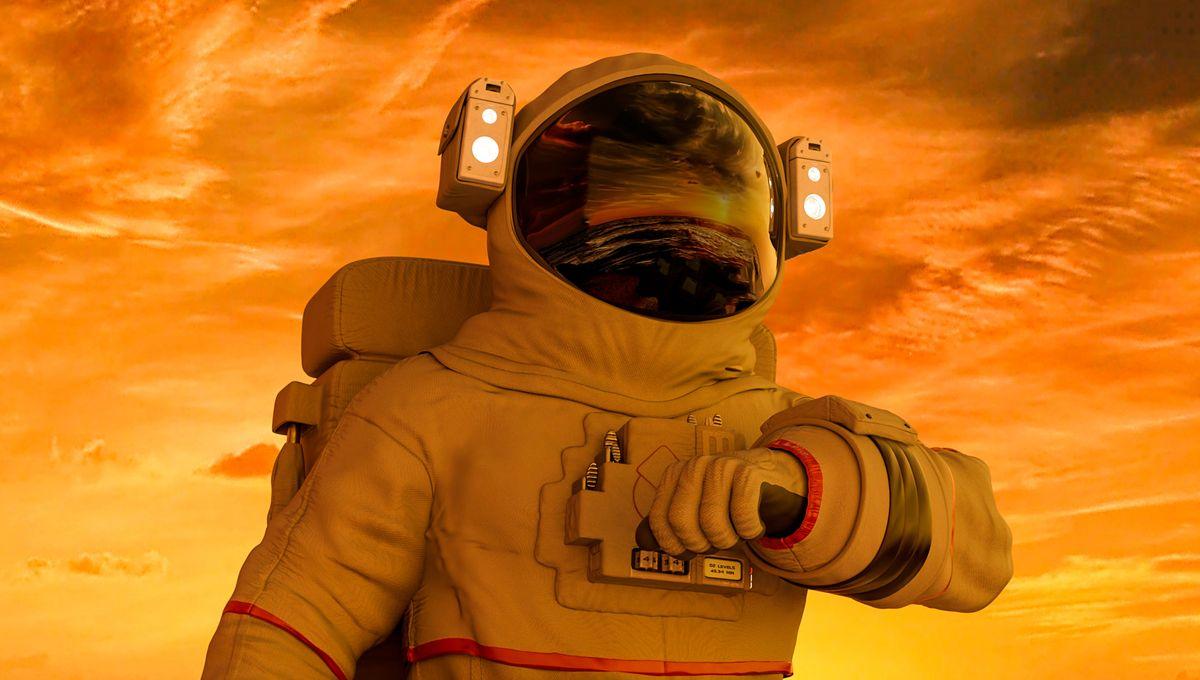
How Does Time Pass On Mars? For The First Time, We Have A Precise Answer
Time is relative. If you don’t believe me, get into a plank for one minute. How was that? Longest minute of your life, huh? And that’s just psychological time. Physical time, too, is relative and it's fairly easy for two clocks to become out of sync. Differences in speed or gravity do the trick, so a clock on Earth and a clock on Mars would not keep the same beat. Now, we know what the difference is – and it does not stay constant.
The rest of this article is behind a paywall. Please sign in or subscribe to access the full content. Physicists at the National Institute of Standards and Technology (NIST) have looked at the motion and pull of Mars with unprecedented precision. Using the time dilation formula to account for the motion and gravitational pull of an object, they were able to estimate the difference that an atomic clock on Mars would experience with respect to a clock on Earth. The team estimated that Martian clocks will be, on average, 477 microseconds faster per day than their earthly counterparts. But this value changes by as much as 226 microseconds a day, depending on Mars’s position in its orbit. Last year, researchers estimated with high precision that on the Moon, clocks move 56 microseconds per day faster. The Moon is in a close-to-circular orbit around the Earth, and the Earth is in a close-to-circular orbit around the Sun, making the difference pretty constant. “But for Mars, that’s not the case. Its distance from the Sun and its eccentric orbit make the variations in time larger. A three-body problem is extremely complicated. Now we’re dealing with four: the Sun, Earth, the Moon and Mars,” NIST physicist Bijunath Patla said in a statement. “The heavy lifting was more challenging than I initially thought.” The team had to consider Martian surface gravity, its eccentric orbit, as well as the effects of the Sun, Earth, and even our Moon on the Red Planet. The combination of all these effects provided researchers with a clear idea of the necessary accommodations to keep clocks in sync between the two worlds. “It may be decades before the surface of Mars is covered by the tracks of wandering rovers, but it is useful now to study the issues involved in establishing navigation systems on other planets and moons,” author Neil Ashby, also with NIST, added. “Like current global navigation systems like GPS, these systems will depend on accurate clocks, and the effects on clock rates can be analyzed with the help of Einstein’s general theory of relativity.” This means that, due to time dilation, you would age faster on Mars than on Earth. If you were to spend a whole 50 years on the Red Planet, you’d end up a whole 9 seconds older than if you had stayed on Earth. The study is published in The Astronomical Journal.

 English
 Arabic
 French
 Spanish
 Portuguese
 Deutsch
 Turkish
 Dutch
Dutch
 Italiano
 Russian
 Romaian
 Greek
Greek