


 PUBLISHED

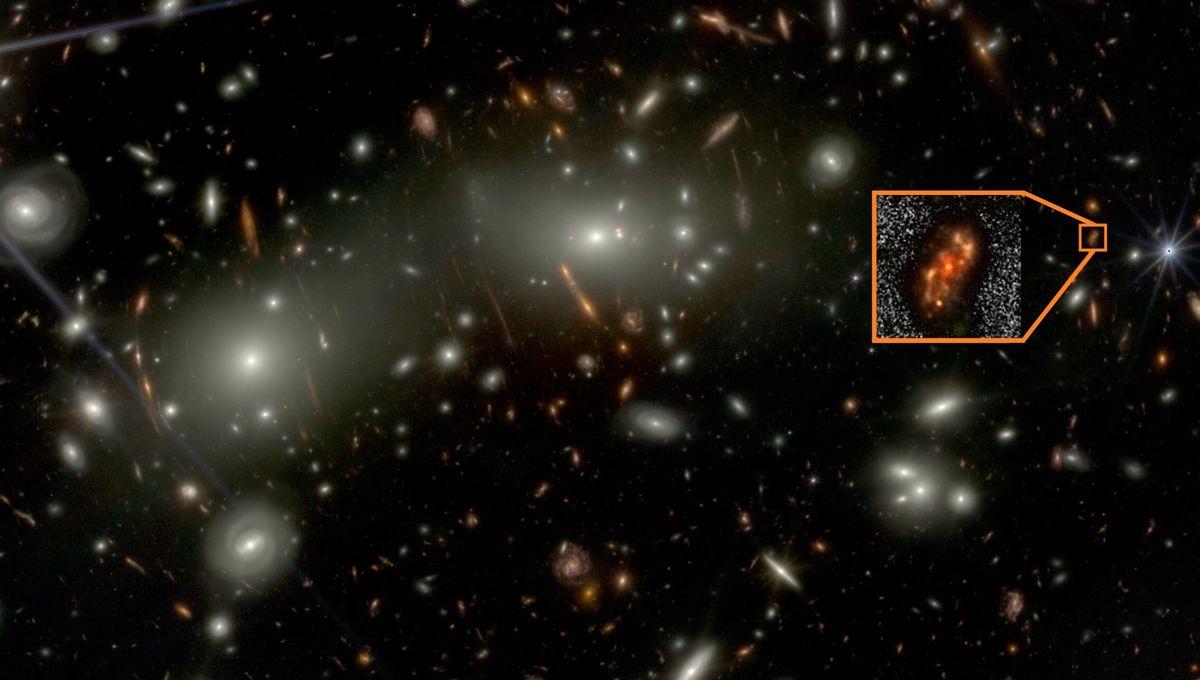
Our galaxy, the Milky Way, is estimated to be 13.6 billion years old. It began to form a few hundred million years after the Big Bang, but its distinctive spiral arms and general structure took many billions of years to assemble. So, imagine astronomers' surprise when they looked at a JWST image and found a spiral galaxy like the Milky Way already well-formed just 1.5 billion years after the Big Bang.
The rest of this article is behind a paywall. Please sign in or subscribe to access the full content. The object was discovered by Rashi Jain and Yogesh Wadadekar National Centre for Radio Astrophysics of the Tata Institute of Fundamental Research (NCRA-TIFR) using JWST. They called it Alaknanda, after the Himalayan river that is a twin headstream of the Ganga alongside the Mandakini. Mandakini is also the Hindi name for the Milky Way, so this is very fitting. The assembly of galaxies is expected to be chaotic, and in fact, many early galaxies are just messy little blobs. Recently, there has been evidence of more ordered galaxies appearing when they shouldn’t have. Alaknanda looks well-evolved: it has two large spiral arms, a round central region, and it is 30,000 light-years across. Smaller than the Milky Way, which is 100,000 light-years across, but still impressive. "Alaknanda has the structural maturity we associate with galaxies that are billions of years older," Jain, the study's lead author, said in a statement. "Finding such a well-organised spiral disk at this epoch tells us that the physical processes driving galaxy formation – gas accretion, disk settling, and possibly the development of spiral density waves – can operate far more efficiently than current models predict. It's forcing us to rethink our theoretical framework." The team estimates that the galaxy has a stellar mass equivalent to about 16 billion Suns, which is between half and one-sixth of the estimate for the Milky Way. This galaxy is also in an intense star-forming phase, over 20 times faster than our own galaxy, producing 63 solar masses worth of stars every single year. So intense, that model suggests that 50 percent of all its stars formed within the last 200 million years. "Alaknanda reveals that the early Universe was capable of far more rapid galaxy assembly than we anticipated," added co-author Wadadekar. "Somehow, this galaxy managed to pull together ten billion solar masses of stars and organise them into a beautiful spiral disk in just a few hundred million years. That's extraordinarily fast by cosmic standards, and it compels astronomers to rethink how galaxies form.” The study is published in the journal Astronomy & Astrophysics.


 English
 Arabic
 French
 Spanish
 Portuguese
 Deutsch
 Dutch
Dutch
 Italiano
 Russian
 Romaian
 Portuguese (Brazil)
 Greek
Greek