


A Wobbling Brown Dwarf Might Be A Sign Of The First Discovered "Exomoon" – A Moon Outside The Solar System
A Wobbling Brown Dwarf Might Be A Sign Of The First Discovered "Exomoon"
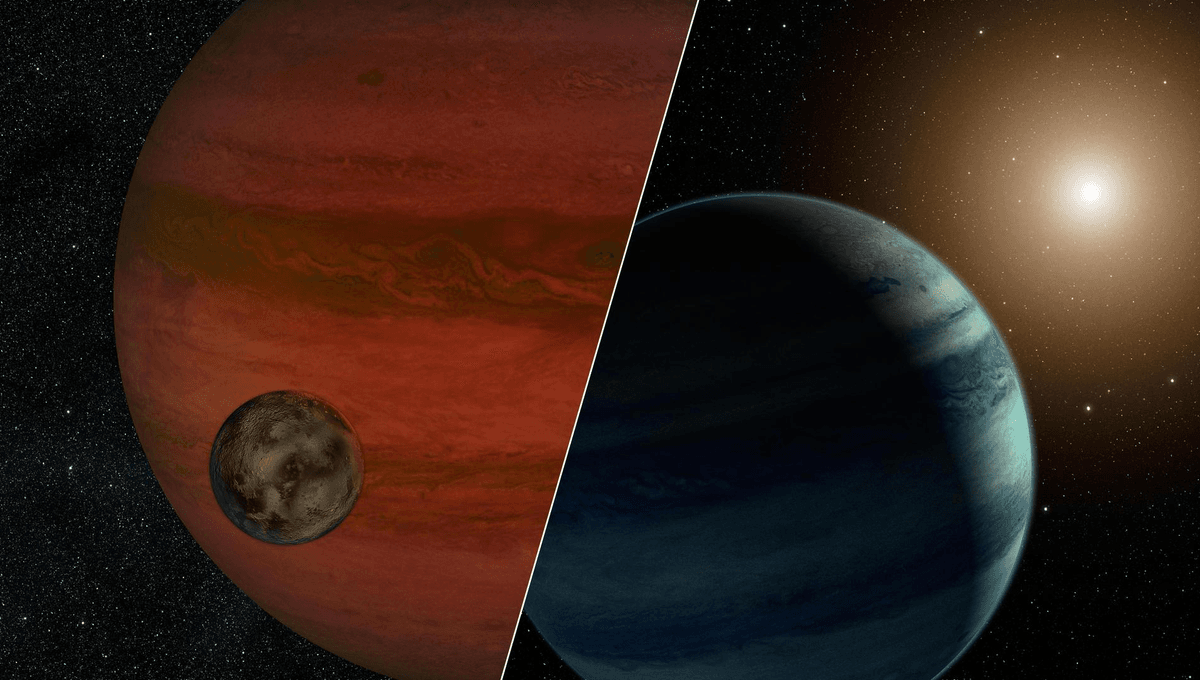
A pattern in the movements of a brown dwarf that orbits a Sun-like star is likely to be caused by a moon. If confirmed, this would be the first exomoon, that is a moon orbiting a planet that in turn orbits a star other than the Sun. However, if the data is to be believed, what we are seeing is on a very different scale to the moons close to home.
The rest of this article is behind a paywall. Please sign in or subscribe to access the full content. Within our Solar System, moons greatly outnumber planets. Even some quite small asteroids have moons, so we expect that most of the more than 6,000 exoplanets (planets orbiting other stars) have moons of their own, called exomoons. However, we are yet to definitely find one; two claims of exomoons remain contested. However, when a large team of astronomers tracked the object HD 206893 B, with the Very Large Telescope’s GRAVITY instrument, they found “residual movement”, that is a wobble they can’t explain with what is known. One highly plausible explanation is that this is caused by the gravity of a smaller object. Besides the obvious objection – that there might be something else behind the residual movement – there’s a question as to whether the cause should count as a moon even if it is real. That’s because HD 206893 B is a brown dwarf, an object massive enough to fuse deuterium but not ordinary hydrogen, rather than a true planet. Brown dwarfs exist in a twilight zone between stars and planets, so something that orbits one deserves a new name. HD 206893 is a much younger than the Sun – born when dinosaurs reigned – but otherwise it’s quite similar, only 30 percent more massive and with a similar concentration of metals. Its planetary system is very different, however. Besides HD 206893 B, which is about 20 times as massive as Jupiter, it contains HD 206893 c, which is around 11 Jupiter masses, and a candidate planet that’s thought to be approximately as massive as our own system’s giant. It also has a debris disk, like a giant version of the asteroid belt, but much further out. In a system so alien, it’s easier to imagine that HD 206893 B could be orbited by an object with a mass easily large enough to make it qualify as a planet. Still, if this companion, which the authors are calling HD 206893 B I, really is the reason for the residual movement, it must be huge. The team estimate its mass would be around 40-50 percent that of Jupiter, or 130-160 times Earth – substantially larger than Saturn. The orbit would take nine months. By comparison, none of the large moons in our Solar System take longer than the Moon’s month-long orbit. Even allowing for HD 206893 B’s great mass, this is a very different ratio to those we see in the Solar System. The Moon’s mass is 1/80 of Earth’s, but that involved a very unusual formation process. The Galilean Moons have less than 1/10,000 the mass of Jupiter. The mass ratio of Neptune to Triton is almost 5,000:1, where this would be around 50:1. Since we’ve never got to see a brown dwarf up close, however, we don’t know what size companions they usually have. Previous claims to have found exomoons relied on looking for accompanying dips before or after stars faded when a planet passed across our line of sight. However, others have argued these were an artifact of the way the data was processed, or caused by activity on the star itself. Those claimed exomoons were at least the size of Neptune – hundreds of times larger than Ganymede, the largest moon in the Solar System. That’s inevitable, however, because currently, we simply lack the capacity to find an exomoon on the scale of our own. The tentative discovery of HD 206893 B I comes out of efforts to test the capacity of the GRAVITY instrument to detect exomoons in places we haven’t looked before. The authors want to measure residual motion around giant planets that are distant enough from their stars, and still hot enough from formation, to be observed directly. Focusing on HD 206893 B helped provide guidance for the prospects for these exoplanets. One advantage of this approach, compared to looking for exomoons during transits, is that it is suited to planets orbiting a long way from their stars, which are thought more likely to have moons than those that orbit close in. The authors report that for five of the targeted exoplanets, “We cannot discard any of them as hosting a massive moon (i.e., a Neptune-mass moon or greater).” If we are to find exomoons this way, we will need longer observations, but we will also need the exomoons to be huge. The study has been accepted for publication in Astronomy and Astrophysics, and the preprint is available on the arXiv. [H/T: Gizmodo]

 English
 French
 Spanish
 Portuguese
 Deutsch
 Turkish
 Dutch
Dutch
 Italiano
 Russian
 Romaian
 Portuguese (Brazil)
 Greek
Greek