


Routine review - the SOMA successor I've always wanted
Routine review - the SOMA successor I've always wanted
Verdict

What Routine lacks in quantity, it makes up for in staggering quality. It’s cassette futurism at its most tactile, with an aesthetic direction that’s only matched by the novelty of its CAT tool. Lunar Software raises the bar in sound design to deliver a singular experience for sci-fi horror fans.
Hype is a curious thing. Each year, videogame after videogame is fed into the machine via a conveyor belt of teasers and trailers. Lunar Software's Routine was one such tender morsel offered up at Gamescom 2012, forgotten by all but the most devoted sci-fi horror fans as it descended into development hell. Its reappearance at Summer Game Fest a decade later left a greater impression, but whatever hype it garnered has died down in the years since. Now, it exists as Schrodinger's cat, gravid with expectation yet weightless in the suspension of all expectations.
After 13 years of development, you might expect a sprawling open-world sandbox or a complex walking simulator whose narrative unspools into multiple endings. Lunar Software delivers neither. What it does deliver is a highly curated, linear horror game that refuses to outstay its welcome. Routine is Kubrickian in a way that many videogames attempt but very few truly capture. Union Plaza, the lunar colony it adopts as its setting, is a collision of multiple decades in the 20th century, fed through the lens of cassette futurism.

It's proof that a strong aesthetic will always beat raw visual fidelity any day of the week. The interplay of light and shadow is delicious: the chalk-white moonlight beaming in from the immense viewing windows; the sickly green glow of fluorescent office lighting; the crushing darkness in the maintenance tunnels. It's also the first time I've ever appreciated a film grain filter - likely because it feels thematically and narratively appropriate, rather than just a shallow attempt to be cinematic for the sake of it. The performance is also butter-smooth, a welcome exception to the woes of Unreal Engine 5.
Routine isn't a 'walking simulator' in the traditional sense of the word; it isn't so preoccupied with movement, but with touch. Lunar Software gives little quarter to the gamification of its environments, and unlike The Chinese Room's Still Wakes the Deep, there is no justification for safety paint on the Moon. The realism is refreshing, but it also demands a deliberate slow pace. You have to factor in time to pore over documents on cluttered desks and scrabble along the floor until you find what you need to progress, without objective markers or highlighted objects to guide the way.

Our protagonist is an empty suit filled by the player, defined only by their occupation: a space engineer, the blue-collar everyman of industrial sci-fi horror. It's an archetype that looms large, cultivated by titans like Isaac Clarke, Ellen Ripley, and her tenacious daughter. By contrast, Routine's space engineer is grounded in reality. They aren't a gun-toting badass dropping iconic one-liners, nor are they divesting alien zombies from their limbs with pinpoint accuracy. Instead, they are fumbling with disc drives in server rooms, juggling power loads on a circuit breaker, and rebooting faulty systems.
Unlike their forebears, the engineer is simultaneously defined and limited by their occupation, not destined to rise above it to meet a supernatural threat. Their Cosmonaut Assistance Tool (or CAT) isn't just a sly reference to Ellen Ripley's loyal cat, Jonesy. It's a shoo-in for the pantheon of iconic sci-fi horror gadgets and gizmos, slotting in neatly between Dead Space's plasma cutter and Alien's motion tracker. Its distinct gun shape invites the player to point and shoot - the principal mode of interaction with an FPS game's world - yet it bears a fitting resemblance to the Hasselblad data camera, developed for NASA's Apollo missions and used to capture the moon landing.

The CAT's tactile collection of buttons and switches is an echo of the basic principles of touch, fed through manipulation of videogame controllers, but also evokes childhood memories of classic Fisher-Price toys. To use it, you must understand how to switch it on, how to load a module, how its wireless function works, and so on. It is perfectly imperfect in a way that all developing technologies are. The viewfinder is flooded with visual noise and prone to distortion, but this screen-within-a-screen holds the means to interact with the world in a meaningful fashion.
Routine's interactive puzzles are the key to progression. They're built on the same theoretical principles as immersive sims, though they're nowhere near as freeform in their execution. Lunar Software provides all the clues that you need to succeed, typically communicated through emails and notes scrawled by the lunar colony's absent populace, with key phrases often highlighted, underlined, or bolded in capital letters. As a result, it's almost impossible to offset the blame for my own lapse in reading comprehension or attention to detail.

There wasn't any puzzle that I couldn't eventually solve on my own, given enough time to mull it over. In fact, when taken at face value, they're remarkably straightforward. The challenge lies in the player's interiority: a tug-of-war between logic and the mental fatigue that builds under sustained tension and anxiety. Union Plaza's threats are ever-present; the pause menu doesn't pause, and the save function is only available via the CAT's personal data assistant, displayed in all its Microsoft 1.0-style glory on an old-school projector screen.
The player is held hostage within the diegetic confines of Routine's world, and every terminal, screen, and monitor on Union Plaza is a clear reminder. SOMA fans will be well-versed in the anxiety this provokes, from the sound of distant movement as you sift through emails, to the frantic attempts to wrangle a tiny cursor and shut an electronic door on a pursuer. Even in its calmest moments, Routine's myriad screens are blood-spattered, flecked with fingerprints or otherwise scratched to hell. At odd angles, the light bounces off them, obscuring the display. This is immersion at its most hostile, and your only escape is to quit the game entirely.

Like all the best horror games, Routine forces you into situations that are profoundly uncomfortable yet necessary to progress, and its horror is built on a cutthroat system of give-and-take. The pitch-dark corners of Union Plaza's arrivals lounge have me desperate for a light source within the first ten minutes of my playthrough. I eventually acquire one courtesy of a CAT module, but whatever relief I feel is undercut by the realization that I can only reap its benefits by squinting through the viewfinder's visual noise or the blurry peripherals beyond the CAT's sightline.
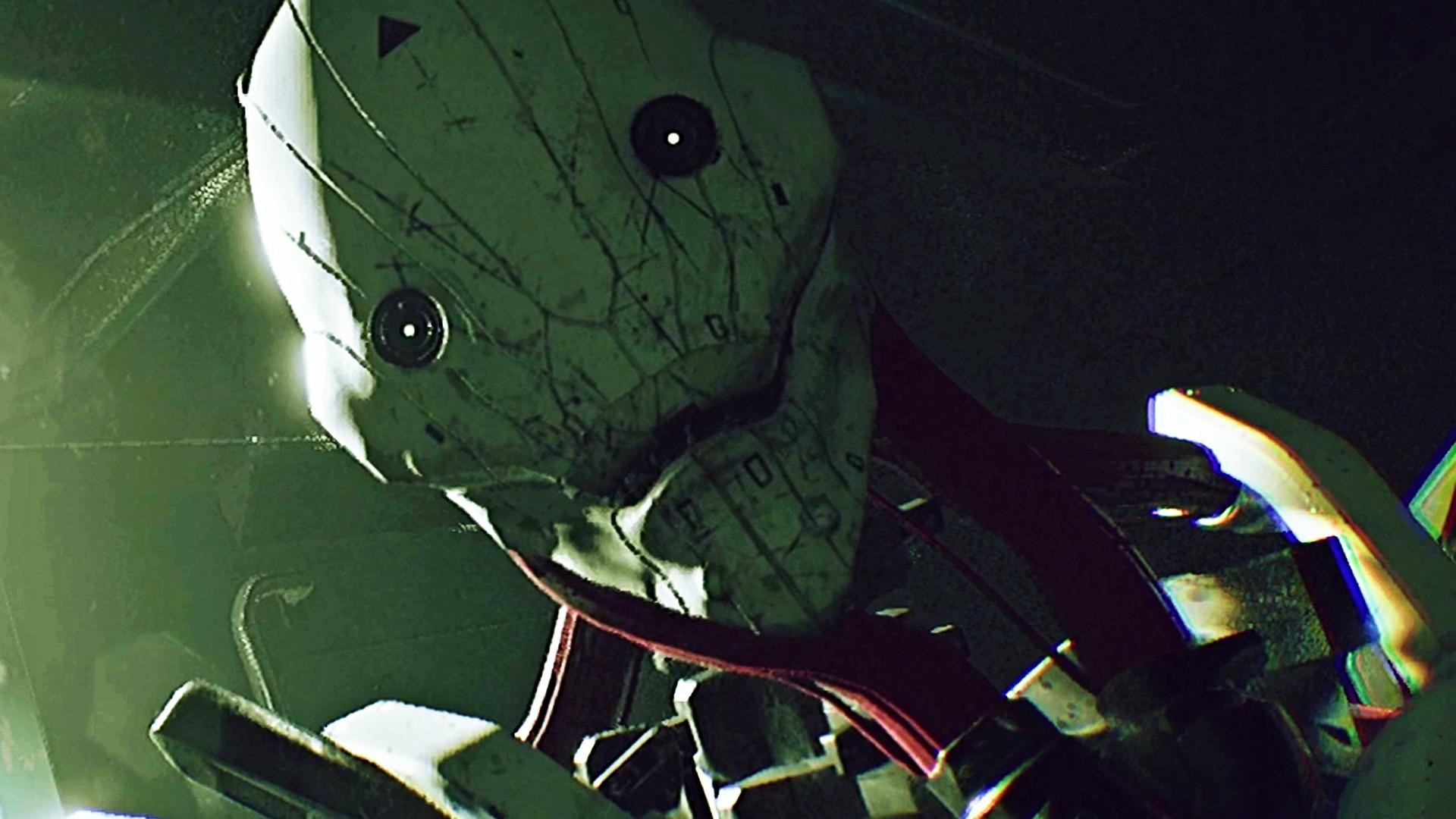
The CAT can be used as a weapon in a pinch, but like Alien Isolation and Amnesia: The Bunker before it, Lunar Software understands that enemy presentation is the key. Where the inability to brandish a weapon in Outlast feels a little silly, Routine gladly hands you one, then invites you to find out just how ineffective it is against the reinforced chassis of a Type-05 security robot, until you come to the correct conclusion that your battery charges would be better spent on other tasks.

I went into my first encounter with the Type-05 (made infamous in that trailer) braced for permadeath. They stand with unnerving stillness in doorways and dark corners, spontaneously jerking to life and giving chase when they have me in their synthetic sights. Death in horror games is a contradiction. It's a player's primal fear, but also the ultimate release valve. The Type-05 doesn't kill me, but the dynamic musical cues as it pursues me around an abandoned shopping mall are more effective than any cut to black. Later, when permadeath does come into play, the death animation is so horrific in its explosive brutality that it makes me flinch away from the screen.
Lunar Software is all too aware of common frustrations plaguing stalker horror - most notably, the waiting game it demands from players. Alien Isolation's xenomorph is a programming marvel, but my lasting memory is of huddling in lockers for minutes at a time, my terror anaesthetized by impatience. By contrast, Routine incorporates an ebb and flow to its encounters that gives you just enough breathing room to progress. In one lengthy puzzle, I'm left to crack a cipher unmolested, only to be dragged into the most sadistic game of hide-and-seek once all the pieces have fallen into place. It's less sophisticated than Creative Assembly's xenomorph, but it's also far less exhausting.
All of this wouldn't be so convincing if Routine's sound design weren't exquisite. The 'schwip' of a module chip sliding into place; the lolloping 'thud thud thud thud' of astronaut boots echoing down titanium corridors; the 'fweeeeschupthunk' of an automated door; even the submarinesque creaks and groans of the lunar structure itself. Union Plaza's soundscape is an analog delight that rivals Still Wakes the Deep's Beira D in its industrial claustrophobia. Its binaural zenith is at the heart of the security network, a symphony of synthetic death so unsettling that it sets my teeth on edge right up until its final gasp.

Still, Lunar Software shows great restraint in how it dispenses its horror, to the extent that it deliberately leaves a few opportunities on the table. By omitting them, it basks in the quiet confidence that Routine's oppressive atmosphere alone is enough to send the imagination into overdrive. The next time I duck into an air vent, will something be in there, waiting for me around the next corner? Will an elevator judder to a halt between floors, lights flickering, as something tries to get in?
Union Plaza is rife with possibilities, of somethings that could leap out at any moment. Still, there are some glaring instances that I wish had made the cut, if only for the sake of realism. I was braced for the hostile powers of Union Plaza to react to the light from my CAT's torch, but it never made a material difference. I would've quite liked to fumble with the CAT's switches, consumed by panic and doubtless making even more mistakes in the attempt to avoid being spotted.

For all that Routine thrives on ratcheting tension, Lunar Software isn't afraid to be funny. The arcade in the Mall comes complete with a fully playable cabinet called Gunshow, in which a masked bodybuilder with a twirly moustache must strike various poses for a high score. "I love helping people who have no clue what they are doing," a service robot cheerily informs me as it trots along on four spindly legs; as someone who has no idea what they're doing, I'm helpless to follow.
These moments of levity are very welcome, but they all feed back into Lunar Software's bid to construct a setting that's lived-in, if caught at cross-purposes for the story's sake. I won't spoil anything, but Routine's plot is quite straightforward once you untangle the mystery at its heart - especially if you're well-versed in its prime inspirations. Carve off a slice of Alien and 2001: A Space Odyssey, add a dollop of fungal horror for flavor, and you're about there. It's nowhere near as impenetrable as the likes of Scorn, and there are enough expositional threads for a player to string together once the credits roll.

Instead, it's the interpretations of those threads that interest me, and elevate Routine above its contemporaries. When the electric spark that passes for consciousness leaps between the Type-05 stock, what reflection can be seen in the player's habitation of an empty spacesuit? After the exhilaration of scientific discovery amid the space race, the tragedy of the Challenger disaster, and the post-millennial rise of space tourism, what is humanity's relationship to the wider universe in the present day? All of these threads can be teased from Routine's story, if you're inclined to tug at them.
Does Routine live up to the hype? Yes, provided you curb your expectations. If Lunar Software had tried to compensate for its lengthy development time with a longer story or a more ambitious scope for its world design, it likely would have compromised the vision it wanted to deliver. Routine is anything but, and it's impossible to feel short-changed by predictable story beats and a sub-ten-hour playtime when the overall experience is so singular.

 English
 Arabic
 French
 Spanish
 Deutsch
 Turkish
 Dutch
Dutch
 Italiano
 Russian
 Romaian
 Portuguese (Brazil)
 Greek
Greek