


Have We Finally "Seen" Dark Matter? Mysterious Ancient Foot May Be From Our True Ancestor, And Much More This Week
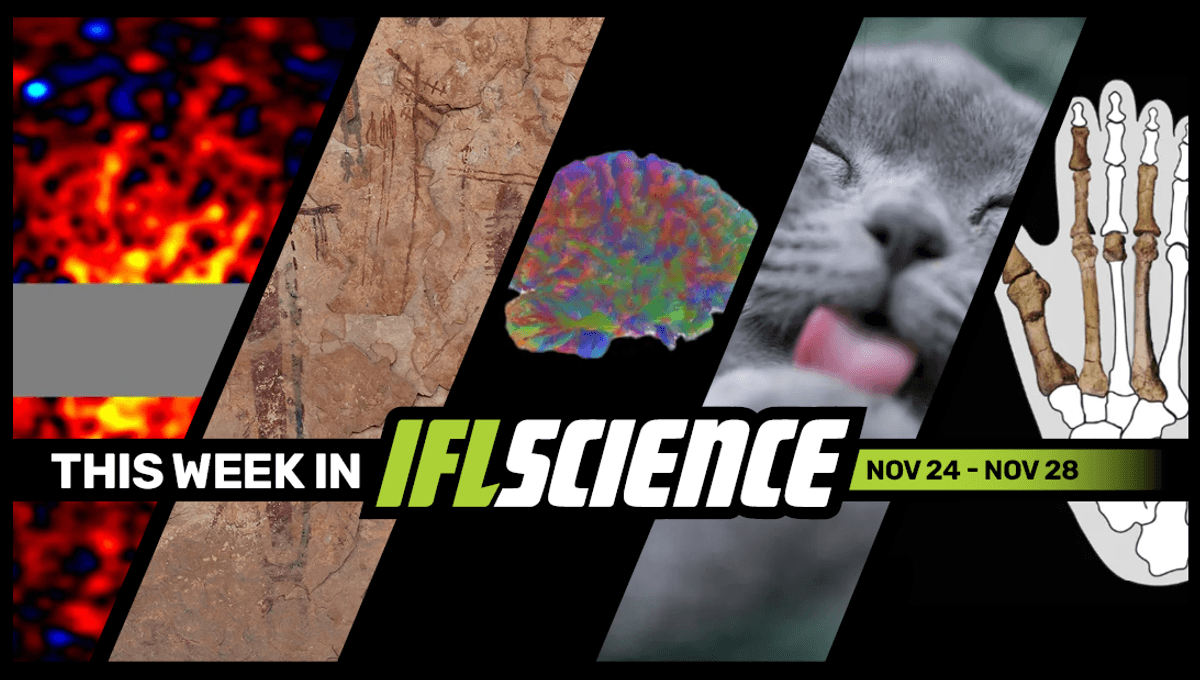
Have We Finally "Seen" Dark Matter? Mysterious Ancient Foot May Be From Our True Ancestor, And Much More This Week
This week, a total of 175 generations of painters created rock art spanning 4,000 years, depicting cyclical time and multiple dimensions. A world-first study has identified five brain “ages”, and we may finally know where pet cats come from – spoiler, it’s not where we thought. Finally, we explore a new vaccine that’s 34.5 percent more effective than standard flu shots, and ask: Is mRNA the future of flu shots?
The rest of this article is behind a paywall. Please sign in or subscribe to access the full content. A halo of gamma-rays detected by the Fermi Space Telescope matches what would be expected if particles with masses around 500 times that of the proton are being annihilated near the Milky Way’s galactic center. A new study argues there is no known source for these gamma-rays, and their distribution is different from what we’d expect if their origins are in galactic light, not dark material. Read the full story here Over the course of four millennia, Native American rock artists in southern Texas followed an unchanged set of conventions to portray a cosmovision that continues to be acknowledged by Indigenous groups across the Americas. Drawing upon an “established iconographic vocabulary”, the ancient artists in the Lower Pecos Canyonlands adhered to a particular set of motifs to create enormous murals depicting metaphysical concepts such as circular time and the separation of the universe into multiple layers. Read the full story here In As You Like It, Shakespeare famously wrote about human life being divided into seven ages, from the “mewling” infant to the “second childishness” of the very elderly (he really did have a way with words, did old Bill). That was less science, more symbolism – but now, neuroscientists have revealed how the human brain really does seem to go through five ages, or epochs, over the course of a lifetime. Read the full story here Domestic cats the world over can trace their ancestry back to North African wildcats that lived around 2,000 years ago. It was from these feral felines that the very first domestic cats were produced, yet their cuteness and companionship were so coveted by humans that within a few decades they had spread to all corners of the Roman Empire. Read the full story here Hominin foot bones found in 3.4-million-year-old sediments in Ethiopia have been assigned to a recently described species. This provides further evidence of different elements of the human family tree living side-by-side in the cradle of humanity and further obscures the question of whether the best-known early human fossil was a direct ancestor of ours. Read the full story here A new mRNA vaccine against the flu has proven itself more effective than existing vaccines in a new clinical trial. The Pfizer-developed vaccine was found to be 34.5 percent more effective than current vaccines at preventing illness caused by influenza A in a trial of over 18,000 people. Though the new vaccine was associated with more side effects, severe adverse events were uncommon regardless of which vaccine people received. Read the full story here Have you seen our e-magazine, CURIOUS? Issue 40, November 2025, is available now. This month, we asked, “How Do We Predict The Weather?” – check it out for exclusive interviews, book excerpts, long reads, and more. PLUS, the We Have Questions podcast – an audio version of our coveted CURIOUS e-magazine column – continues. In episode 15, we ask, “Can Sheep Livers Predict The Future?” The Big Questions podcast concludes season 5 with a special bonus episode: Searching For Nessie: IFLScience Takes On Cryptozoology.Create an IFLScience account to get all the biggest science news delivered straight to your inbox every Wednesday and Saturday.
Have We Finally "Seen" Dark Matter? Galactic Gamma-Ray Halo May Be First Direct Evidence Of Universe’s Invisible "Glue"
Cyclical Time And Multiple Dimensions Seen in Native American Rock Art Spanning 4,000 Years Of History
Scientists Say The Human Brain Has 5 “Ages”. Which One Are You In?
We Finally Know Where Pet Cats Come From – And It’s Not Where We Thought
Fossil Foot Shows Lucy Shared Space With Another Hominin Who Might Be Our True Ancestor
TWIS is published weekly on our Linkedin page, join us there for even more content.
Feature of the week:
Is mRNA The Future Of Flu Shots? New Vaccine 34.5 Percent More Effective Than Standard Shots In Trials
More content:

 English
 Arabic
 Spanish
 Portuguese
 Deutsch
 Turkish
 Dutch
Dutch
 Italiano
 Russian
 Romaian
 Portuguese (Brazil)
 Greek
Greek