


433 Eros: First Near-Earth Asteroid Ever Discovered Will Fly By Earth This Weekend – And You Can Watch It
433 Eros: First Near-Earth Asteroid Ever Discovered Will Fly By Earth This Weekend – And You Can Watch It
It’s time to say hello to an old friend again. The first near-Earth asteroid ever discovered by humans, 433 Eros, will have a close fly-by of Earth this weekend, and it should stay visible for a few weeks for anyone with a half-decent telescope.
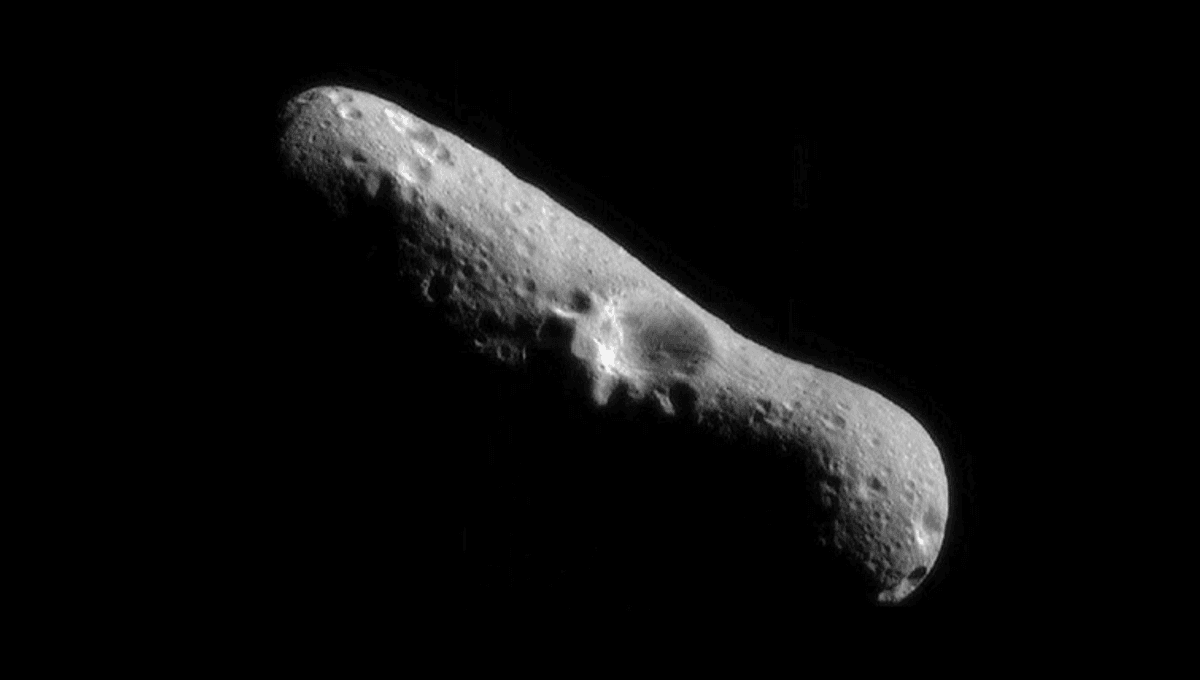
The rest of this article is behind a paywall. Please sign in or subscribe to access the full content. On Sunday, November 30, 2025, Eros will fly about 60 million kilometers (37.2 million miles) from Earth – or about 0.4 astronomical units (the Earth-Sun distance). That’s a totally safe distance, yet close enough to get a good look. The stony asteroid will skim just a couple of degrees from the glowing core of the Andromeda Galaxy, our nearest galactic neighbor. Since this hurtling space rock is relatively large, around 34 × 11 × 11 kilometers (~21 × 6.8 × 6.8 miles), it will shine brightly for several weeks and should be visible with a modest 60 millimeter telescope. If you’re unable to catch it in person, the Virtual Telescope Project and the Asteroid Foundation will livestream the spectacle on November 30, 8pm UTC (3pm EST) at virtualtelescope.eu. Eros was first documented by astronomers as far back as 1898, making it the first near-Earth asteroid to be discovered. The feat is often attributed to German astronomer Gustav Witt and his assistant, Felix Linke, at the Urania Observatory in Berlin, as he was the first to publish the discovery of the new body, although it was also identified independently by Auguste Charlois at the Nice Observatory in France. Since this first encounter, humans have maintained a close relationship with the space rock. In 1998, the NEAR (Near Earth Asteroid Rendezvous) Shoemaker spacecraft was sent to visit Eros at a distance of about 3,800 kilometers (2,400 miles). Using its onboard instruments, it managed to gather all kinds of insights into its size, shape, spin, and other features. On Valentine's Day 2000 – an apt date for an asteroid named after the Greek god of love – Eros became the first asteroid ever studied from its own orbit when its space probe entered its gravitational influence. By 2001, NEAR successfully pulled off the first asteroid surface landing, marking an end to its mission – or so NASA thought. To the surprise of scientists back home, the Shoemaker probe survived the landing and its instruments remained operational. The spacecraft was able to run the first-ever gamma-ray experiment from the surface of a body other than Earth. This was a big deal because it showed that you can place sensitive instruments directly on an asteroid and gather detailed information about what it’s made of. So, if you’re lucky enough to catch a glimpse of 433 Eros over the next few weeks, send our regards and say thanks for all the science.

 English
 Arabic
 French
 Spanish
 Portuguese
 Deutsch
 Turkish
 Dutch
Dutch
 Italiano
 Russian
 Portuguese (Brazil)
 Greek
Greek