


You May Believe This Widely Spread Myth About How Microwave Ovens Work
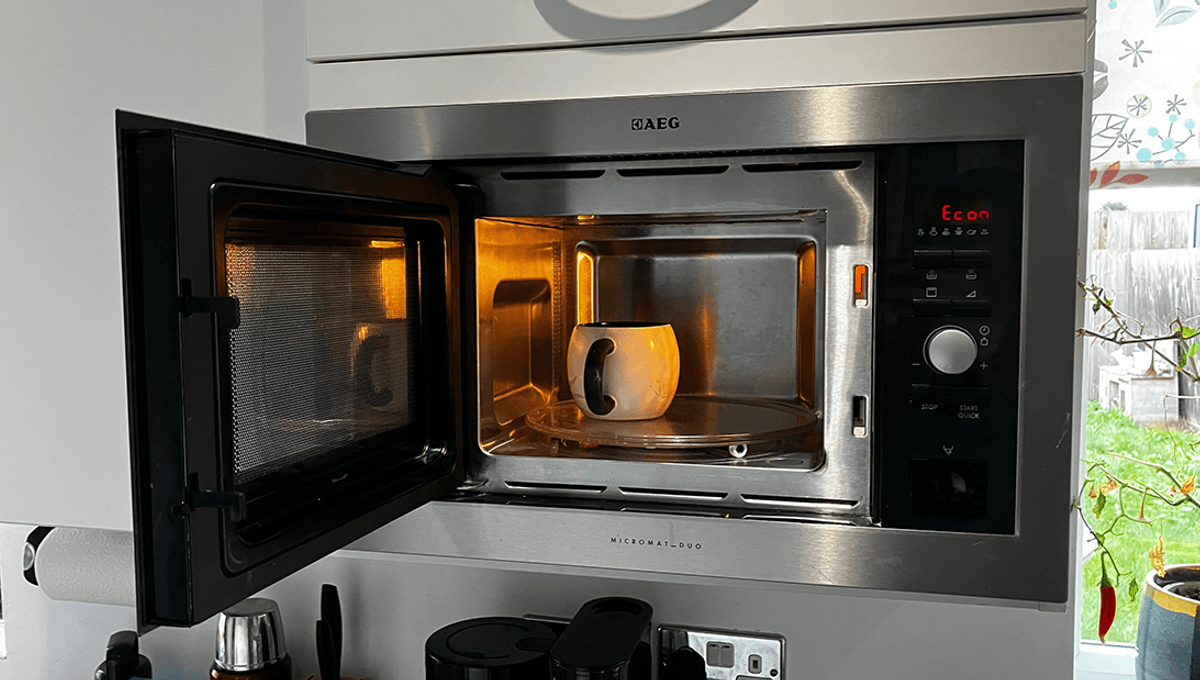
You May Believe This Widely Spread Myth About How Microwave Ovens Work
If you've grown up in the modern era of microwaves, aka the "science oven", you may have stumbled across a fairly common myth that they heat your food using the "resonant frequency" of water.
The rest of this article is behind a paywall. Please sign in or subscribe to access the full content. How prevalent is this myth? Well, it's still going around today, nearly 78 years after the first commercial microwave became available to the public. That's ok. Microwaves are a pretty difficult topic to get your head around, or at least in comparison to traditional "fire hot" methods of cooking we have partaken in since ancient times. Let's start with how microwaves work. First up, they do heat the water within your food. "Microwaves are produced inside the oven by an electron tube called a magnetron. The microwaves are reflected within the metal interior of the oven where they are absorbed by food. Microwaves cause water molecules in food to vibrate, producing heat that cooks the food," the US Food and Drug Administration explains. "That's why foods that are high in water content, like fresh vegetables, can be cooked more quickly than other foods." To be clear, that doesn't mean that microwaves are "tuned" to water, though water is a good absorber of these frequencies. Microwaves are not tuned to the specific resonant frequency of water, but produce several (fairly) broad peaks in the frequency spectrum which can also be affected by factors like the orientation of the food within the microwave. "In reality, this myth is just that, a myth," Ron Schmitt, former Director of Electrical Engineering at Sensor Research and Development Corp, explained in the book Electromagnetics Explained. "[T]here is no resonance of water at this frequency. The first resonant peak occurs above 1 THz, and the highest loss occurs well into the infrared. There is no special significance of 2.45 GHz, except that it is allocated by the FCC as being allowable for microwave oven usage." Solids are pretty good vibrators. The tightly bound atoms allow vibrations to pass through more quickly than in a liquid or gas, which is why sound is quicker passing through, for example, metal, than water or the air around you. "So how do microwaves in an oven heat food if they are not tuned to a specific resonant frequency of water? They heat the food through simple dielectric heating," Dr Christopher S. Baird, Associate Professor of Physics at West Texas A&M University, explained in a university blog post. "In dielectric heating, the electric field in the electromagnetic wave exerts a force on the molecules in the food, causing them to rotate in order to align with the field. Because of this rotating motion, the molecules collide into each other and convert their somewhat ordered rotational motion into disordered motion, which we macroscopically call heat. Many types of molecules in the food absorb energy from the microwaves in this way, and not just water molecules." 2.45 GHz is used because it is good for heating a broad range of consumables, such as water, fats, and proteins, with good penetration depth. Higher frequencies, meanwhile, would mean less penetration depth. But also, the frequency is used because it is easy to produce, and is reflected well off the walls of your science oven. While we're here, we should clear up a few other myths, including that ice is unable to heat up because we are using the wrong frequency. The molecules in ice are able to vibrate just fine, they are much less able to rotate due to hydrogen bonds formed with neighboring water molecules. Fewer collisions and less disordered motion result, and so ice takes longer to melt in the microwave. There is another common myth that the food is cooked from the inside out in a microwave. This also is not correct, with the outside receiving heat from microwaves and the inside being cooked through traditional conduction. Now the basics are out of the way, let's move on to how an early use of microwaves was to attempt to revive dead hamsters.

 English
 Arabic
 French
 Spanish
 Portuguese
 Deutsch
 Turkish
 Dutch
Dutch
 Italiano
 Russian
 Romaian
 Portuguese (Brazil)