


Theia – The Giant Impactor That Formed The Moon – Assembled Closer To The Sun Than Earth Is Now
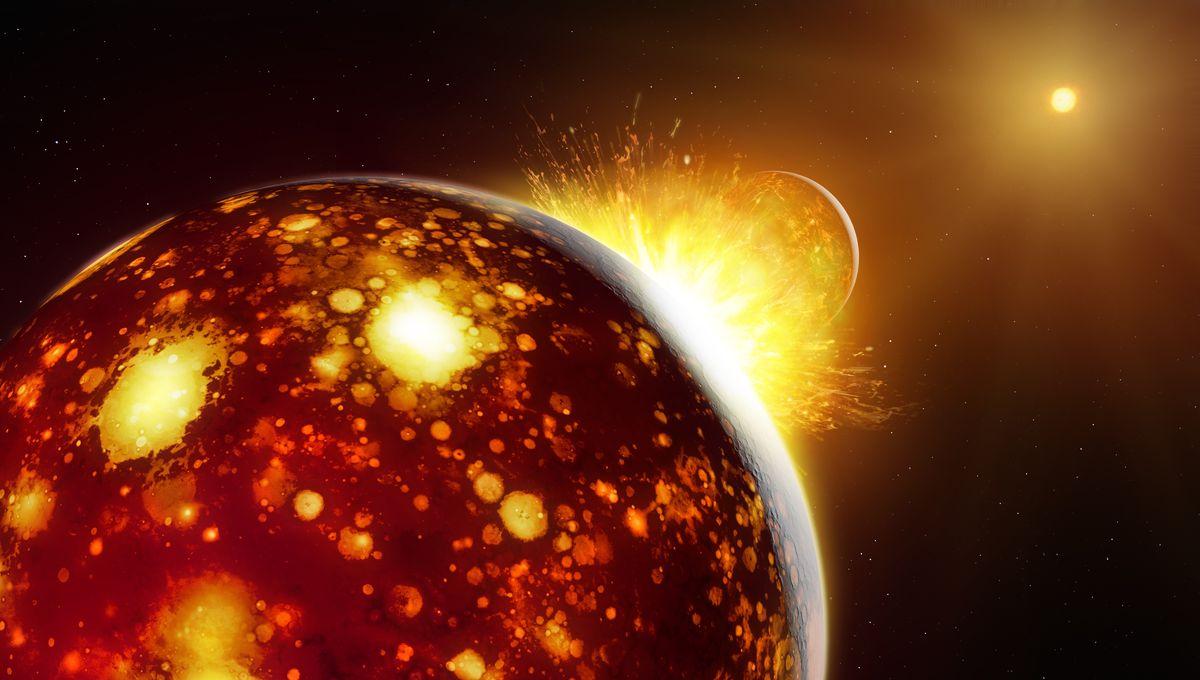
Theia – The Giant Impactor That Formed The Moon – Assembled Closer To The Sun Than Earth Is Now
To our best of our understanding, the Moon formed from Earth following a colossal impact. A Mars-sized world we nicknamed Theia slammed and merged with the primordial Earth, throwing material into space. Some fell back onto the planet, while some spread out and formed the Moon. New analysis is providing novel insights into Theia and where it came from. It was a lot closer than expected.
The rest of this article is behind a paywall. Please sign in or subscribe to access the full content. According to the new work, Theia formed in the inner Solar System closer to the Sun than the Earth is and was. To establish that, the team looked at the isotopic composition of the Earth and the Moon. Isotopes are versions of the same chemical elements but with a different number of neutrons in their nuclei. Some isotopes are stable and others decay, so they can be used both as “fingerprints” and as “timestamps.” The Earth and the Moon have a similar isotopic composition, suggesting that both our planet and our natural satellite were a mixture of the proto-Earth and Theia. But the original composition of Theia and the proto-Earth is a matter of guesswork. To get there, the team analyzed 15 terrestrial samples, six lunar samples from the Apollo missions, and 20 non-carbonaceous meteorites. Both the Earth and the Moon have an isotopic composition consistent with the non-carbonaceous meteorites. The asteroid that those space rocks came from must have been similar to the building blocks that made the Earth. By modeling different scenarios and performing mass balance calculations for Theia, the team concluded that all of Theia and most of Earth originated in the inner Solar System. Without the formation of the Moon we humans might not be here. Dr Timo Hopp That said, the models suggest that Theia had some enrichment compared to the proto-Earth, enrichment that is only possible if it experienced the formation of certain elements (nucleosynthesis) through the slow neutron-capture process (s-process). If this is indeed the case, Theia must have formed a lot closer to the Sun, before some dynamical processes led it to smash into our planet 100 million years after the formation of the Solar System. “The isotopic data itself only confirms that the Moon and today's Earth are isotopically similar. However, when the isotopic compositions of Theia and proto-Earth are back-calculated, an enrichment of s-process nucleosynthesis is required for Theia. Such a composition is expected closer to the Sun,” lead author Dr Timo Hopp, from The University of Chicago/Max Planck Institute for Solar System Research, told IFLScience. There are many unknowns about the formation of the Moon, and this work might have opened a window on a planet that no longer exists. Further isotope investigations, maybe with new rocks collected from the Moon (although we do not know when the next Moon landing is happening), could strengthen this work. Regardless, understanding the formation of the Moon is about more than just the Moon. “The Moon, while small when viewed from our backyard, was and is extremely important for the formation and evolution of the Earth to its version today. Without the formation of the Moon we humans might not be here,” Dr Hopp told IFLScience. The study is published in the journal Science.

 English
 Arabic
 French
 Portuguese
 Deutsch
 Turkish
 Dutch
Dutch
 Italiano
 Russian
 Romaian
 Portuguese (Brazil)
 Greek
Greek