


The Solar System Might Be Moving Faster Than Expected – Or There’s Something Off With The Universe
The Solar System Might Be Moving Faster Than Expected – Or There’s Something Off With The Universe
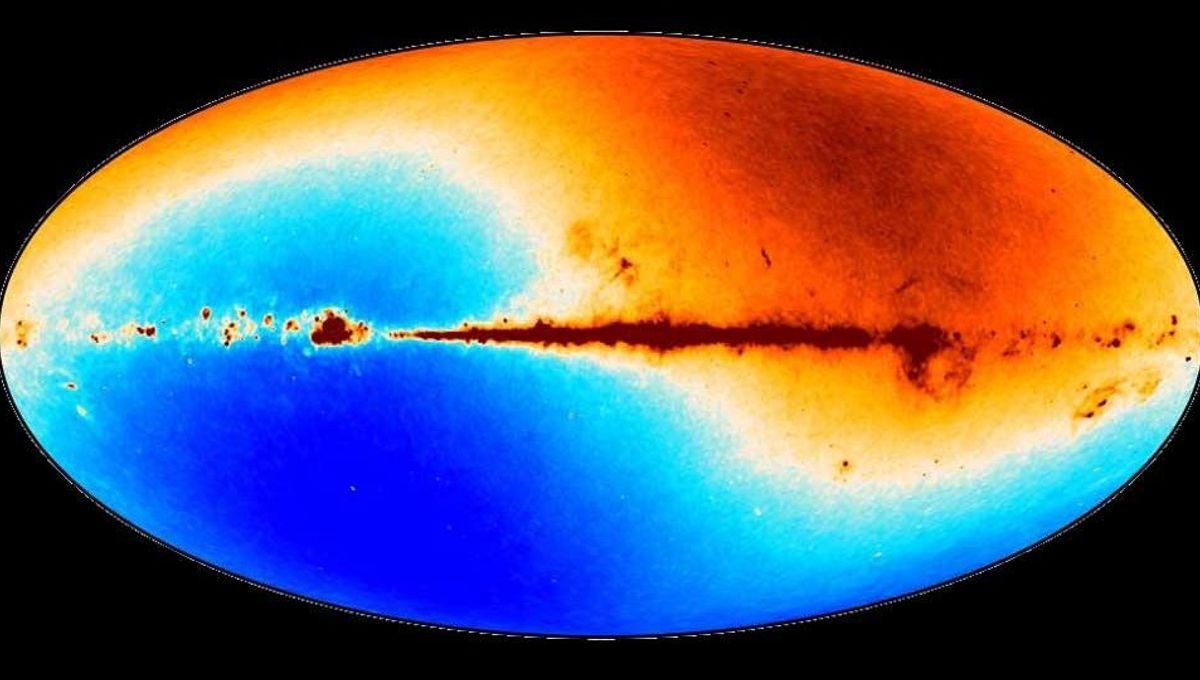
According to the standard model of cosmology, the universe should be the same everywhere and look the same in every direction. A little caveat on this last part is that it’s the same in every direction if the observer is not moving, but the Solar System is. This creates an effect, known as a dipole, with the leading side looking different from the receding side. The problem is that it seems that the Solar System is moving a lot faster than it should.
The rest of this article is behind a paywall. Please sign in or subscribe to access the full content. The most recent estimate, using radio galaxies, suggests that the Solar System is moving 3.67 times faster than expected. Previous work had shown this excess of dipole across different wavelengths, but a new study uses radio galaxies as a way to reduce possible confounding factors. The presence of interstellar material within the Milky Way might affect some observations. Infrared, optical, and microwave light is blocked by gas and dust, as well as releasing light from that very gas and dust. Radio waves can pierce through a lot of that, so that one possible source of error can be avoided. Researchers used the Low Frequency Array (LOFAR), a Europe-wide network of radio telescopes, to observe radio galaxies from very far into the universe. They were able to do a precise count of how many galaxies are in the sky. The cosmic dipole should create a small excess of galaxies in the direction of motion of the Solar System. But this excess is not small in the data. "Our analysis shows that the Solar System is moving more than three times faster than current models predict," lead author Lukas Böhme, from Bielefeld University, said in a statement. "This result clearly contradicts expectations based on standard cosmology and forces us to reconsider our previous assumptions." The team used a new statistical method to make sure they weren’t counting galaxies with multiple radio sources as more than one object. This produced larger uncertainties, but the team believes them to be more realistic uncertainties. When combined with two other radio telescope observations, the statistical significance crossed the five sigma threshold, which is considered the gold standard for evidence in physics. "If our Solar System is indeed moving this fast, we need to question fundamental assumptions about the large-scale structure of the universe," co-author Professor Dominik J. Schwarz, cosmologist at Bielefeld University, added. "Alternatively, the distribution of radio galaxies itself may be less uniform than we have believed. In either case, our current models are being put to the test." This has not been the only recent challenge to the standard model. Findings about standard candles and the so-called Hubble Tension are causing a big headache for our understanding of the universe. New observational methods are revealing just how much there still is to discover and understand about the universe. The new study is published in the journal Physical Review Letters.

 English
 Arabic
 French
 Spanish
 Portuguese
 Deutsch
 Turkish
 Dutch
Dutch
 Italiano
 Russian
 Portuguese (Brazil)
 Greek
Greek