


Kissing Has Survived The Path Of Evolution For 21 Million Years – Apes And Human Ancestors Were All At It
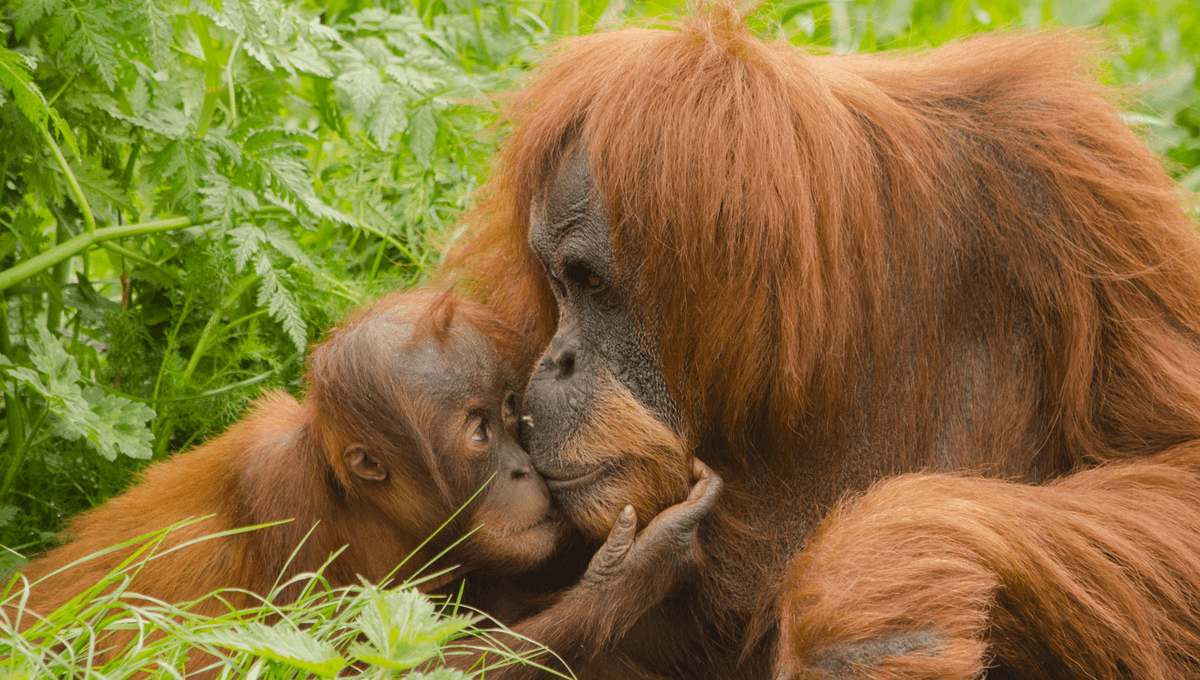
Neanderthals, Ancient Apes, And Human Ancestors Were All Kissing – Just Not Each Other (Mostly)
Evolutionary biologists have been investigating the evolutionarily origins of kissing by taking a broad look at behaviour in Afro-Eurasian primates, a family tree that includes chimps, bonobos, and us, Homo sapiens, and our ancient ancestors. They found that lip-touching displays of affection are found in most of the large apes, suggesting it emerged in an extinct ancestor of this group around 21.5 to 16.9 million years ago. In other words, kissing likely evolved around 21 million years ago in our distant primate family, and everyone has been at it since.
The rest of this article is behind a paywall. Please sign in or subscribe to access the full content. "This is the first time anyone has taken a broad evolutionary lens to examine kissing," Dr Matilda Brindle, lead author and evolutionary biologist at Oxford’s Department of Biology, said in a statement. "Our findings add to a growing body of work highlighting the remarkable diversity of sexual behaviours exhibited by our primate cousins.” The team reached these findings by first establishing what was meant by "kissing" and then searching through scientific literature for data about primates that have been observed partaking in “non-aggressive, mouth-to-mouth contact that did not involve food transfer,” such as chimps, bonobos, and orangutans. They then mapped this "trait" – its presence or absence – across the primate family tree. Using statistical modeling, they simulated numerous possible evolutionary pathways to estimate how likely it was that various ancestral primates also practised kissing. The analysis was repeated 10 million times to ensure strong statistical confidence in their results. They found that kissing is likely an ancient trait that evolved in the ancestors of large apes around 21 million years ago. "By integrating evolutionary biology with behavioural data, we’re able to make informed inferences about traits that don’t fossilise – like kissing. This lets us study social behaviour in both modern and extinct species," explained Professor Stuart West, co-author and Professor of Evolutionary Biology at Oxford. The researchers note that there’s strong evidence that are closer evolutionary ancestors also practised schmooching. Previous research has shown how Homo sapiens and Neanderthals shared oral microbes, which could be evidence of saliva transfer. Plus, it’s evident we share genetic material via interbreeding, so it’s likely that humans and Neanderthals kissed one another, the researchers argue. It’s still not clear why kissing evolved. From a utilitarian viewpoint, it doesn’t provide any immediate reproductive or survival advantage, plus it can carry strong risks, such as disease transmission. Nevertheless, it appears to be a behaviour that has persisted for millions of years, suggesting it has some value. One theory is that it stems from a grooming behavior present among apes. As it requires intimacy and trust, it developed as a way to express affection, whether it's familial, friendly, romantic, or sexual. However, kissing means different things to different primates – and people. In 2015, anthropologists surveyed 168 different cultures from around the world and found that kissing only featured in 46 percent of them. Lip pecking may have deep evolutionary origins, but the behaviour is also shaped by complex social norms and cultural conventions. “While kissing may seem like an ordinary or universal behaviour, it is only documented in 46 percent of human cultures," said Catherine Talbot, co-author and Assistant Professor in the College of Psychology at Florida Institute of Technology. "The social norms and context vary widely across societies, raising the question of whether kissing is an evolved behaviour or cultural invention. This is the first step in addressing that question.” The new study is published in the journal Evolution and Human Behaviour.

 English
 French
 Spanish
 Portuguese
 Deutsch
 Turkish
 Dutch
Dutch
 Italiano
 Russian
 Romaian
 Portuguese (Brazil)
 Greek
Greek