


Earliest Detailed Observations Of A Star Exploding Show True Shape Of A Supernova
Earliest Detailed Observations Of A Star Exploding Show True Shape Of A Supernova
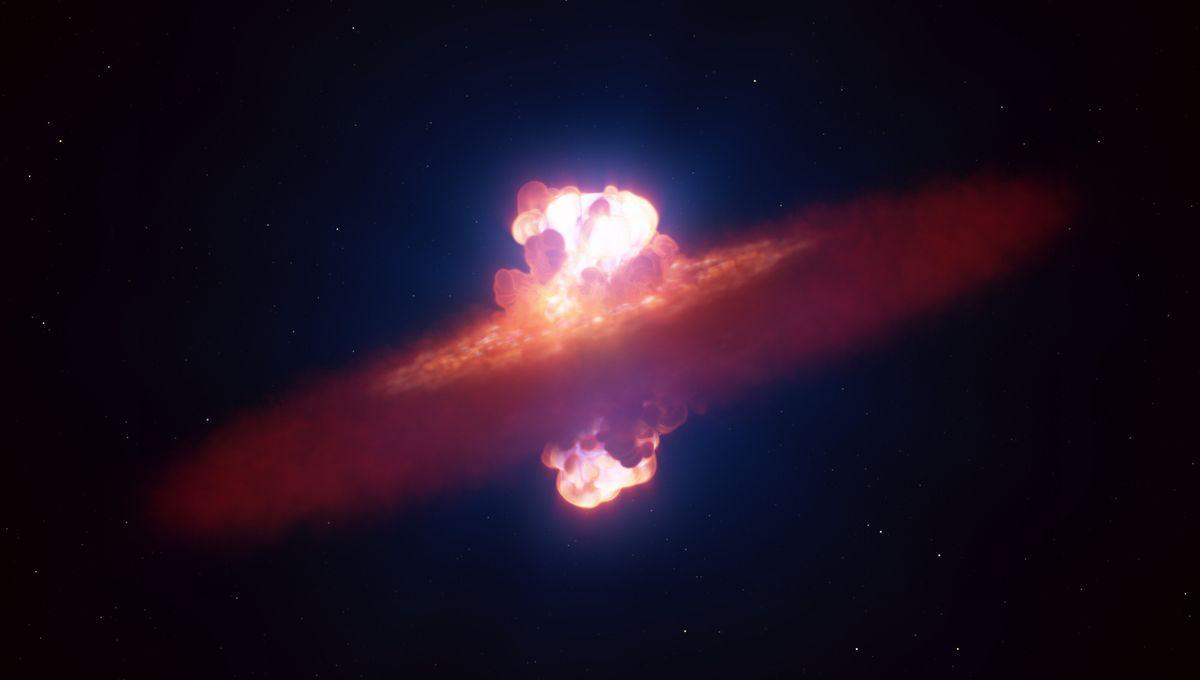
Astronomers have been able to catch the earliest phases of supernova explosions with one of the most powerful observatories on Earth. These incredible observations have provided our first look at what the shape of a supernova is. It turns out, they are not really spherical.
The rest of this article is behind a paywall. Please sign in or subscribe to access the full content. The European Southern Observatory’s Very Large Telescope (ESO’s VLT) looked at Supernova SN 2024ggi just 26 hours after it was discovered on April 10, 2024. Yi Yang, an assistant professor at Tsinghua University in Beijing, had detected it, and he was the one to send a proposal to ESO to immediately point the VLT at this event. The quick turnaround meant that for the first time, we could have a detailed view of the short-lived stage of a supernova. It turns out that as SN 2024ggi began to explode, it was not shaped like a ball but more like an olive. The true shape of a supernova is an ellipsoid. “The first VLT observations captured the phase during which matter accelerated by the explosion near the centre of the star shot through the star’s surface. For a few hours, the geometry of the star and its explosion could be, and were, observed together,” co-author Dietrich Baade, an ESO astronomer in Germany, said in a statement. Stars with a mass over eight times that of our Sun end their lives in a supernova. Eventually, their cores are no longer fusing elements, and without the energy release pushing material out, the star collapses on itself. The collapse releases an enormous amount of energy, which causes the supernova. The exact details are uncertain; this is why the observations of SN 2024ggi are so valuable. “The geometry of a supernova explosion provides fundamental information on stellar evolution and the physical processes leading to these cosmic fireworks,” lead author Yang explained. "These findings suggest a common physical mechanism that drives the explosion of many massive stars, which manifests a well-defined axial symmetry and acts on large scales.” Knowing that the explosion is not spherical has allowed us to rule out some possible models of supernova formation. It is also improving some other possible models. A better understanding of how massive stars end their lives is at hand. "This discovery not only reshapes our understanding of stellar explosions, but also demonstrates what can be achieved when science transcends borders,” says co-author and ESO astronomer Ferdinando Patat. “It’s a powerful reminder that curiosity, collaboration, and swift action can unlock profound insights into the physics shaping our Universe." The study is published in the journal Science Advances.

 English
 Arabic
 Spanish
 Portuguese
 Deutsch
 Turkish
 Dutch
Dutch
 Italiano
 Russian
 Romaian
 Portuguese (Brazil)
 Greek
Greek