


For First Time, Astronomers Record A Coronal Mass Ejection From A Star That's Not Our Sun
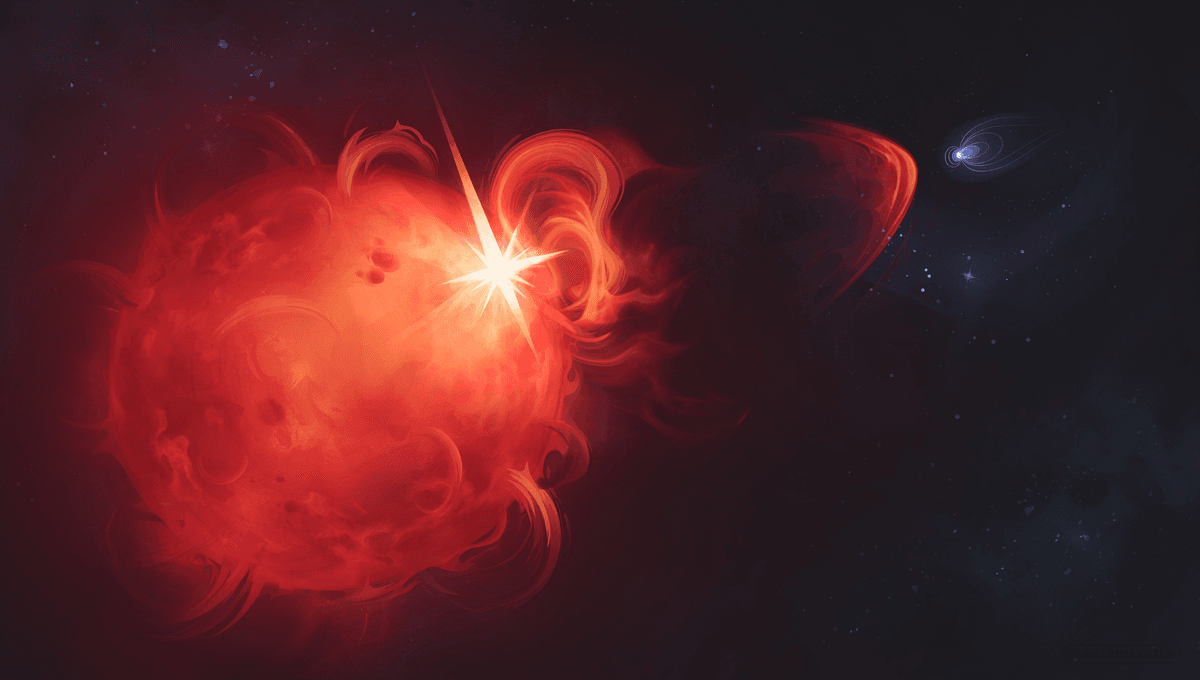
For First Time, Astronomers Record A Coronal Mass Ejection From A Star That's Not Our Sun
Astronomers have detected the radio burst from a massive eruption known as a coronal mass ejection (CME) on an M-type star 133 light-years away. CMEs have been suspected to occur on other stars based on activity that frequently accompanies them on the Sun, but this is the first direct evidence. Unfortunately, the major advance for stellar research makes it unlikely that planets in this star’s habitable zone could have atmospheres, and the same may be true for similar stars.
The rest of this article is behind a paywall. Please sign in or subscribe to access the full content. The skies across North America lit up with auroras last night, and more is to come, thanks to a series of CMEs released by the Sun earlier this week. CMEs are bursts of magnetized plasma ejected from the Sun's heliosphere, which can produce auroras (and radio blackouts, technology interference etc) when they hit Earth and the impact compresses the magnetic field, funneling the particles towards the poles. CMEs are lifted off the surface of the Sun by solar flares, which in turn are the product of twisted magnetic fields within sunspots. Astronomers have long wondered if other stars have them as well. The answer was almost certainly yes. Not only would it be odd for the Sun to be the only star to behave like this, but we have seen starspots and flares on many nearby stars. Indeed, starspots are often so common that they interfere with planet-hunting efforts, and many stars produce flares much larger than anything we have seen from the Sun. However, it is only now that we have confirmed a CME on another star, rather than relying on these indirect indications. “Astronomers have wanted to spot a CME on another star for decades,” said Dr Joe Callingham of the Netherlands Institute for Radio Astronomy (ASTRON) in a statement. “Previous findings have inferred that they exist, or hinted at their presence, but haven’t actually confirmed that material has definitively escaped out into space. We’ve now managed to do this for the first time.” To do this, Callingham and colleagues looked for the burst of radio waves matching those produced by the shockwaves CMEs create as they escape the Sun’s corona. They found just a burst with what they call a “striking similarity” coming from StKM 1-1262. “This kind of radio signal just wouldn’t exist unless material had completely left the star’s bubble of powerful magnetism,” Callingham said. “In other words: it’s caused by a CME.” StKM 1-1262 is a previously undistinguished red dwarf that was one of 5,000 surveyed for the study. Unsurprisingly, the only CME detected in the survey was a big one, moving at 2,400 kilometers per second (5.4 million miles per hour), faster than 99.95 percent of the Sun’s CMEs. And therein lies the problem. The Earth has survived many powerful CMEs largely unscathed in its lifetime, but it has both a powerful magnetic field and sits a comfortable 150 million kilometers (90 million miles) from the Sun, giving us a bit of safety. StKM 1-1262 is so faint, any planet warm enough to have liquid water would need to be about five times closer. Repeated CMEs this size could quickly strip the atmosphere from such a planet, although an even more powerful magnetic field might help a little. StKM 1-1262 is just one star, and it does have the rare feature of rotating 20 times faster than the Sun, so it’s possible its CMEs are also unusually large. However, most red dwarfs release large flares, so powerful CMEs were already expected without this evidence. If space weather like this is the norm for red dwarfs, not the exception, the prospects for life around the galaxy’s most common type of star are slim. Nevertheless, if the LOFAR radio telescope and XMM-Newton space observatory, with which this observation was made, allow us to identify which types of stars have large CMEs and which don’t, it could help us focus on the most promising planets. “This work opens up a new observational frontier for studying and understanding eruptions and space weather around other stars,” added the European Space Agency’s Dr Henrik Eklund. “We’re no longer limited to extrapolating our understanding of the Sun's CMEs to other stars. It seems that intense space weather may be even more extreme around smaller stars. The study is published in Nature.

 English
 Arabic
 French
 Spanish
 Portuguese
 Deutsch
 Dutch
Dutch
 Italiano
 Russian
 Romaian
 Portuguese (Brazil)
 Greek
Greek