


This “Ant-Mimicking” Spider Produces Its Own Kind Of Milk And Nurses Its Babies
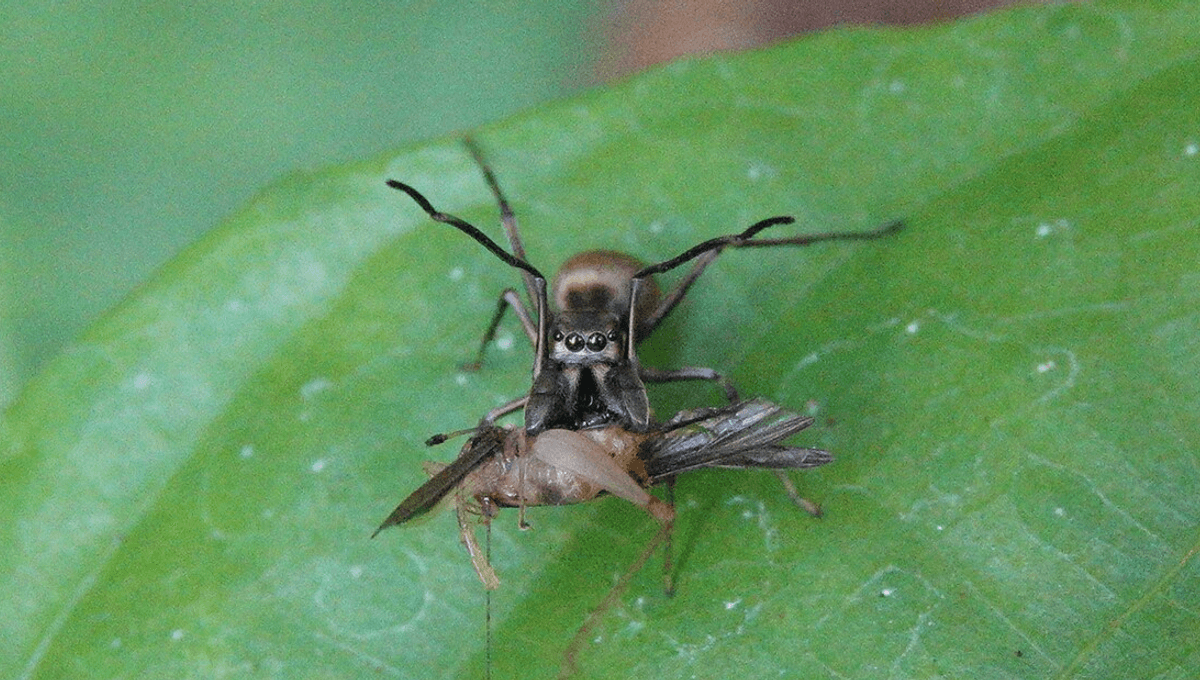
This Momma Spider Produces Milk For Her Babies To Feed On Until They’re Ready To Go Out On Their Own
How do you milk a spider? It’s a question you’ve probably (read: hopefully) never asked yourself, but one that the ant-mimicking spider Toxeus magnus has got us thinking about. You see, when the momma spider’s eggs hatch and she finds herself with a clutch of bouncing baby spiderlings, she does something remarkable: she produces milk.
The rest of this article is behind a paywall. Please sign in or subscribe to access the full content. Her spiderlings are completely reliant on the spider milk in the same way that mammals are reliant on their mother’s milk to keep them fed in their early days. What’s more, she’ll continue feeding them the nutrient-rich excretion until well after they’re big enough to go foraging on their own. Mom of the year, amiright? And as for what a nursing spider looks like? Well, it sounds rather similar to us, really. “The spiderlings ingest nutritious milk droplets secreted from the mother’s epigastric furrow until the subadult stage,” wrote the authors of a 2018 paper describing the behavior. “These findings demonstrate that mammal-like milk provisioning and parental care for sexually mature offspring have also evolved in invertebrates, encouraging a re-evaluation of their occurrence across the animal kingdom, especially in invertebrates.” Known as the ant-mimicking spider, T. magnus is a jumping spider. Scientists had noticed how its breeding nest was quite unusual compared to other, more solitary spiders. It usually consisted of a few adults and several juveniles, not what you’d expect from a species we didn’t think lived in colonies. The scientists took the spiders to the lab to see how the offspring developed under maternal care. They noticed that neither the mother nor any of her spiderlings left the nest until they were around 20 days old. Despite this, their body size grew continuously. When they looked a little closer, the team saw that the mother spider was providing a kind of nutritious fluid that they considered to be a kind of milk. The milk was indispensable for the spiderlings and is deployed functionally and behaviorally in a similar fashion to lactation in mammals. It marks a kind of convergent evolution whereby similar traits emerge in unrelated species. So, what inspires one group of spiders to start producing milk when so many others (so far as we know) don’t? “In nonmammals, we suggest that the most important ecological conditions favoring the evolution of lactation might be predation risk and uncertain food access,” concluded the authors. “As a response, the mother’s physiology, behavior, and cognition might have changed to adapt to providing milk and prolonged maternal care as in mammals.” “Extended parental care could have evolved in invertebrates as a response to complex and harsh living environments that require offspring skills (e.g., hunting, predator defense) to be fully developed before complete independence. Another aspect to investigate is whether lactation and extended parental care are accompanied by a reduction in offspring number because of milk production and parental care costs.” The spider milk was something of a “superfluid”, too, containing nearly four times the protein of cow’s milk (don’t get any ideas, alternative milk brands). And if weird milks are your thing, have you ever wondered if we could make cheese out of whale milk?

 English
 Arabic
 French
 Spanish
 Portuguese
 Deutsch
 Turkish
 Italiano
 Russian
 Romaian
 Portuguese (Brazil)
 Greek
Greek