


 PUBLISHED
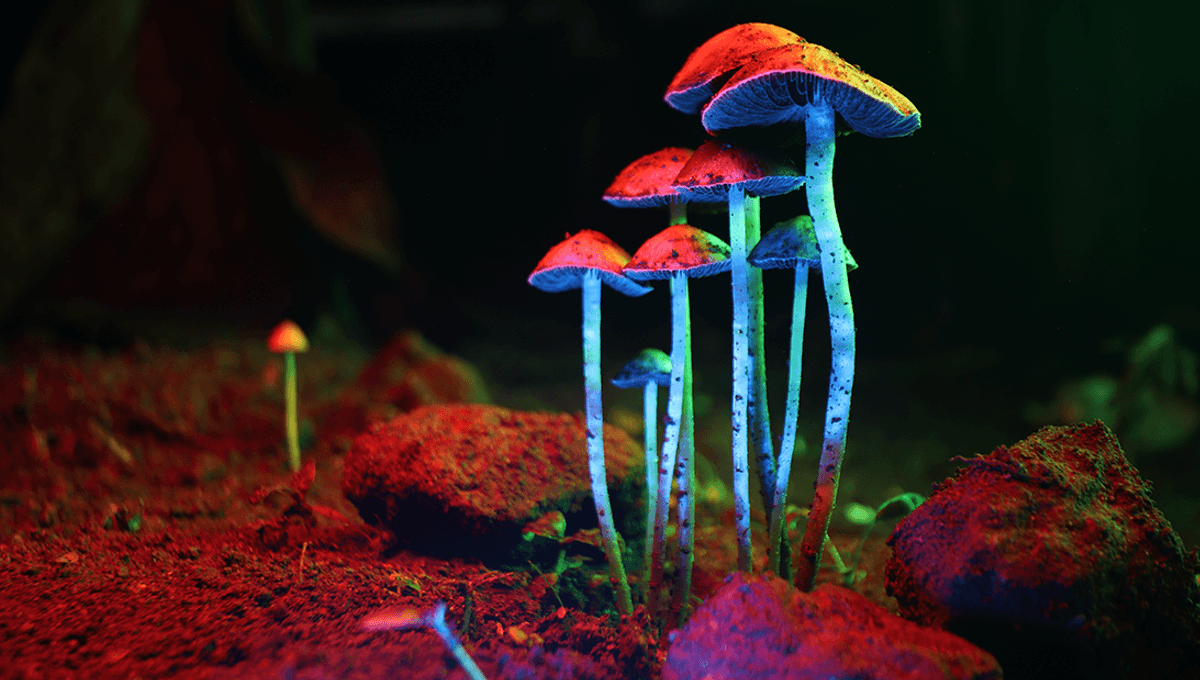
Magic mushrooms, or specifically psilocybin, the active compound contained within these fungi, has gained a lot of attention since the mid-20th Century as a promising treatment for all sorts of conditions, from addiction to depression and anxiety. Hell, it even appears to be useful for providing relief for the existential fear of cancer patients.
The rest of this article is behind a paywall. Please sign in or subscribe to access the full content. Given its versatile ability to help with these problems (research is, of course, ongoing), and the hallucinogenic properties of psilocybin, it's no wonder they've earned the nickname "magic mushrooms". But it may have crossed your mind at some point: what is in it for the mushrooms themselves? In short, why did these mushrooms evolve to be psychedelic? The trait must be useful in some way to the fungi. In fact, it may be so useful that it has evolved this property several times. "Nature has actually invented the same active compound twice,” Tim Schäfer, lead author of a recent genetic study which found this surprising result, said in a statement. “It was like looking at two different workshops, but both ultimately delivering the same product. In the fiber caps, we found a unique set of enzymes that have nothing to do with those found in Psilocybe mushrooms. Nevertheless, they all catalyze the steps necessary to form psilocybin.” Quite why this has happened is still unclear, though there are several hypotheses to explore. “The real answer is: we don’t know,” Prof. Dirk Hoffmeister, head of the research group Pharmaceutical Microbiology at Friedrich Schiller University Jena and the Leibniz Institute for Natural Product Research and Infection Biology (Leibniz-HKI), added. “Nature does nothing without reason. So there must be an advantage to both fiber cap mushrooms in the forest and Psilocybe species on manure or wood mulch producing this molecule – we just don’t know what it is yet.” “One possible reason could be that psilocybin is intended to deter predators. Even the smallest injuries cause Psilocybe mushrooms to turn blue through a chemical chain reaction, revealing the breakdown products of psilocybin. Perhaps the molecule is a type of chemical defense mechanism." The chemical defense mechanism idea suggests that the evolution of psilocybin is about deterring fungivores: insects and slugs, which would otherwise consume the mushroom. "Patterns of gene distribution and transmission suggest that synthesis of psilocybin may have provided a fitness advantage in the dung and late wood-decay fungal niches," one genetic paper on the topic explains, "which may serve as reservoirs of fungal indole-based metabolites that alter behavior of mycophagous and wood-eating invertebrates." While this has the advantage of being neat, and it is the leading hypothesis on the topic, it isn't a perfect shot. Psilocybin-producing mushrooms are pretty rare in nature, and to be a useful deterrent, the fungivores would have to learn what they look like in order to avoid them. Some animals, including humans and certain insect larvae, will also happily ingest the mushroom, so if it is a deterrent, it doesn't work on everything. Another small mystery is why the mushrooms, found on every continent except Antarctica, put so much energy into producing this compound. "Despite environmental limitations, a large portion of nitrogen is allocated to psiloids. For example, psilocybin can make up to 1.6% of a mushroom’s total nitrogen content," another review explains. "The high nitrogen allocation to psilocybin production suggests that its benefits outweigh any cost to nitrogen-limited growth and reproduction processes." Another suggestion is that psilocybin helps to disperse spores around the place by altering the behavior of whatever creature is unfortunate (or fortunate, depending on your perspective) to consume it. This is appealing too, as without animal help, these fungi cannot disperse their spores very far. "While the agaricoid morphology is thought to facilitate wind dispersal, where investigated, only about 2% of wind-dispersed spores travel greater than 5 m, and only about 5% travel more than 1 m," the paper continues. "Animals can facilitate long-distance dispersal by transporting spores on their exteriors (e.g., exoskeletons, scales, feathers, skin, fur, etc.) or by transporting the whole sporebearing basidiocarp. Furthermore, spores are usually viable after passing through animal digestive tracts and even after secondary consumption by a carnivore." In short, in this hypothesis, the creature's behavior is altered and they travel further, taking the spores with them. However, little research has been conducted in this area, and it remains unclear why this would be necessary to disperse spores far and wide. If they survive digestion pretty well, as pointed out by YouTube channel MinuteEarth, why would they need to be anything other than delicious? All in all, we don't really know why magic mushrooms produce this compound, though we know it can produce some benefits to the mushrooms themselves. It could be a combination of these factors, but further study is needed. But given how much psilocybin is produced by the mushrooms, and the fact that it has evolved multiple times, it clearly offers the mushrooms something. “Convergent evolution suggests something confers a particular selective advantage," Jason Slot, a biochemist at Ohio State University, explained to Science. “What the advantage is could be obvious, like eyes that see predators or wings that increase mobility and range—but for chemical features like psilocybin, it is much less obvious.”



 English
 Arabic
 French
 Spanish
 Portuguese
 Deutsch
 Dutch
Dutch
 Italiano
 Russian
 Romaian
 Portuguese (Brazil)
 Greek
Greek