


“We Captured Something No One Had Documented Before”: Wild Worm Towers Seen For The First Time
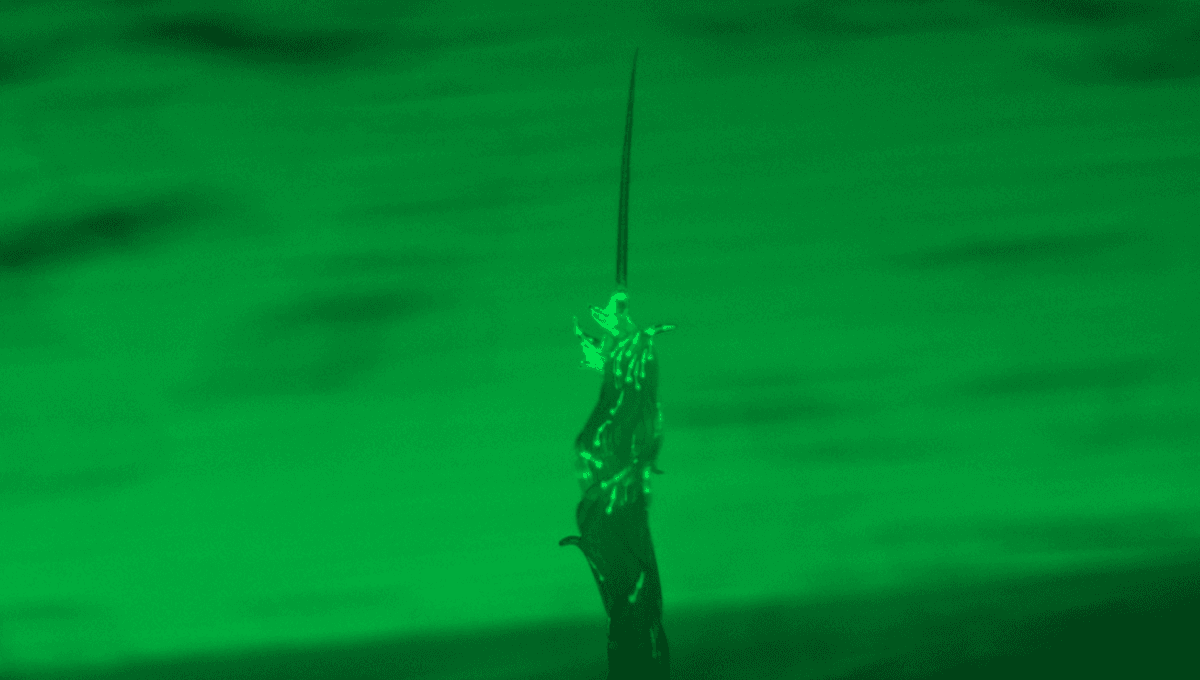
Behold! Worm Towers, A Bizarre Superorganism That’s Hitching A Ride On Anything That Gets Close Enough
Word of a curious worm phenomenon has spread among scientists over the years. Words like, “they’re living in giant towers, Jim.” An understandably perplexing concept, but one that we can now confirm thanks to the first-ever recordings of the nematode worm Caenorhabditis elegans forming towers in nature.
Turns out, there’s a lot more to them than just a big pile of worms. The stacks of worms are actually coordinated and move like a superorganism in motion. Glued together in a great, wiggling plinth, the worms can sense and grow and respond to touch, sticking to anything that gets close enough. Finding these nematode towers involved a lot of diving into rotten fruit out in an orchard. That was the task senior author Dr Serena Ding, group leader at the Max Planck Institute of Animal Behavior (MPI-AB), undertook for months, gathering what she could find and bringing it back to the lab. In the end, it was more than worth it. Our field observations confirmed that towering is a genuine behaviour with ecological relevance, and that was a big moment. Dr Daniela Perez “What was very exciting is that we captured something no one had documented before: nematode towers forming in the wild,” said study author Dr Daniela Perez of the MPI-AB to IFLScience. “While towering had been reported in previous studies, it was always under artificial conditions. Our field observations confirmed that towering is a genuine behaviour with ecological relevance, and that was a big moment.” “Once we had that, the next exciting step was figuring out what the towers actually do. Since we already knew that individual worms stand on their tails (nictate) to disperse, we tested whether towers might be a collective version of that same strategy. We found that they’re incredibly responsive to touch – worms in the tower can attach to passing objects like our glass pick or potential animal vectors. Towers also help worms bridge gaps that no single worm could cross on its own. To me, that’s the coolest part: uncovering how a simple animal solves complex problems together.” A closer look at the wild worm towers revealed some surprising insights. Though there were all kinds of worm species present on the fruits, only one made up the natural towers, and these were all in the dauer larval stage. Clubbed together, they could wave in unison and – as a unit – hitch a ride on anything they could get their mitts on, such as a passing fly. The fact that they form a coherent structure together that behaves like a super organism and does things, just blows my mind. Dr Serena Ding "Worms do things collectively out there in nature," said Ding to IFLScience. "The fact that they form a coherent structure together that behaves like a super organism and does things, just blows my mind." As well as spotting the assemblages in the wild, the team were able to recreate them with worms in the lab. They saw towers emerging within two hours, sticking together for 12, and as a team, they could accomplish all sorts in their time together. Worm towers stuck and detached to things, they built bridges between objects, wiggling their way to feats we never imagined possible. Though the towers gathered from the wild were exclusively dauer, the lab experiments revealed that adult worms could band together, too. As Ding put it to IFLScience, “Now we’ve opened this can of worms (ha ha) there are so many questions to ask!” Their next goal is to focus on the evolution of sociality, looking specifically at: “We're just scratching the surface,” added Perez. “The species we study, C. elegans, is a major model organism in biomedical research with a fully mapped genome and powerful molecular tools. That gives us a big advantage." "We can track individual worms in towers using fluorescent markers, or use sensory mutants to dissect the role of mechanosensation in tower formation. We’re also beginning to ask whether genes known to influence 2D collective behaviours, like aggregation on plates, also play a role in 3D tower formation.” The study is published in the journal Current Biology.

 English
 Arabic
 French
 Spanish
 Deutsch
 Turkish
 Dutch
Dutch
 Italiano
 Russian
 Romaian
 Portuguese (Brazil)
 Greek
Greek