


Gaia18cdj: The Biggest Explosion Event Since The Big Bang Seen By Astronomers
Gaia18cdj: The Biggest Explosion Event Since The Big Bang Seen By Astronomers
Astronomers using data from NASA, the European Space Agency (ESA), and other observatories around the world have discovered the most energetic explosions to occur since the Big Bang 13.8 billion years ago.
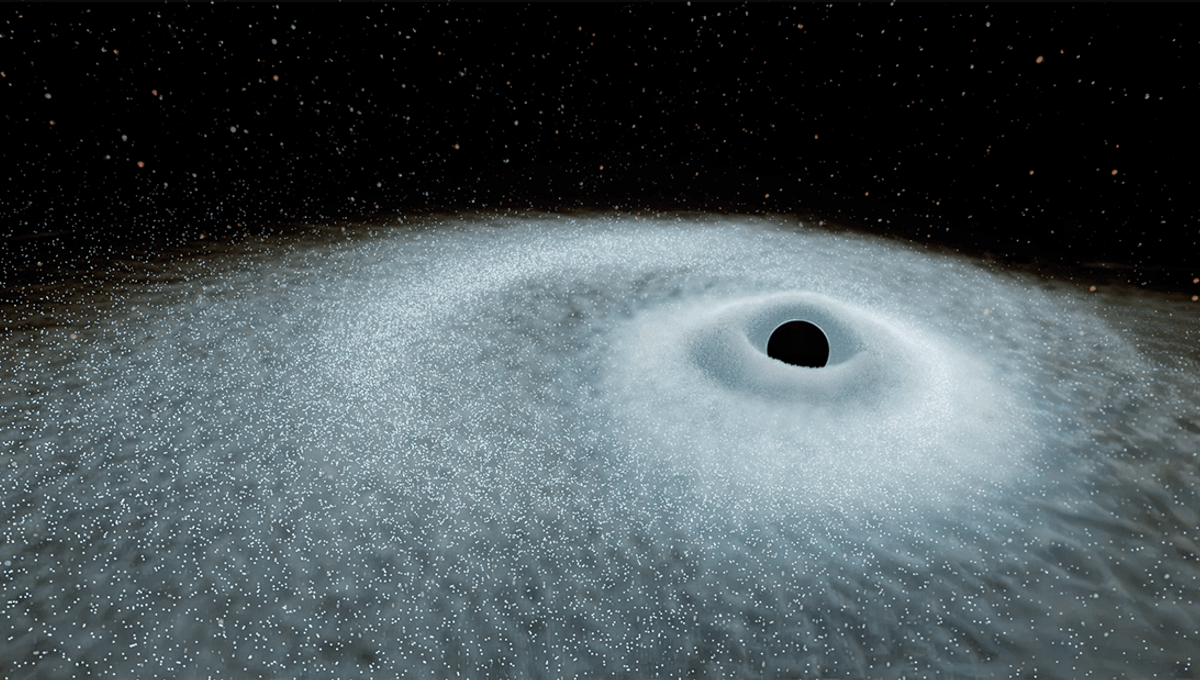
Black holes, being one of the more annoying space objects, cannot be seen by our observations except when something else interacts with them. For years, we have observed them indirectly through tidal disruption events (TDEs), when gravitational forces of the black hole create "tides" that tear apart a star into giant streams of gas that surround the black hole as debris. These events are highly energetic, but in a new study, a team from the University of Hawaiʻi’s Institute for Astronomy (IfA) report a new class of event that makes them look puny in comparison. Searching through ESA's Gaia data, lead author Jason Hinkle found several unusual, long-lived flares that took place in 2016 and 2018. After looking at observations from other ground and space-based telescopes, the team found that they – and a third identified in 2020 – were the highest-energy explosions known to date. The new class of cosmic explosion has been dubbed Extreme Nuclear Transients (ENTs). “We’ve observed stars getting ripped apart as tidal disruption events for over a decade, but these ENTs are different beasts, reaching brightnesses nearly 10 times greater than what we typically see,” Hinkle said in a statement. “Not only are ENTs far brighter than normal tidal disruption events, but they remain luminous for years, far surpassing the energy output of even the brightest known supernova explosions.” According to the team, while supernovae – the explosions at the end of a massive star's life – emit around the same energy that the Sun will over its 10 billion year lifespan, ENTs radiate the energy of 100 Suns. For a time, these events far outshine every star and supernova in the host galaxy. The most powerful of these events detected – Gaia18cdj – emitted 25 times more energy than the most powerful supernova ever observed, making it the most powerful cosmic explosion since the Big Bang banged. These events are far rarer than supernova, but could be useful for studying supermassive black holes (SMBH) at the center of distant galaxies. “These ENTs don’t just mark the dramatic end of a massive star’s life," Hinkle explained. "They illuminate the processes responsible for growing the largest black holes in the universe." “ENTs provide a valuable new tool for studying massive black holes in distant galaxies. Because they’re so bright, we can see them across vast cosmic distances – and in astronomy, looking far away means looking back in time," Benjamin Shappee, Associate Professor at IfA, added in a second statement. "By observing these prolonged flares, we gain insights into black hole growth when the universe was half its current age and galaxies were busy places – forming stars and feeding their supermassive black holes 10 times more vigorously than they do today.” While we need to observe some more of these events to study black holes, the team believes they have a reasonable explanation for what causes them. "The most plausible physical scenario for these ENTs is the tidal disruption of a high-mass star and the subsequent return of material onto the SMBH. The high masses of the SMBHs naturally provide long-duration flares consistent with the ENT timescales, as the flare timescale scales as MBH1/2," the team writes in their paper. "As roughly half of the disrupted stellar mass in a TDE leaves the system, the total radiated energies provide a lower limit on the stellar masses of [over 3 solar masses]. The timescales and luminosities for the disruption of ~3- to 10 [solar mass] stars match the ENT observables well." As well as being useful for studying supermassive black holes, the events need to be understood for their effect on the central regions of their host galaxies. "That has implications for the environments in which these events are occurring,” Hinkle added. “If galaxies have these events, they’re important for the galaxies themselves.” The study is published in Science Advances.

 English
 Arabic
 Spanish
 Portuguese
 Deutsch
 Turkish
 Dutch
Dutch
 Italiano
 Russian
 Romaian
 Portuguese (Brazil)
 Greek
Greek