


The “Sailor’s Eyeball” Blob Is One Of The Largest Single-Celled Organisms Ever Discovered
The “Sailor’s Eyeball” Blob Is One Of The Largest Single-Celled Organisms Ever Discovered
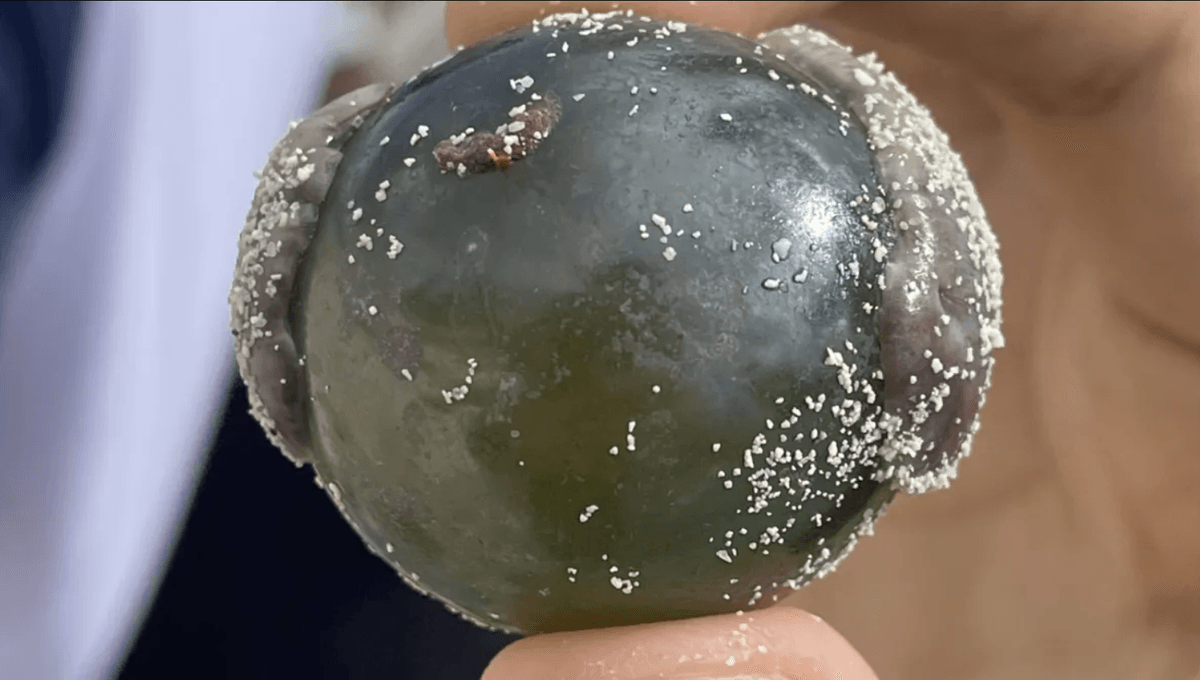
There are sailors’ eyeballs to be found at sea, that is, if you know where to look. Fortunately not the result of any gouging injuries, these curious blobs are a type of algae called Valonia ventricosa, and they’re one of the largest single-celled organisms on Earth.
The rest of this article is behind a paywall. Please sign in or subscribe to access the full content. The size of sailors' eyeballs can vary from a speck the size of a pinhead to, well, an eyeball. Just how big the blob gets all comes down to the contents of its vacuole – the space inside its cell wall. V. ventricosa is unicellular, but it can contain the nuclei of many cells. This is because they’re coenocytic organisms, meaning they’re made up of a mass of cytoplasm containing many cell nuclei that aren’t separated by a cell wall. They're also loaded with chloroplasts, the organelle that conducts photosynthesis, providing the organism with energy from the sun. The unusual arrangement comes with a fun party trick. If you pop a sailor’s eyeball – the algal version– it can actually result in more V. ventricosa springing up as they only need one cell nucleus to grow into new organisms. And hoo boy, are they poppable. The cytoplasm vacuole contains nuclei organized in lobes that radiate from its center, creating an internal anatomy the New Heaven Reef Conservation Program describes as “something like a Tesla plasma ball”. Sailors’ eyeballs are also known as dead man's eyeballs, bubble algae, sea grapes, and sea pearls. They are often spotted by divers drifting through coral reefs in tropical and subtropical regions of the world’s oceans. They can vary in color from bright green to black, and sometimes very silvery because of the unique structure of their cell walls’ cellulose crystals. The shimmering coloration is reminiscent of the NOAA Ocean Exploration’s “golden egg” mystery when they found an alien-like shiny orb on the seabed of Alaska. The shiny blob was spotted at a depth of 3.1 kilometers (2 miles), anchored to a rocky surface. Most curious of all, the mysterious object had a hole in it, inspiring one researcher to say during the live feed, “Something tried to get in… or to get out." Sailors' eyeballs, on the other hand, are just trying to get on with their day, so don't you go popping those weird jelly blobs now, will you? An earlier version of this article was published in December 2023.

 Arabic
 French
 Spanish
 Portuguese
 Deutsch
 Turkish
 Dutch
Dutch
 Italiano
 Russian
 Romaian
 Portuguese (Brazil)
 Greek
Greek