


First-Ever Detection Of Complex Organic Molecules In Ice Outside Of The Milky Way
First-Ever Detection Of Complex Organic Molecules In Ice Outside Of The Milky Way
A fantastic new discovery has given astronomy an unexpected window into the formation of life-precursor molecules in an environment significantly different from our galaxy, the Milky Way. Scientists report the first-ever detection of Complex Organic Molecules (COMs) – potential "building blocks" of life – in ice outside of our galaxy.
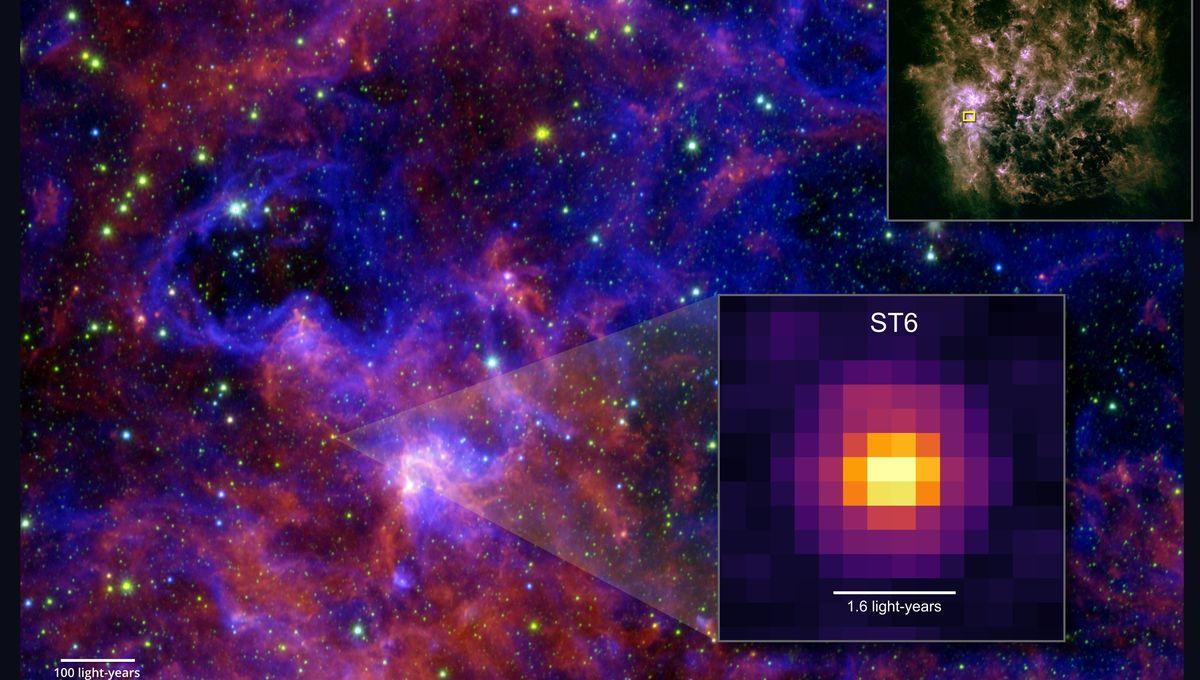
The rest of this article is behind a paywall. Please sign in or subscribe to access the full content. The detection comes from the surroundings of a young star called ST6 located in the Large Magellanic Cloud (LMC), the largest of the satellite galaxies that orbit the Milky Way. It's so large and close that it can be seen with the naked eye from the Southern Hemisphere. This is the first detection of COMs larger than 6 atoms in ices (in ice mantles on dust grains) outside the galaxy. Dr Marta Sewilo University of Maryland and NASA research scientist Dr Marta Sewilo and her team used observations by JWST to study the presence of COMs in the ice around ST6. They detected five: alcohols methanol and ethanol, as well as methyl formate, acetaldehyde, and even acetic acid, the main component of vinegar. This is the first time acetic acid has been conclusively detected in space. “This is the first detection of COMs larger than six atoms in ices (in ice mantles on dust grains) outside the galaxy,” Dr Sewilo told IFLScience. The LMC is very different from our galaxy. Stars and nebulae there have a lower percentage of elements heavier than hydrogen and helium, so fewer building blocks for complex molecules and dust grains. There is also a lot more ultraviolet light. In certain respects, the LMC is similar to a primitive Milky Way, so this provides crucial insight into the formation of COMs in earlier epochs of the universe. COMs are seen as precursors to life molecules. It is not a sign of life, but the molecules that make us and every living creature on this planet had to come from somewhere. Their integral parts likely formed in space and eventually found their way to Earth. In this new work, the team actually found signs of a lot more than those five, but they have not been able to classify all of them. “We have found evidence that several of the unidentified absorption features could be attributed to glycolaldehyde (HOCH2CHO), a precursor of biomolecules; however, the detection remains inconclusive since more laboratory spectra of HOCH2CHO are needed to verify it," Dr Sewilo explained. "HOCH2CHO is a precursor of ribose, which is a major constituent of RNA. HOCH2CHO was the first sugar-related molecule detected in interstellar space in the gas phase." JWST's sensitivity is unprecedented. Its high sensitivity, combined with its high spatial resolution, allowed us to detect faint ice spectral features toward an extragalactic protostar. Dr Marta Sewilo Crucial to this was the Medium Resolution Spectrograph of the Mid-Infrared Instrument (MIRI MRS) on JWST. There have been other telescopes that covered a similar wavelength range, but none had the sensitivity and resolution of JWST. “JWST's MIRI is currently the only instrument capable of detecting icy COMs. The quality of the JWST MIRI MRS spectrum of ST6 is exceptional. JWST's sensitivity is unprecedented. Its high sensitivity, combined with its high spatial resolution, allowed us to detect faint ice spectral features toward an extragalactic protostar. The high spectral resolution is also key to resolving different spectral features from each other,” Dr Sewilo told IFLScience. The findings are important to understand the cosmic emergence of organic molecules, and in at least one case, life. However, it may also have practical applications. “Our results can be briefly unfolded into two directions. First, these findings connect us to our astrochemical origins and offer us solid scientific evidence that building blocks of life are present beyond the Milky Way,” Dr Sewilo told IFLScience. “Second, this clearly shows how it is important to invest in science. Without JWST, the engineers and the scientists doing the data analysis, such a result would never be possible. We are just scratching the surface of how solid-phase chemical reactions occur in such harsh conditions of space. Knowing more about the presence of icy COMs in the LMC also opens doors to understanding how they are chemically formed, and potentially leads to industrial and pharmaceutical applications.” The study is published in The Astrophysical Journal Letters.

 English
 Arabic
 French
 Spanish
 Deutsch
 Turkish
 Dutch
Dutch
 Italiano
 Russian
 Romaian
 Portuguese (Brazil)
 Greek
Greek