


World's First Plasma "Fireballs" Help Explain Supermassive Black Hole Mystery
World's First Plasma "Fireballs" Help Explain Supermassive Black Hole Mystery
Supermassive black holes remain full of mysteries, from their formation to their behaviors. One of them might soon be solved, though this won’t be coming from some new space observations. The insights from a particle accelerator on Earth deliver a solution to a long-standing problem.
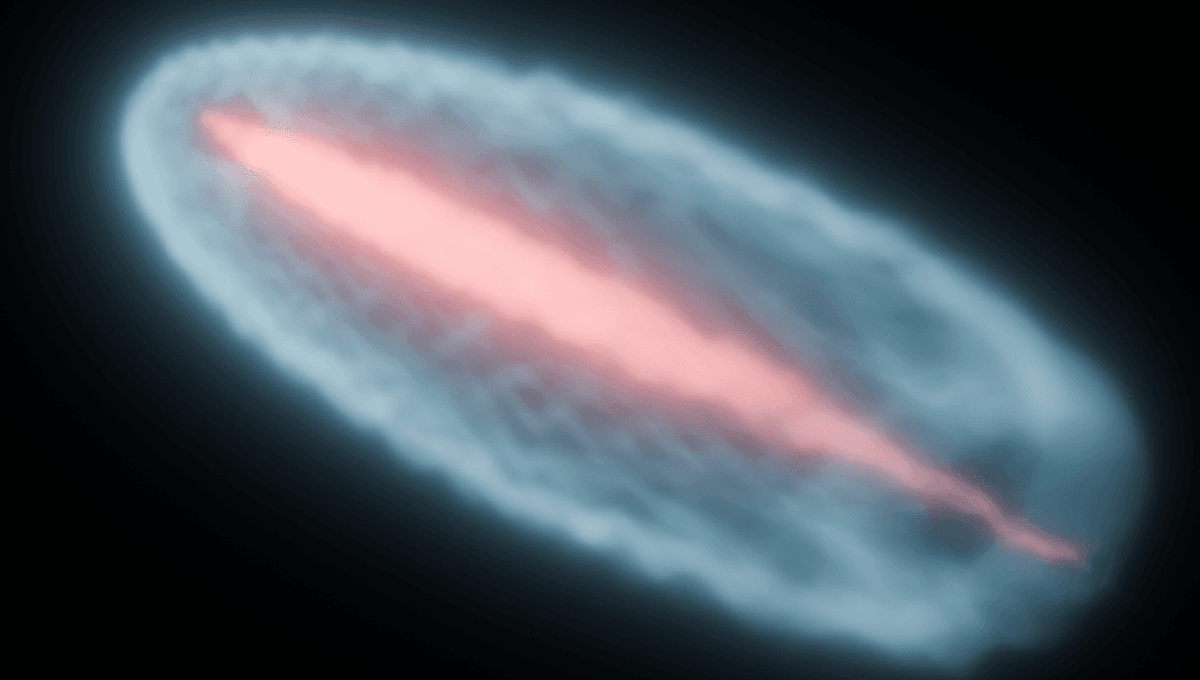
The rest of this article is behind a paywall. Please sign in or subscribe to access the full content. Supermassive black holes that are actively feeding on gas can create a powerful jet of particles. These particles are moving close to the speed of light, and in the case of the Blazars class, these jets are pointed at Earth. From that specific vantage point, we see the emission of gamma-rays at really high energy, and this powerful light interacts with other light particles to produce a cascade of matter-antimatter, in the form of electron-positron pairs. These pairs of particles and antiparticles should interact with the cosmic microwave background, scattering on that light, and creating a different gamma ray emission with one-thousandth of the energy of the original. And yet, that emission has not been seen. Enter the Super Proton Synchrotron accelerator at CERN. The machine was used to create the world's first plasma fireballs to test the main competing hypothesis. One idea suggests that instabilities within the jet disrupt it on an astronomical scale, leading to a loss of energy. Another is that the beam stays stable for thousands of light-years, and it’s a weak intergalactic magnetic field that disrupts the particle cascade, pushing the weak gamma-rays beyond the line of sight. The experiment at CERN produced pairs of electron and positron beams, propagating into an ambient plasma. The international team of researchers found that the beams were narrow and nearly parallel, with minimal disruption. These results suggest that the culprit is the weak intergalactic magnetic field, possibly a relic of the early universe. “Our study demonstrates how laboratory experiments can help bridge the gap between theory and observation, enhancing our understanding of astrophysical objects from satellite and ground-based telescopes,” lead researcher Professor Gianluca Gregori, from the University of Oxford, said in a statement sent to IFLScience. “It also highlights the importance of collaboration between experimental facilities around the world, especially in breaking new ground in accessing increasingly extreme physical regimes.” “It was a lot of fun to be part of an innovative experiment like this that adds a novel dimension to the frontier research being done at CERN – hopefully our striking result will arouse interest in the plasma (astro)physics community to the possibilities for probing fundamental cosmic questions in a terrestrial high energy physics laboratory,” co-investigator Professor Subir Sarkar, also at Oxford, added. The study is published in the Proceedings of the National Academy of Sciences.

 English
 Arabic
 French
 Spanish
 Deutsch
 Turkish
 Dutch
Dutch
 Italiano
 Russian
 Romaian
 Portuguese (Brazil)
 Greek
Greek