


"Dueling Dinosaurs" Fossil Confirms Nanotyrannus As Own Species, Interstellar Comet 3I/ATLAS Is Back From Behind The Sun, And Much More This Week
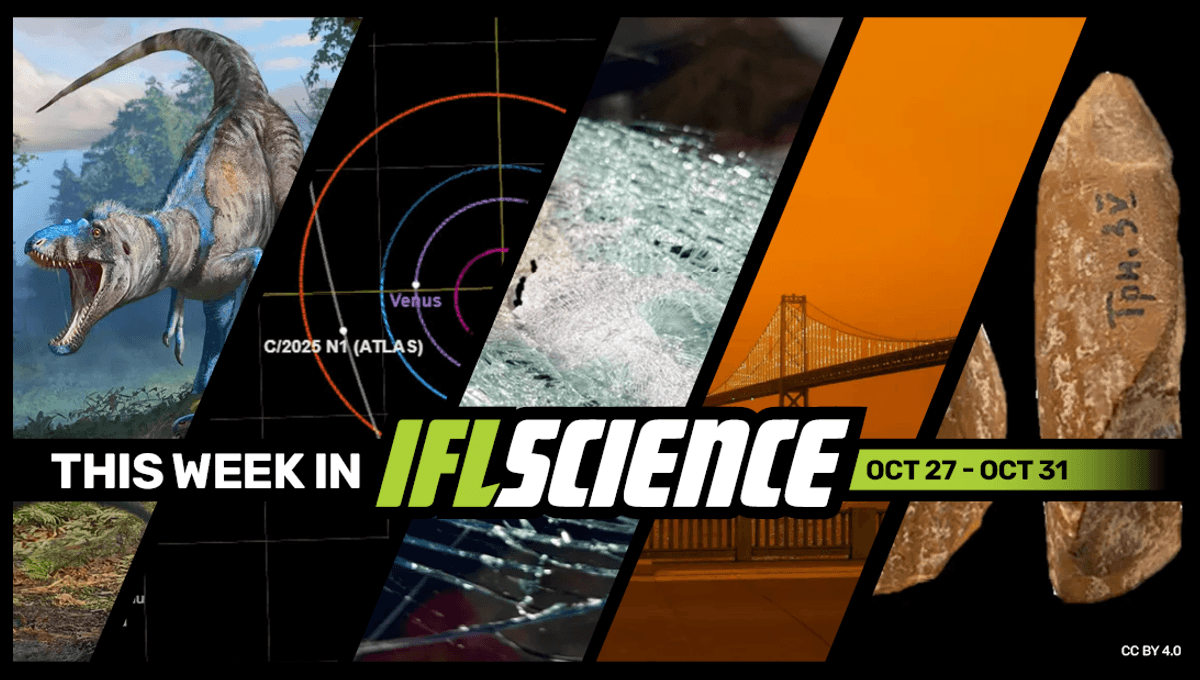
"Dueling Dinosaurs" Fossil Confirms Nanotyrannus As Own Species, Interstellar Comet 3I/ATLAS Is Back From Behind The Sun, And Much More This Week
This week, could the world’s first meteorite collision with a moving vehicle explain this Tesla’s melted windscreen? Of Earth’s 34 vital signs, 22 are now at record levels, and a 42,000-year-old sharp, yellow crayon suggests Neanderthals were creating art. Finally, we take a look at true crime; why it’s so widely enjoyed, and is consuming it ever truly ethical?
The rest of this article is behind a paywall. Please sign in or subscribe to access the full content. Thanks to the iconic "Dueling Dinosaurs" fossils, two paleontologists appear to have finally settled a long-standing debate as to whether remains found from the very end of the Cretaceous represent a distinct species of small tyrannosaur or juvenile T. rex, as many had assumed. Besides adding another dinosaur for enthusiasts to learn – meet Nanotyrannus – the conclusion has implications for an even bigger dinosaur debate, about their evolutionary health before the asteroid/comet wiped them out. Read the full story here Our interstellar visitor is visible again after reaching its closest approach to the Sun this week. The PUNCH mission, a group of small satellites studying the Sun, shared the first image of comet 3I/ATLAS as it came out of the Sun’s glare. The object's perihelion also offered the perfect opportunity to find out if those "alien spacecraft" hypotheses hold water, and guess what? It's a comet! Read the full story here On October 19, South Australian vet Dr Andrew Melville-Smith’s newly collected car was struck by something, leaving damage unlike anything repairers have seen before. The South Australian Museum has requested access to the car to collect samples, and suspects this may be the first recorded case of a meteorite striking a car while it was moving. Read the full story here Of the planet’s 34 vital signs, 22 are now at record levels, with many still skidding and nosediving in the wrong direction. That’s the central message of this year’s State of the Climate 2025 report, an annual assessment of Earth's natural systems by an international team of researchers led by Oregon State University. As you might expect, it’s not optimistic reading — though the authors manage to find a few glimmers of hope amid the alarming trends. Read the full story here The creation of art has historically been thought of as a distinctly Homo sapien behavior, but the recent discovery of a crayon-like piece of ocher that’s at least 42,000 years old adds to a growing body of evidence suggesting that our Neanderthal cousins also dabbled in a bit of symbolism. Read the full story here The surge in true crime’s popularity suggests something slightly uncomfortable about our media habits: many of us – this writer included – now casually unwind to real-life stories of murder, deception, and forensic investigation. But as public appetite grows, so does criticism, and it raises an uneasy question for fans: what exactly are we getting out of it? Read the full story here Have you seen our e-magazine, CURIOUS? Issue 40, November 2025, is available now. This month, we asked, “How Do We Predict The Weather?” – check it out for exclusive interviews, book excerpts, long reads, and more. PLUS, the We Have Questions podcast – an audio version of our coveted CURIOUS e-magazine column – continues. In episode 14, we ask, “Can Burying Scientists Alive In The Snow Help Us Protect Polar Bears?” The Big Questions podcast concludes season 5 with a special bonus episode: Searching For Nessie: IFLScience Takes On CryptozoologyCreate an IFLScience account to get all the biggest science news delivered straight to your inbox every Wednesday and Saturday.
Tiny Triceratops-Tackling Tyrannosaur Was Its Own Species, Not A Baby T. Rex
Interstellar Comet 3I/ATLAS Is Back From Behind The Sun – Still Not An Alien Spacecraft, Though
Something Melted This Tesla’s Windscreen. Could It Have Been A World-First Meteorite Collision?
“Breaking Records By Extraordinary Margins”: 22 Of Earth's 34 Vital Signs At Record Levels
42,000-Year-Old Yellow Crayon Suggests Neanderthals Created Art – And It’s Still Sharp Too
TWIS is published weekly on our Linkedin page, join us there for even more content.
Feature of the week:
Why We Can’t Stop Watching True Crime: The Psychological Pull And The Ethical Push
More content:

 English
 Arabic
 French
 Spanish
 Portuguese
 Deutsch
 Turkish
 Dutch
Dutch
 Italiano
 Russian
 Portuguese (Brazil)
 Greek
Greek