
JWST Reveals Never-Before-Seen Details Of The Red Spider Nebula And It's Spectacular

0
610

JWST Reveals Never-Before-Seen Details Of The Red Spider Nebula And It's Spectacular

clock-iconPUBLISHED7 minutes ago

JWST Reveals Never-Before-Seen Details Of The Red Spider Nebula And It's Spectacular

The death of a star spun this incredible celestial object.

Dr. Alfredo Carpineti headshot

Senior Staff Writer & Space Correspondent

Alfredo has a PhD in Astrophysics and a Master's in Quantum Fields and Fundamental Forces from Imperial College London.View full profile

Alfredo has a PhD in Astrophysics and a Master's in Quantum Fields and Fundamental Forces from Imperial College London.

View full profile

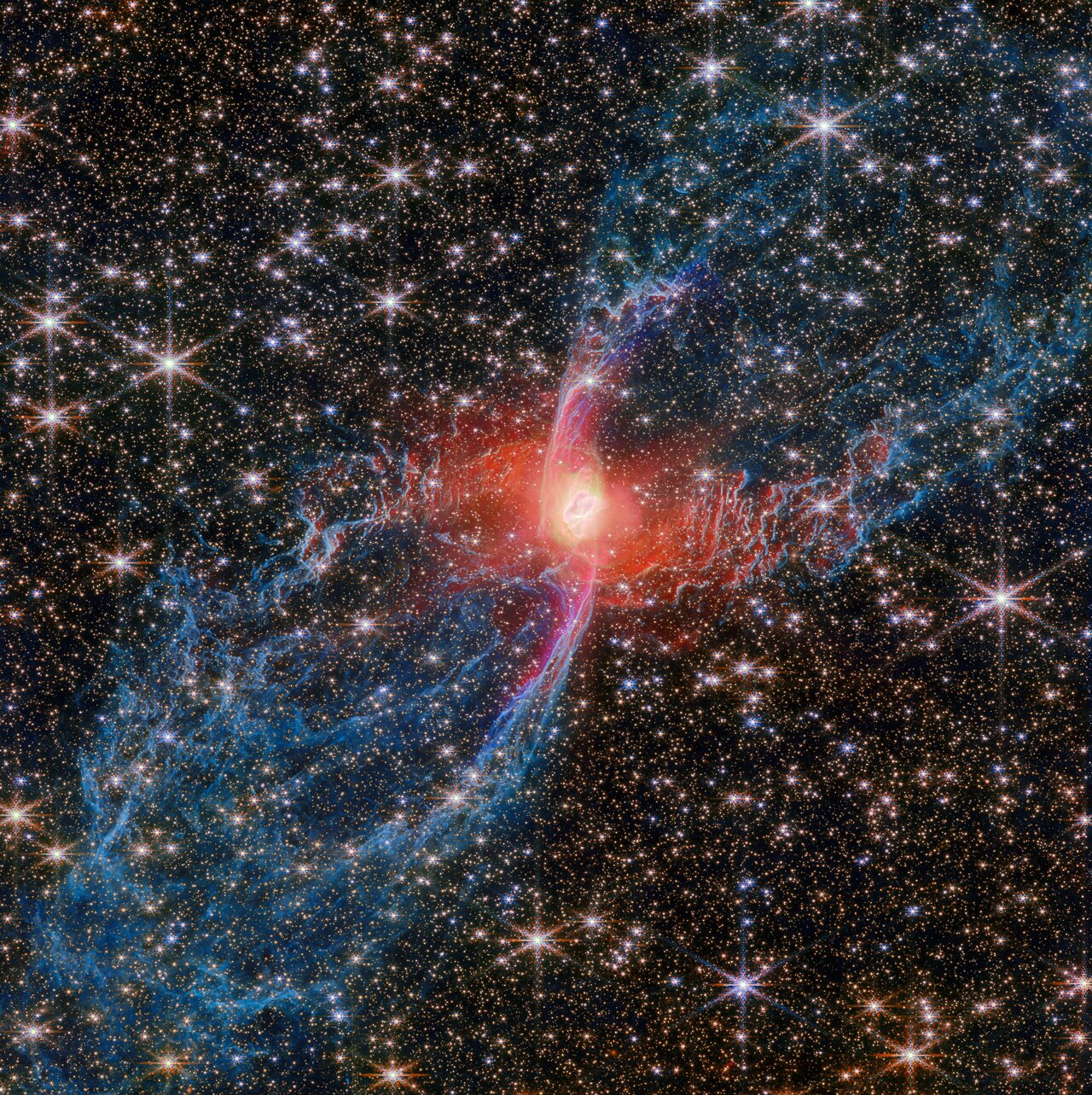
 A large planetary nebula. The nebula’s central star is hidden by a blotchy pinkish cloud of dust. A strong red light radiates from this area, illuminating the nearby dust. Two large loops extend diagonally away from the centre, formed of thin ridges of molecular gas, here coloured blue. They stretch out to the corners of the view. A huge number of bright, whitish stars cover the background, also easily visible through the thin dust layers.

A portion of the Red Spider Nebula taken by JWST. Don't worry, we share the full thing in the article.

Image Credit: ESA/Webb, NASA & CSA, J. H. Kastner (Rochester Institute of Technology)

Google prefered source badge

Stars like our Sun turn into red giants as they run out of hydrogen to fuse at their core. As the star continues to age, it will blow out its outer layers until the only thing that remains is an exposed core, a white dwarf. Before getting to the white dwarf state, Sun-sized stars can form beautiful nebulae, and among the most stunning is the Red Spider nebula.

The rest of this article is behind a paywall. Please sign in or subscribe to access the full content.

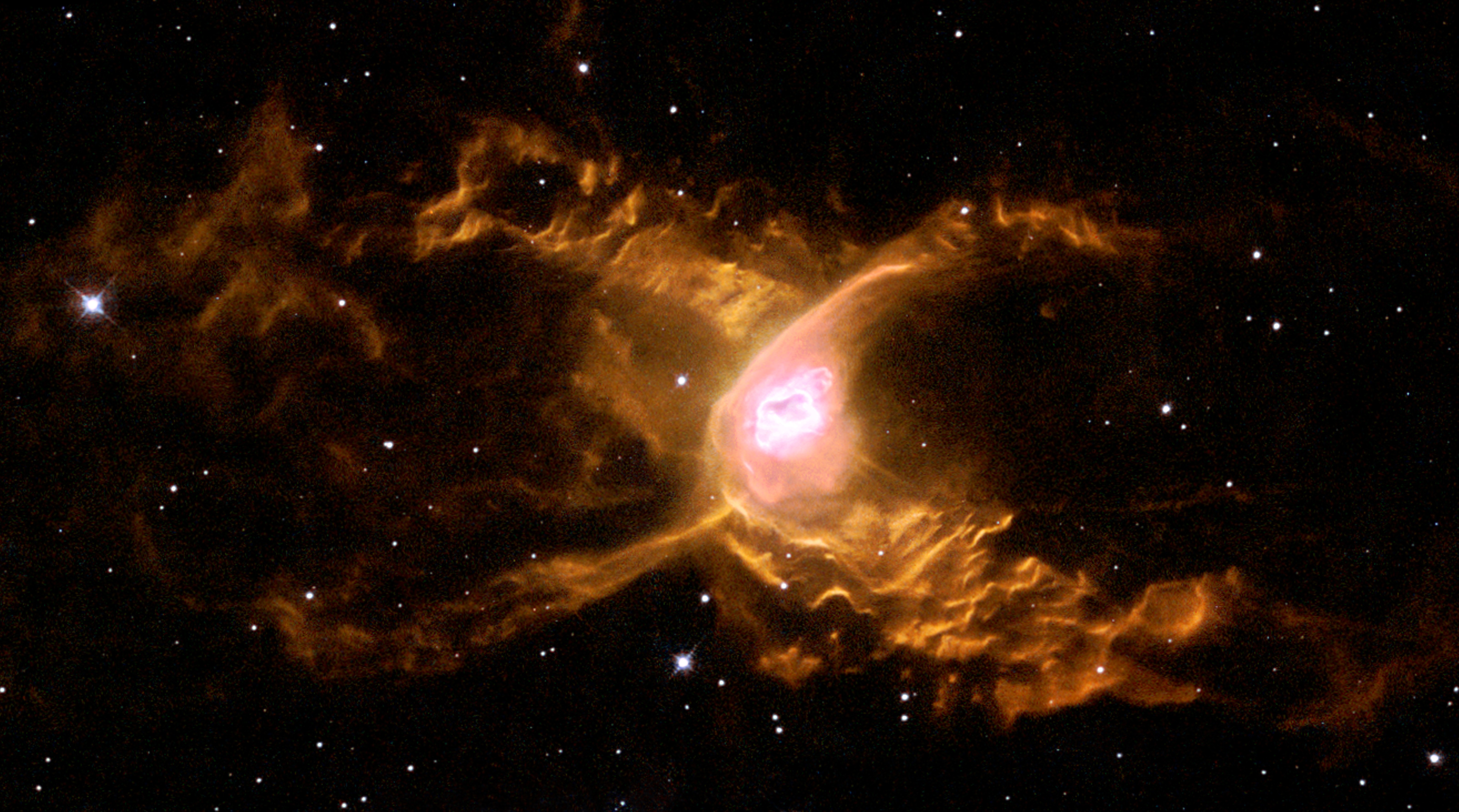
The Red Spider nebula is located about 3,000 light-years away in the constellation of Sagittarius. In optical light, the nebula shines in reddish light as the name suggests, with its central star showing off in blue. In infrared light, the domain of JWST, we see much more of the structure of this object, with the tenuous gas filaments it has released shining in blue and the central region shining in red.

the nebula looks like two interlocking semicircles, the legs of the spider, with a bright messy central region.

The Red Spider Nebula as seen by Hubble in visible light.

Image Credit: ESA & Garrelt Mellema (Leiden University, the Netherlands)

The incredible capabilities of JWST have revealed so much more about the central star that we have been able to decode with Hubble and other telescopes. It has revealed hot dust surrounding the central star, and this hot dust is likely in the shape of a disk. Gas is also jetting out from the center of the nebula, which was a main motivation for this object to be studied by the JWST.

The observations also reveal a peculiar formation, really close to the star, and it might indicate that the star is not alone. Scientists suspect the presence of an invisible companion star – invisible to our current instruments at least. The gravity of this unknown partner might have shaped the whole structure of the nebula.

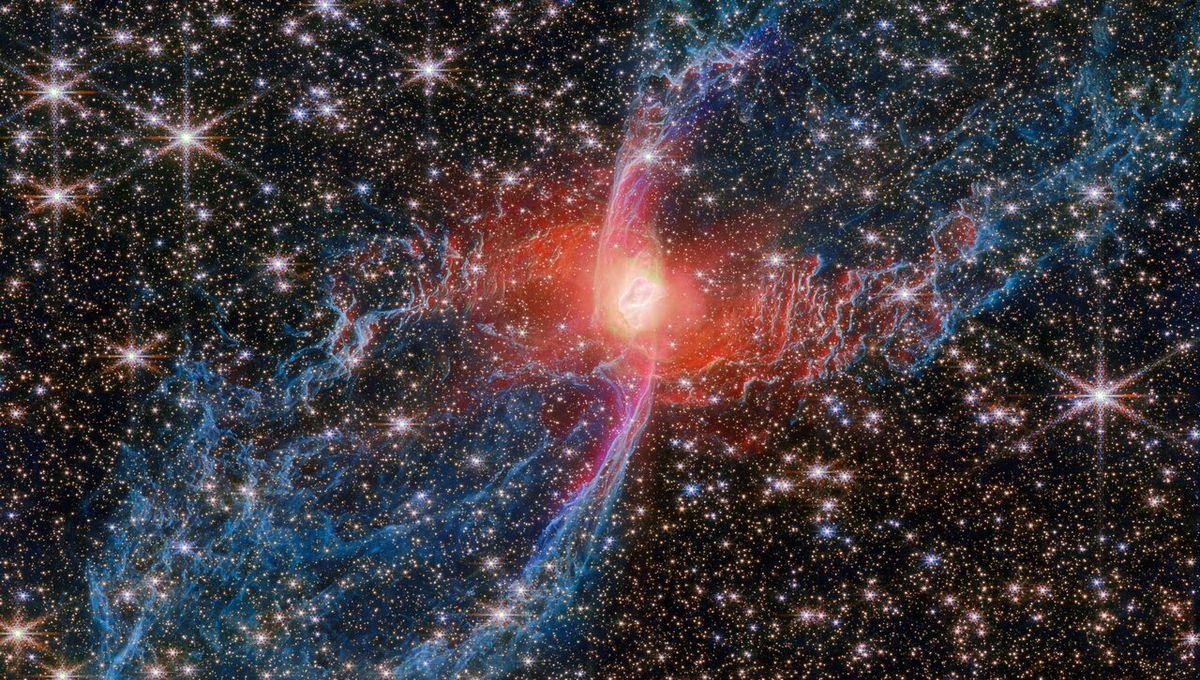
 A large planetary nebula. The nebula’s central star is hidden by a blotchy pinkish cloud of dust. A strong red light radiates from this area, illuminating the nearby dust. Two large loops extend diagonally away from the centre, formed of thin ridges of molecular gas, here coloured blue. They stretch out to the corners of the view. A huge number of bright, whitish stars cover the background, also easily visible through the thin dust layers.

The glorious infrared view of the Red Spider Nebula.

Image Credit: ESA/Webb, NASA & CSA, J. H. Kastner (Rochester Institute of Technology)

This new image from JWST also reveals for the first time the full extent of the nebula's lobes, or the spider's "legs", seen here in blue. These lobes are traced by the light emitted from molecular hydrogen and are bubbles that have been released by the dying star thousands of years ago, each extending around three light-years.

These observations by JWST will be combined with data from the X-ray observatory Chandra to better understand the formation of bipolar planetary nebulae such as this one. 

clock-icon

ORIGINALLY PUBLISHED7 minutes ago

Google prefered source badge


space-icon

More Space and Physics Stories

clock-icon19 hours ago

clock-icon20 hours ago

clock-icon20 hours ago

comments icon2

Buscar
Categorías
Read More
Juegos
Path of Exile 3.26 brings a big endgame upgrade and mercenaries to the free ARPG
Path of Exile 3.26 brings a big endgame upgrade and mercenaries to the free ARPG As an Amazon...
By Test Blogger6 2025-06-05 22:00:07 0 3K
Juegos
EA Sports FC 26 players get a red card for cheating the system with VPNs
EA Sports FC 26 players get a red card for cheating the system with VPNs EA Sports FC 26...
By Test Blogger6 2025-10-12 22:00:14 0 713
Technology
These Bose QuietComfort Ultra headphones 31% off this weekend and selling fast
These Bose QuietComfort Ultra headphones 31% off this weekend and selling fast...
By Test Blogger7 2025-11-15 20:00:21 0 411
Directorio
North America and Europe: The Mature Centers of Bioprocess Innovation and Revenue
Geographically, the Bioprocess Technology Market is characterized by the dominance of established...
By Sophia Sanjay 2025-10-08 09:54:24 0 1K
Technology
Boses new QuietComfort Ultra headphones are available now: Heres what we think of them so far
Bose's new QuietComfort Ultra headphones: First impression review...
By Test Blogger7 2025-10-02 14:00:12 0 1K