


Video Shows Physicists Achieve "Impossible" Feat Of Rolling A Ball Vertically
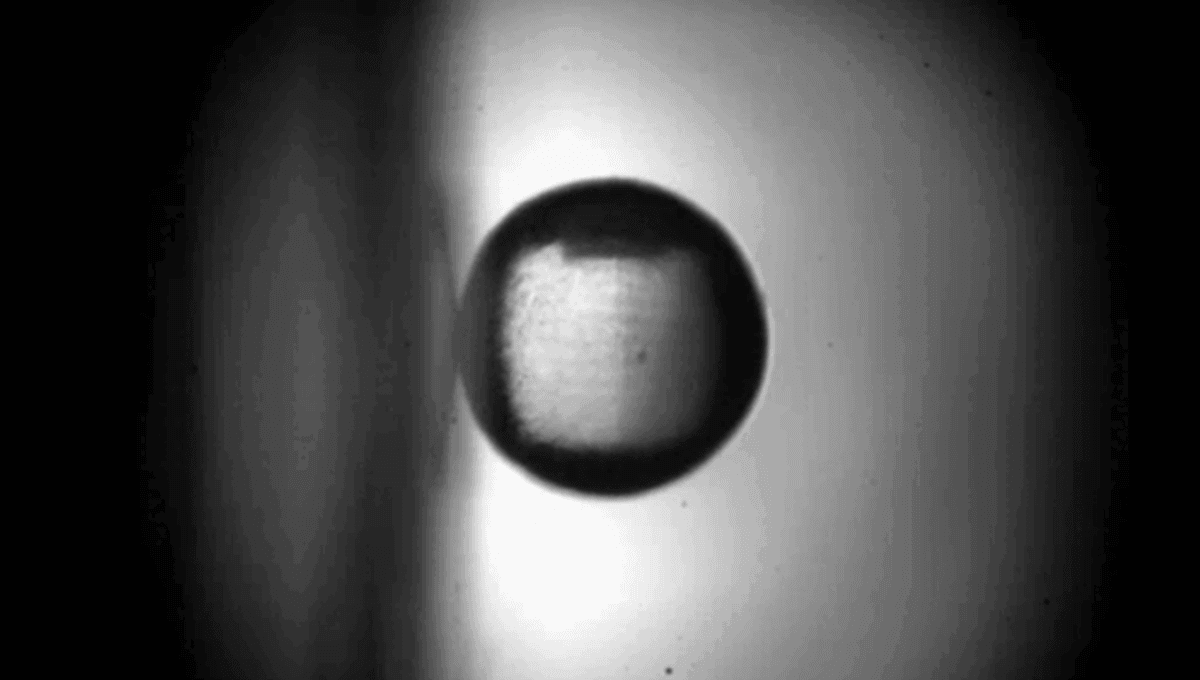
Video Shows Physicists Achieve "Impossible" Feat Of Rolling A Ball Vertically
A team of physicists from the University of Waterloo have succeeded in making a ball roll vertically down a wall without applying any external force, a feat once thought impossible.
"On perfectly vertical surfaces, rolling is conventionally deemed impossible without external torque. While various species like geckos and spiders exhibit vertical locomotion, they cannot achieve rolling; instead, they fall," the team explains in their new paper. "Revisiting introductory physics textbooks: when a rigid glass sphere, for instance, of mass m is gently dispensed on an inclined plane of a similar rigid material, the sphere will roll down freely due to gravity for any inclination angle 0◦ < θS < 90◦. But what happens when θS = 90◦, i.e., a perfectly vertical surface? The intuitive answer is that the sphere will undergo free fall without any contact with the surface unless it has an initial roll. This is because, on a perfectly smooth vertical surface, the normal force at the contact interface (or point), i.e., mg cos 90◦ is zero, resulting in no static friction force to generate the torque needed for rolling." On a slope less than 90 degrees, the surface provides friction, which can set the ball rolling, with the helpful assistance of gravity. But on a smooth vertical surface, the normal force at the contact point between the ball and that surface – or the force pushing against the ball – is zero, and so there is no friction to cause rolling. For rigid surfaces and spheres, no rolling should occur, while adhesive (or sticky) spheres and surfaces result in the ball sticking to the surface, or sliding rather than rolling. But after months of theoretical calculations and a little trial and error, the team was able to achieve this "impossible" feat, finding the perfect balance between elasticity and softness of the sphere and surface. There was something strange about the way it rolled. Much more vertical than usual. Image credit: University of Waterloo “When we first saw it happening, we were frankly in disbelief,” Dr Sushanta Mitra, professor of mechanical and mechatronics engineering and executive director of the Waterloo Institute for Nanotechnology, said in a statement. “We double-checked everything because it seemed to defy common sense. There was excitement in the lab when we confirmed it wasn’t a fluke and that this was real vertical rolling.” As expected, when the ball was too rigid, it would simply fall down, and if it was too adhesive, it would stick. But when the sphere was roughly as elastic as a gummy bear, and the surface was about as spongy as a mousepad, the pea-sized ball rolled down the vertical surface at a rate of around 1 millimeter every two seconds. “The key is that as it rolls, the sphere slightly changes shape at the contact point,” Mitra added. “The front edge acts as a closing zipper, while the back edge acts like opening it. This asymmetry creates just enough torque, or grip, to maintain rolling without either sticking or completely falling off.” A ball rolling vertically; a feat once thought "impossible". Image credit: University of Waterloo According to the team, the findings of the study "challenge the traditional understanding of vertical surface interactions and open new avenues for exploring soft-on-soft contact systems," as well as being cool to see. While there are no areas where this could be immediately applied – don't expect to go bowling down skyscrapers any time soon – the research could be used to develop soft matter robots that could, for example, slide down pipes or explore cave systems, or be used in missions to Mars. “This opens up a whole new way of thinking about movement on vertical surfaces,” Mitra added. “Currently, robots and vehicles are limited to horizontal or slightly inclined surfaces. This discovery could change that.” The study is published in Soft Matter.


 English
 Arabic
 French
 Spanish
 Deutsch
 Turkish
 Dutch
Dutch
 Italiano
 Russian
 Romaian
 Portuguese (Brazil)
 Greek
Greek