


Comet 3I/ATLAS Losing At Least Two Kangaroos' Worth Of Dust Every Second
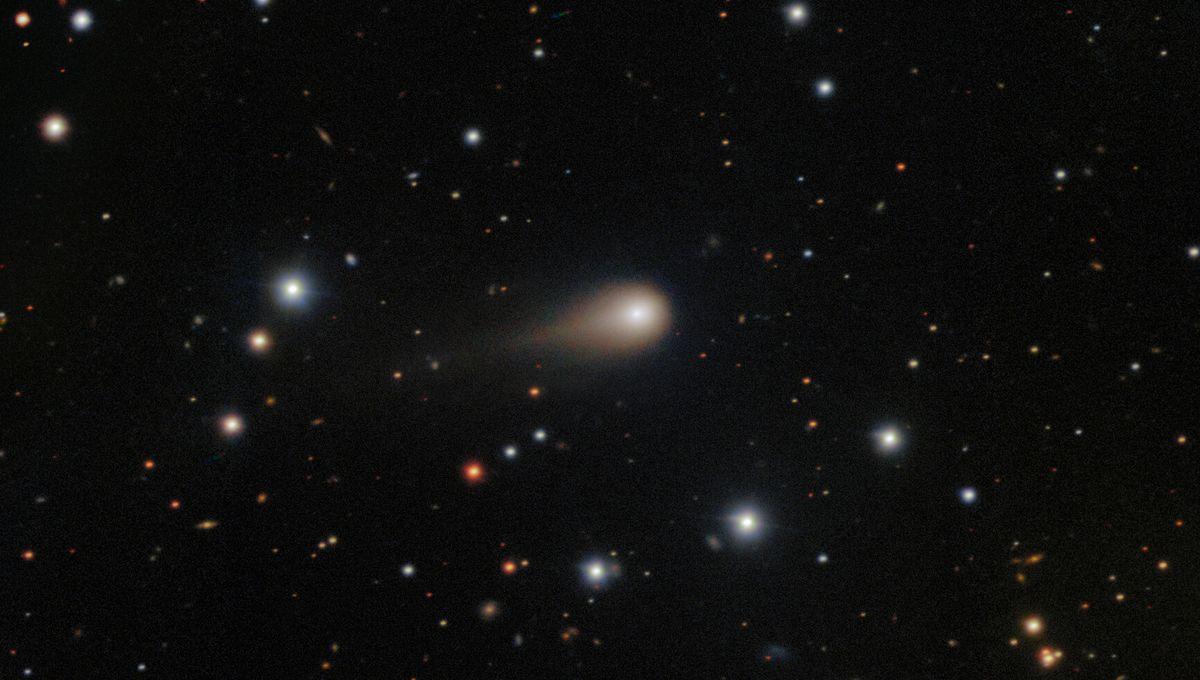
Comet 3I/ATLAS Losing At Least Two Kangaroos' Worth Of Dust Every Second
In a matter of days, Comet 3I/ATLAS will reach its closest point to the Sun. The third known interstellar object will reach its peak of activity, releasing gases and dust like it might not have done in tens of millions of years, or maybe even longer. Comparison between this interstellar interloper and the previous two suggests that Comet 3I/ATLAS continues to be in a class of its own.
The rest of this article is behind a paywall. Please sign in or subscribe to access the full content. Using observations from July to September by the Nordic Optical Telescope in the Canary Islands, researchers David Jewitt and Jane Luu tracked changes in the comet in its trek across the Solar System. In a paper waiting for peer review, the scientists confirmed the presence of its intriguing anti-tail, estimated the possible properties of the dust, and worked out just how much dust it is losing. On October 29, the comet will be 203 million kilometers (126 million miles) from the Sun. When it was 300 million kilometers (186 million miles) away, astronomers estimated that it was releasing 180 kilograms (397 pounds) of dust every second. We got some complaints on our recent article on America’s cheese caves for using kilograms as units, so let’s add some color to that number. Throwing 180 kilos of dust each second is like losing two kangaroos' or about 11 corgis' worth of microscopic cosmic dust to interplanetary space in the same amount of time. Every hour, six blue whales of dust were released by the comet, and every 20.4 hours, enough dust to weigh about the same as the Brooklyn Bridge. As comets go, 3I/ATLAS is nothing exceptional. We have seen more active comets, but compared to Comet 2I/Borisov, the second ever interstellar object discovered, 3I/ATLAS is a lot more effervescent! At the same distance, Borisov was releasing 70 kilograms (154 pounds) of dust, less than half of what 3I/ATLAS has been seen emitting. Both ranges are perfectly normal for comets, but the difference in the behavior of these two comets (and the even weirder first interstellar object 1I/’Oumuamua) underlines the variety of what’s out there beyond the confines of our Solar System. Comet 3I/ATLAS already had a bunch of record-breaking features compared to the other two, moving faster and on a more eccentric hyperbolic orbit, as well as being older – possibly, twice as old as the Solar System. Currently, the comet is on the other side of the Sun from Earth, making observations difficult. We literally had to use Martian orbiters to study it at one point. It will soon become visible again in our skies, however, and there are more spacecraft that will try to get a glimpse of it over the next month. The paper is available on arXiv.

 English
 Arabic
 French
 Spanish
 Portuguese
 Deutsch
 Turkish
 Dutch
Dutch
 Italiano
 Russian
 Romaian
 Greek
Greek