


We Now Know How The First People Reached America – And It Wasn’t On Foot

We Now Know How The First People Reached America – And It Wasn’t On Foot
The first people to enter the Americas may have sailed from Japan around 20,000 years ago, according to a new analysis of prehistoric stone tools from 10 sites across the US.
The rest of this article is behind a paywall. Please sign in or subscribe to access the full content. Until now, researchers had only uncovered a few tantalizing hints that humans had reached the American continent by this time, with ancient footprints in New Mexico representing the earliest evidence. However, with no widespread culture emerging in North America until the rise of the Clovis tradition some 13,000 years ago, scholars have remained divided on exactly when the first Americans appeared – and how they arrived. According to the authors of the new study, though, there are now at least 10 known sites across the US bearing evidence of human occupation between 13,000 and 20,000 years ago. Five of these – located in Virginia, Idaho, Pennsylvania, and Texas – have even yielded enough stone tools to suggest that a technological industry – known as the American Upper Paleolithic – had spread across the region prior to the emergence of the Clovis culture. To understand where this lithic tradition came from, the researchers turned to previous genetic studies, which suggest that the first people in the Americas probably descended from a group that lived in Northeast Asia around 25,000 years ago. Scanning the region’s archaeological record, they noted that Paleolithic hunting weapons – called bifaces – from the Japanese island of Hokkaido match those that characterize the American Upper Palaeolithic. "The discovery of this archaeological connection rewrites the opening chapter of human history in the Americas," explained study author Loren Davis in a statement. "It shows that the First Americans were not cultural isolates, but participants in the same Paleolithic traditions that connected people across Eurasia and Asia." Paleolithic tools from Idaho match those found in Hokkaido, Japan. Image credit: Oregon State University Combining all of this evidence, the researchers propose that the first people in the Americas may have come from Hokkaido around 20,000 years ago. What’s more, because no Paleolithic tools have been found in the northernmost regions of Canada or Alaska, they suggest that prehistoric Asians probably didn’t reach America via the frozen land bridge that opened up in the Bering Strait during the last Ice Age. Given that all the sites yielding such tools are found to the south of this ice-covered region, the study authors conclude that people probably sailed gradually from Hokkaido to North America, following the southern coastline of Beringia and stopping at numerous points along the way. “We suggest that early seafarers, well adapted to the use of boats on the open ocean, probably followed a circum-Pacific coastal route into the Americas,” they write. Highlighting the significance of these findings, Davis says that "we can now explain not only that the First Americans came from Northeast Asia, but also how they traveled, what they carried, and what ideas they brought with them." "It's a powerful reminder that migration, innovation, and cultural sharing have always been part of what it means to be human," he said. The study is published in the journal Science Advances.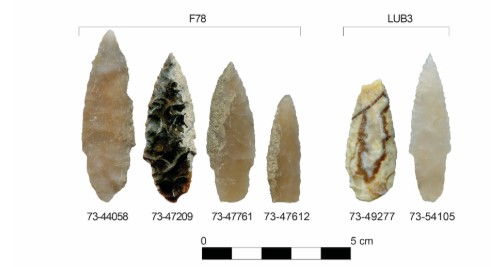

 English
 Arabic
 French
 Spanish
 Portuguese
 Deutsch
 Dutch
Dutch
 Italiano
 Russian
 Romaian
 Portuguese (Brazil)
 Greek
Greek