


Elon Musk's Classified "Starshield" Satellites Are Emitting An Unusual Signal, Amateur Astronomer Finds
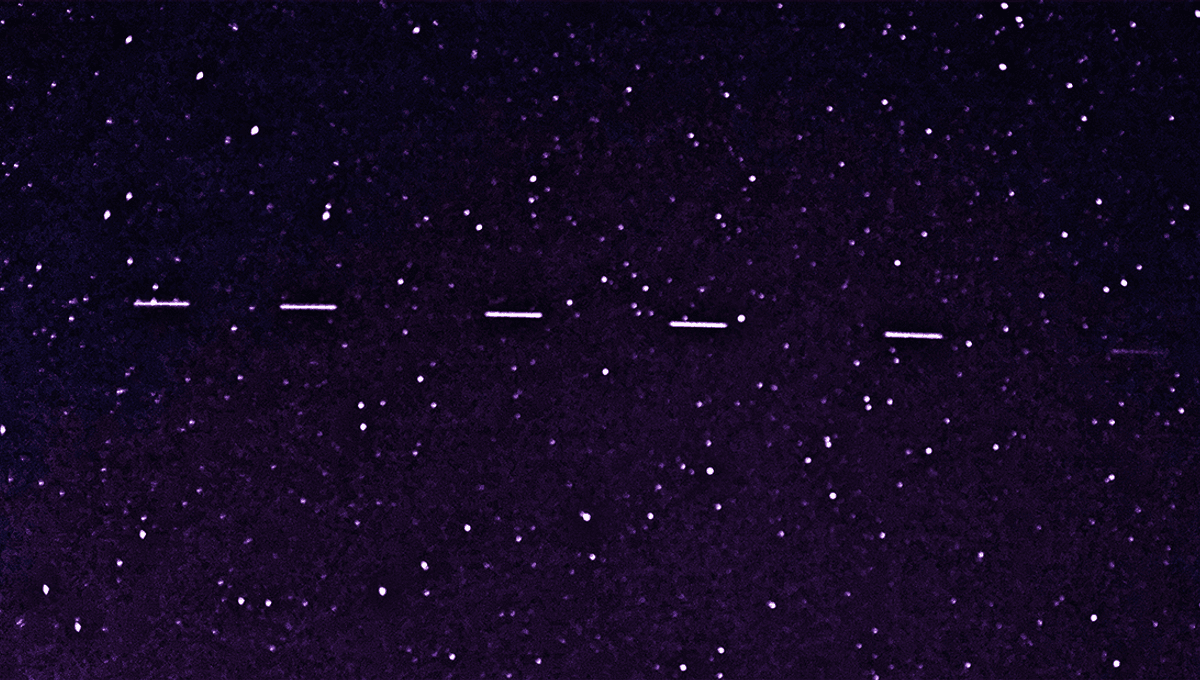
Elon Musk's Classified "Starshield" Satellites Are Emitting An Unusual Signal, Amateur Astronomer Finds
An amateur astronomer monitoring satellites as a hobby has discovered a strange signal being emitted by SpaceX's classified network of satellites known as "Starshield".
The rest of this article is behind a paywall. Please sign in or subscribe to access the full content. In 2021, Elon Musk's space firm SpaceX signed a $1.8 billion classified contract with an unknown US government agency, as reported by the Wall Street Journal. In 2024, Reuters reported that the contract SpaceX signed is with the National Reconnaissance Office (NRO), the government agency responsible for managing spy satellites. According to sources who spoke to the news agency, Musk's firm is creating a network of hundreds of satellites that can operate as a swarm in low-Earth orbit, capable of imaging the Earth below. "The National Reconnaissance Office is developing the most capable, diverse, and resilient space-based intelligence, surveillance, and reconnaissance system the world has ever seen," the NRO said in a statement seen by Reuters. The specific capabilities of the satellite network are unknown, with both SpaceX and the NRO declining to comment on the specifics of the project. However, a source told Reuters that "no one can hide" from the system's reach. Cut to amateur satellite tracker Scott Tilley, tracking satellites from his home in British Columbia. Tilley was working on one of his projects, when he accidentally began a search of radio frequencies which are usually not used by satellites to send data back to Earth. "It was just a clumsy move at the keyboard," Tilley told NPR. "I was resetting some stuff and then all of a sudden I'm looking at the wrong antenna, the wrong band." There in the 2,025-2,110 MHz range, where there should be nothing but silence, he found a spacecraft emitting a signal back down to Earth. Comparing his observations to those from other amateur satellite trackers around the world, he found the culprit. "Bang, up came an unusual identification that I wasn't expecting at all," he added. "Starshield." It is unusual to see satellites emitting in this range for a good reason. That band is not allocated for sending data down from satellites to Earth, but is reserved for "uplinking" to satellites. "Strong wideband S-band emissions have been detected from satellites associated with the Starshield constellation. These emissions, centred within the 2025–2110 MHz band allocated internationally for Earth-to-space and space-to-space links, exhibit Doppler characteristics and power levels consistent with direct space-to-Earth transmissions," Tilley explained in a paper detailing these observations. "In plain terms, this band is reserved primarily for uplinks (Earth-to-space) and, to a limited extent, space-to-space crosslinks between authorized spacecraft. There is no provision in the ITU regulations for space-to-Earth downlink transmissions within 2,025–2,110 MHz," he added. In total, 193 separate satellites have been catalogued in this constellation, with Tilley finding that 170 are emitting on S-band. Without notifying the proper authorities and gaining permission to use this band, which SpaceX does not appear to have done, the firm could be in breach of national licensing requirements. It is not clear why the satellites are sending data in this band, particularly as transmission speeds would be around those achieved by 3G. Tilley suggested that it could be a deliberate tactic to hide Starshield away from observers below, while Kevin Gifford, a computer science professor at the University of Colorado and specialist in spacecraft radio interference, told NPR that it could just be that SpaceX is simply taking advantage of the quiet band, and worrying about permissions later. "From a regulatory perspective, the apparent downlink operation within the 2025–2110 MHz band raises questions regarding compliance with ITU Radio Regulation Footnote 5.392, which reserves this spectrum primarily for Earth-to-space and space-to-space links in the Space Operation, Space Research, and Earth Exploration-Satellite Services," Tilley adds. "To date, no public record exists in the ITU Master International Frequency Register (MIFR) authorizing Starshield downlink transmissions in this range. If confirmed, this would highlight a gap between the practical deployment of modern large constellations and the international coordination mechanisms intended to prevent harmful interference." The study is posted to open research repository Zenodo.

 English
 Arabic
 French
 Spanish
 Portuguese
 Turkish
 Dutch
Dutch
 Italiano
 Russian
 Romaian
 Portuguese (Brazil)
 Greek
Greek