


How You Can Navigate Your Way North Or South Using A Crescent Moon
How You Can Navigate Your Way North Or South Using A Crescent Moon
If you look up into the clear night sky in the Northern Hemisphere, you will see the star Polaris, more commonly known as the North Star.
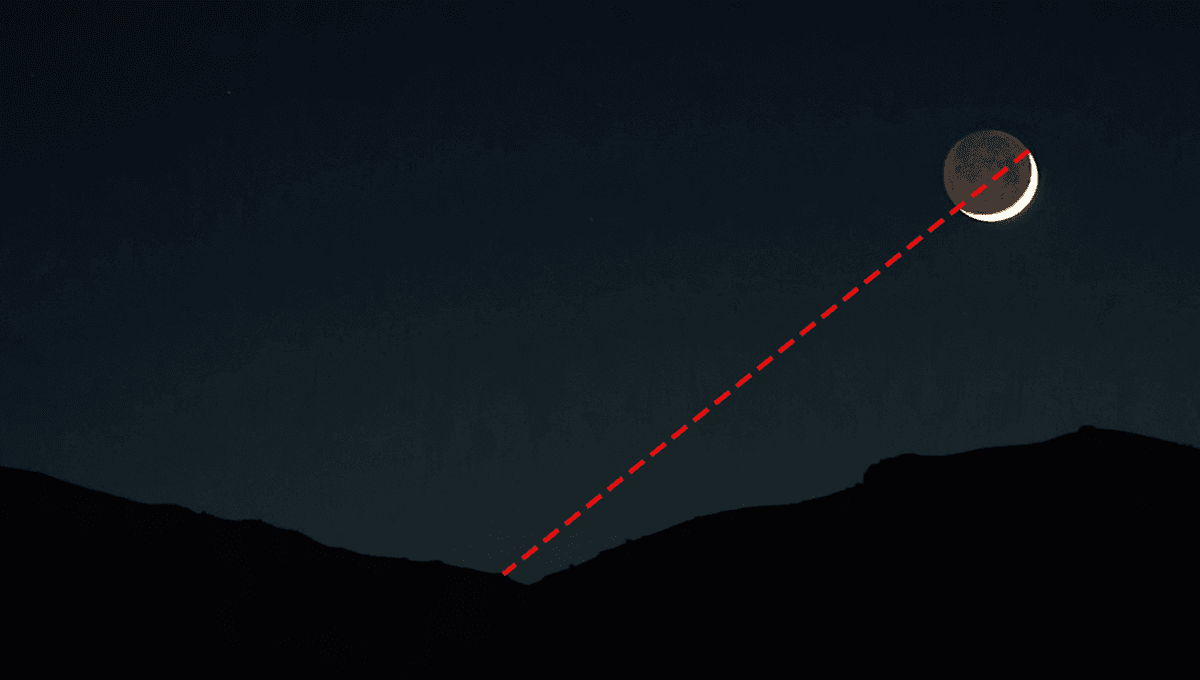
Sitting around 1 degree away from the geographic North Pole, this helpfully bright star has been used in navigation (of the Northern Hemisphere) for centuries. In the Southern Hemisphere, where no particularly bright stars stand out, the Southern Cross is used by people looking for due south. But say you were stuck in a situation where you could only see the Moon, or were simply unwilling to learn the positions of useful stars. Would it be possible to orient yourself using only our natural satellite? The short answer is: kind of. If you happen to be lost on a day when the Moon appears as a crescent in the night sky, it is possible to get your bearings, though it won't be as accurate as other Moon methods. To do so, you simply draw an imaginary line from the top point of the crescent, past the bottom point of the crescent, and down until it hits the horizon. In the Northern Hemisphere the point where the line hits should be roughly due south, while in the Southern Hemisphere it will point you towards the north. "The reason this method works is not very complex. The Sun and Moon move across the sky in an east-west plane. In other words when they are not aligned (a new Moon) then they are roughly either east or west of each other. Since the Moon reflects the Sun’s light, its bright side will be ‘pointing’ to the direction of the Sun, ie. approximately east or west," Tristan Gooley, author of The Natural Navigator, explains on The Natural Navigator website. "The line that joins the horns of a crescent Moon together is at right-angles to this east/west line and any line that is perpendicular to an east/west line must be a south/north line. This is why it works equally well from southern latitudes, for example in New Zealand it can be used to find north." The method will give you a general direction of south or north (depending on your hemisphere) but works best when the Moon is high in the sky, rather than at moonrise or moonset. An alternative method, should the Moon be bright or full, and assuming you have access to a stick, is the "shadow stick" method. In this method, you push a stick into the ground and place a mark where the stick's shadow ends. Then simply wait half an hour and mark the new position, and draw a line between these two marks. This will make a line from east to west in the Northern Hemisphere, and west to east in the Southern (assuming you are looking in the Moon's direction). While cool to know, these methods are not as accurate as devices like a compass or GPS, so maybe don't throw away all your equipment in favor of a trusty old stick.

 English
 French
 Spanish
 Portuguese
 Deutsch
 Turkish
 Dutch
Dutch
 Italiano
 Russian
 Romaian
 Portuguese (Brazil)
 Greek
Greek