


Seals Playing Video Games For Science? We've Got The Footage To Prove It
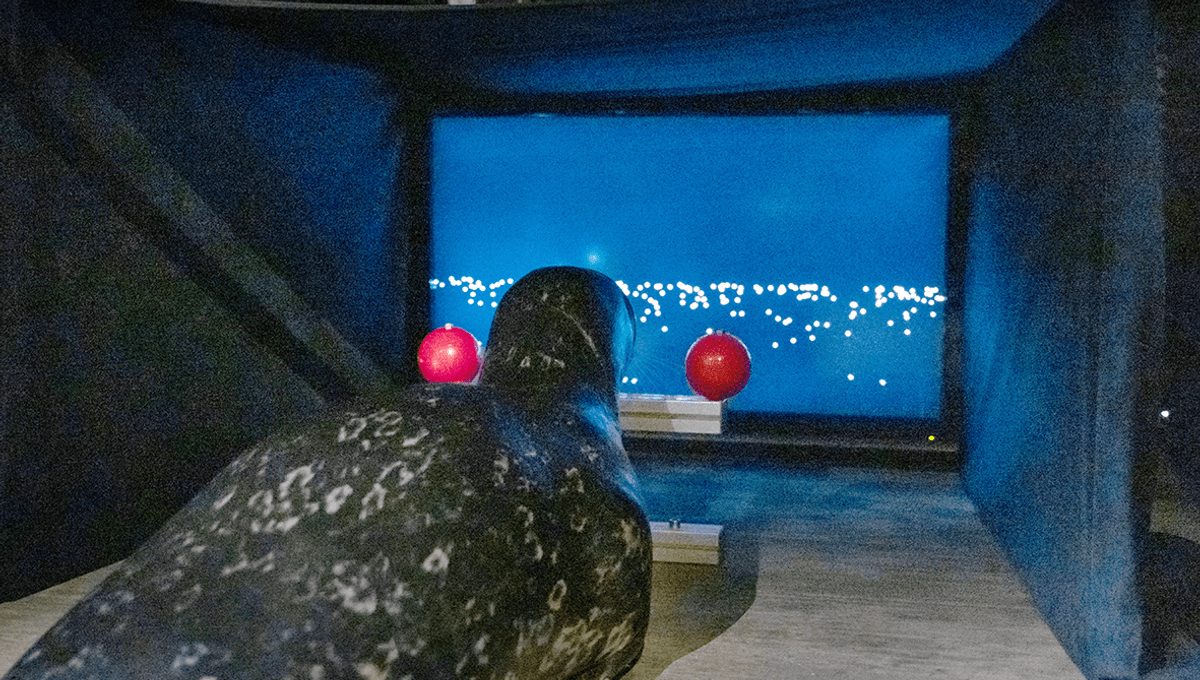
Seals Playing Video Games For Science? We've Got The Footage To Prove It
Seals are pretty incredible mammals. Not only do they possess the lung capacity to make epic dives and are caring mothers, but they also survive in some pretty testing conditions. Down deep in the ocean, there is very little light, and the water can be very cloudy, so how are these pinnipeds navigating? One research group came up with a pretty unique way to find out.
By looking at harbor seals (Phoca vitulina), the team wanted to learn more about how they can navigate through waters with low visibility conditions, particularly with particles like grains of sand or phytoplankton in the water. They were especially interested in whether the seals were using their vision to determine which direction they were traveling in, or if they were more reliant on other senses through means like their whiskers. "We wanted to know whether harbour seals can determine their heading from optic flow fields – the pattern of motion on the retina generated as a seal moves past visible objects, including particles in the water, in their surroundings," said study author Frederike Hanke in a statement. To test what was going on, Hanke and colleagues designed three computer simulations: one simulated the open sea, with dots rushing past the seal; one mimicked a seabed with dots rushing towards the seal; and the third simulated finding the surface of the water with the plane of dots over the seal's head. A trio of seals called Nick, Luca, and Miro viewed these simulations on a large screen and then tapped a red ball to indicate which direction they thought they were moving in. If they were right, they were treated to a sprat-based reward. Nick and Luca had used a similar setup before, so were able to take to the task quite quickly, with gaming novice Miro taking around six times as many sessions to learn the system. However, he did learn it, and Miro exhibited performance equal to that of the other two seals when determining the heading in the experiments. Even in simulated cloudy dark waters, the seals could take advantage of the dots streaming past to work out the direction. The team found that the seals could determine the headings with quite a good degree of accuracy, though they were not as good as humans or rhesus macaques at doing so. "These are living animals, not robots," said Hanke. "Errors are most likely due to inattentiveness or sometimes a drop in motivation." In the future, the team plans to explore more experiments that take into account particles drifting due to sea currents and how animals may cope with these conditions. The study is published in The Journal of Experimental Biology.

 English
 Arabic
 French
 Spanish
 Portuguese
 Turkish
 Dutch
Dutch
 Italiano
 Russian
 Romaian
 Portuguese (Brazil)
 Greek
Greek