


Titan Breaks A Key Chemistry Rule: What That Means For Alien Life
Titan Breaks A Key Chemistry Rule: What That Means For Alien Life
Just like oil and water, certain substances in chemistry simply do not mix. At least this was our understanding. It turns out that some of these substances do mix under certain conditions, a discovery that might have a major impact on what we expect to discover on Saturn’s moon Titan and what the conditions on the primordial Earth might have been like before the emergence of life.
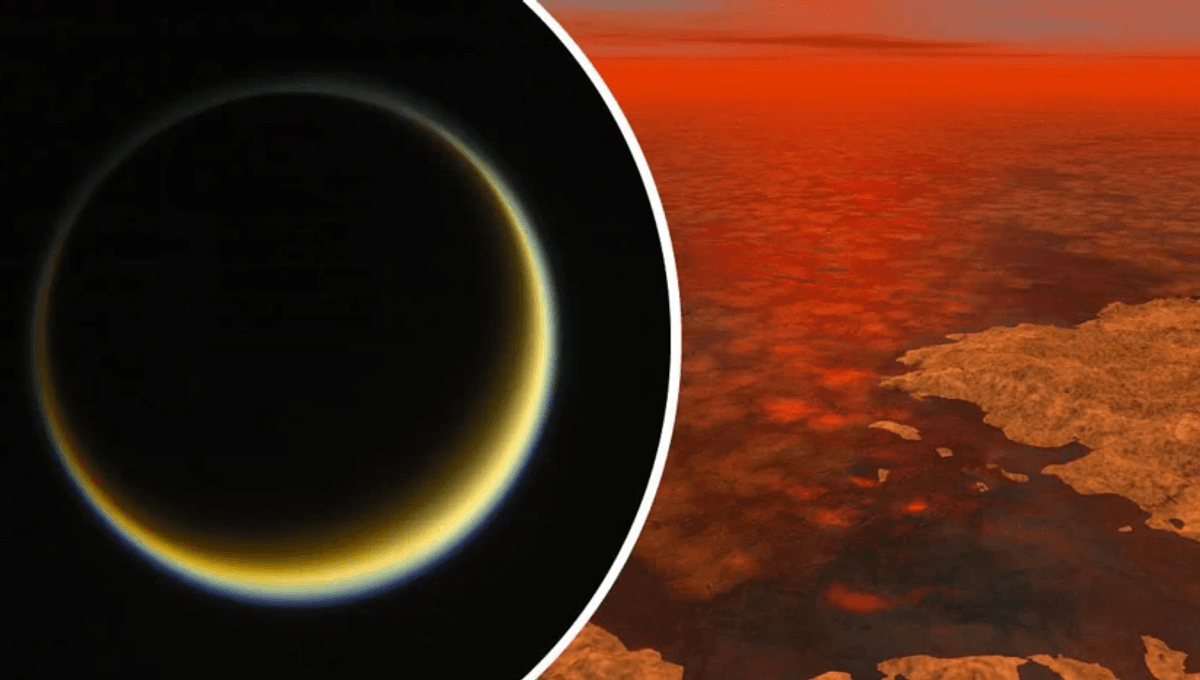
The rest of this article is behind a paywall. Please sign in or subscribe to access the full content. The crucial chemistry discovery in this work is the ability of polar and non-polar substances to mix under very cold conditions. Polar substances have molecules where the electric charge is not equally distributed, so they have a positive side and a negative side. In non-polar substances, the charge is instead symmetric. So polar substances tend to attract one another, and not really mix with non-polar. The work was focusing on answering a specific question about Titan. In the cold atmosphere of the moon, rich in methane and ethane, crystals of hydrogen cyanide (which is polar) form, falling to the surface, together with the rain of methane and ethane that forms the lakes and rivers of Titan. What happens to those crystals? What they found is that under Titan conditions, it is possible for the hydrogen cyanide to become mixed with the non-polar methane and ethane. The standard rule of like dissolves like doesn’t seem to work there, but it doesn’t mean that chemistry books should be thrown away. “I see it as a nice example of when boundaries are moved in chemistry and a universally accepted rule does not always apply,” lead author Martin Rahm, from Chalmers University of Technology in Sweden, said in a statement. Titan is a target for the search for life beyond Earth. It might be analogous of a very ancient Earth, and the abundance of organic compounds and its river, lakes, and rains (albeit made of hydrocarbons and not water) could provide conditions for life to emerge. Given that chemistry might not work exactly as expected there, it is very important to understand what happens on Titan, which might give us insights into the emergence of life on Earth. “The discovery of the unexpected interaction between these substances could affect how we understand the Titan’s geology and its strange landscapes of lakes, seas and sand dunes. In addition, hydrogen cyanide is likely to play an important role in the abiotic creation of several of life’s building blocks, for example amino acids, which are used for the construction of proteins, and nucleobases, which are needed for the genetic code. So our work also contributes insights into chemistry before the emergence of life, and how it might proceed in extreme, inhospitable environments,” added Rahm. Titan will be visited by the mission Dragonfly in the 2030s, a flying vehicle that will study the moon like never before. A paper describing the results is published in the Proceedings of the National Academy of Sciences.

 English
 Arabic
 French
 Spanish
 Portuguese
 Deutsch
 Turkish
 Dutch
Dutch
 Italiano
 Russian
 Portuguese (Brazil)
 Greek
Greek