


Two Spacecraft To Fly Through Comet 3I/ATLAS's Ion Tail – Will They Be Able To Catch Something?
Two Spacecraft To Fly Through Comet 3I/ATLAS's Ion Tail – Will They Be Able To Catch Something?
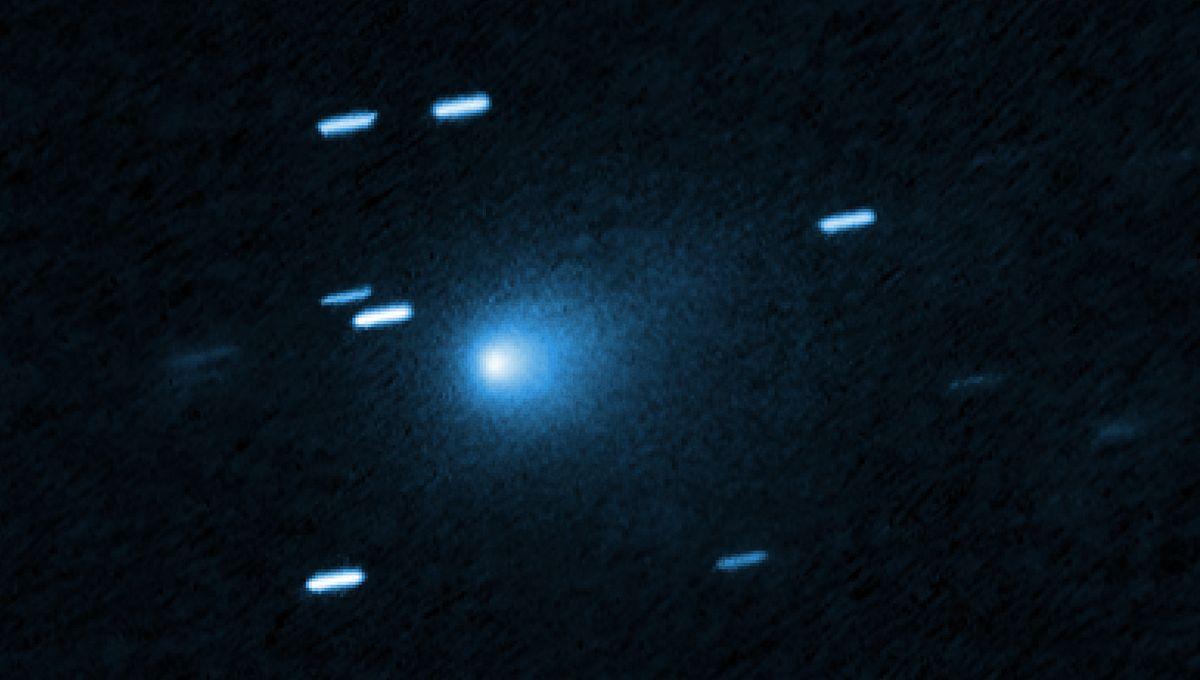
Comets tend to have two tails. One is known as the dust tail, and it tends to be more curved, while the other, known as the ion or plasma tail, is straighter, pointing away from the Sun. The tails can also be long, with ion tails often extending for hundreds of millions of kilometers. We have not seen the ion tail for interstellar comet 3I/ATLAS, but if it’s there, two spacecraft might soon cross it.
The rest of this article is behind a paywall. Please sign in or subscribe to access the full content. The spacecraft in question are NASA’s Europa Clipper, going to the eponymous icy moon of Jupiter, and the European Space Agency’s Hera, which is travelling to the binary asteroid Didymos and Dimorphos, the site of the first-ever planetary defense demonstration when the DART mission purposely hit Dimorphos, shifting its orbit. According to a new paper, both spacecraft will be aligned in such a way that they could be entering the comet’s ion tail in the coming weeks. It is an excellent time to do so; the interstellar comet is not going to get very close to the Sun (203 million kilometers; 126 million miles), but that minimum distance will also mark a peak in activity. It is happening on October 29, and both spacecraft will be within the possible location of the ion tail. Hera will be in the right position first, from October 25 to November 1, right at the peak. While this is exciting, and we know that ESA is always ready to jump on an opportunity when it comes to 3I/ATLAS, the probe does not have the right suite of instruments to study the ion tail. “My understanding is that because Hera is not equipped with any in-situ instruments, there is no opportunity to measure any properties of the comet’s tail as it passes through,” an ESA spokesperson told IFLScience. They assured us that the team will look at the paper, and we will be informed if there are any new developments. Europa Clipper, on the other hand, has the right instruments to try, and if the solar wind conditions are favorable between October 30 and November 6, “Europa Clipper has a rare opportunity to sample an interstellar object’s tail,” write the authors. Will Europa Clipper conduct these observations? Unsure. We got in touch with NASA’s Jet Propulsion Laboratory (JPL), which runs the mission, but at the time of publication, we have not received a reply. This might be due to the effect of the current government shutdown, though JPL is also undergoing an internal restructuring, firing 550 people. This could also affect the possibility of actually using the mission for this investigation. If neither spacecraft can catch a whiff of comet 3I/ATLAS, worry not! While the interstellar comet is currently not visible from Earth (we are on the other side of the Sun), the ESA mission JUICE will be looking at the comet both on November 2 and November 25. It might not be like catching a sample of the comet, but it will do cool science! The paper has been accepted for publication in Research Notes of the AAS and is available on arXiv.

 Arabic
 French
 Spanish
 Portuguese
 Deutsch
 Turkish
 Dutch
Dutch
 Italiano
 Russian
 Romaian
 Portuguese (Brazil)
 Greek
Greek