


Brain Implant Enables Paralyzed Man To Feel And Use Objects Using Someone Else’s Hands
Brain Implant Enables Paralyzed Man To Feel And Use Objects Using Someone Else’s Hands
A paralyzed man in his 40s is now able to feel and use objects through the hands of another person, after receiving a brain implant that connects him to a “human avatar”.
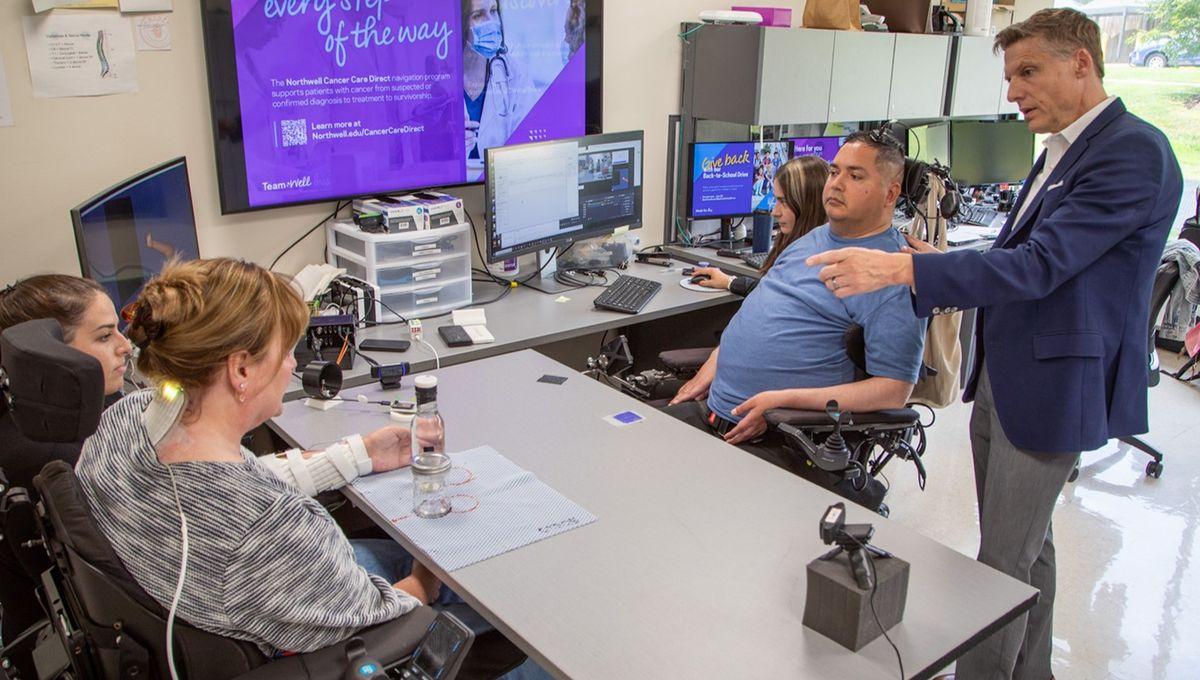
The rest of this article is behind a paywall. Please sign in or subscribe to access the full content. Keith Thomas became paralyzed in all four limbs – known as quadriplegic – in 2020, when he dived into a pool and broke his neck, injuring his spinal cord and rendering him unable to move or feel anything from the chest down. Then, in 2023 he received a first-of-its-kind brain implant that utilized artificial intelligence and non-invasive electrodes to reconnect the bridge between his brain and his body, partially restoring movement and sensation to his hands. A year later, he was able to feel his dog’s fur, use his arm and hands to pick up a cup and drink out of it, and outside of the lab when he wasn’t connected to the computer, he had also regained some sensation in his arms and wrists. Now, as described in a preprint study that is yet to be peer reviewed, Thomas’ brain implant has allowed him to control the movement of other people’s hands to pick up and use objects – and feel them too. One element of the study involved a non-disabled woman acting as Thomas’ avatar, hooked up with electrodes and force sensors. In experiments where both were blindfolded, Thomas was successfully able to control the woman’s hands not only to open and close, but also to grasp objects, and feel enough sensation to tell the difference between them too. When Thomas spoke about his experience with the implant back in 2023, he also expressed a desire for the technology to benefit other people. “The only thing I want to do is to help others. That’s always been the thing I’m best at. If this can help someone even more than it’s helped me somewhere down the line, it’s all worth it,” Thomas said in a statement at the time. This study has enabled him to do that. Thomas was able to control the hands of Kathy Denapoli – a woman in her 60s with a partially damaged spinal cord, affecting the movement of her hands – such that she was able to pick up a water bottle and pour from it, and in another task, pick up and take a drink from a can too. The researchers hope that this kind of cooperative task will help to boost motivation for patients with spinal cord injuries undergoing rehabilitation. “Both participants valued the collaborative nature of the interaction and the shared sense of accomplishment,” wrote the study authors, with Denapoli telling Thomas “I wouldn’t have done that without you,” and Thomas finding “the paradigm engaging and that gave him a sense of purpose, stating ‘I was more satisfied [because] I was helping somebody in real life…rather than just a computer.’” The preprint is posted to medRxiv.

 English
 Arabic
 French
 Portuguese
 Deutsch
 Turkish
 Dutch
Dutch
 Italiano
 Russian
 Romaian
 Portuguese (Brazil)
 Greek
Greek