


Purple Earth Hypothesis: Our Planet Was Not Blue And Green Over 2.4 Billion Years Ago
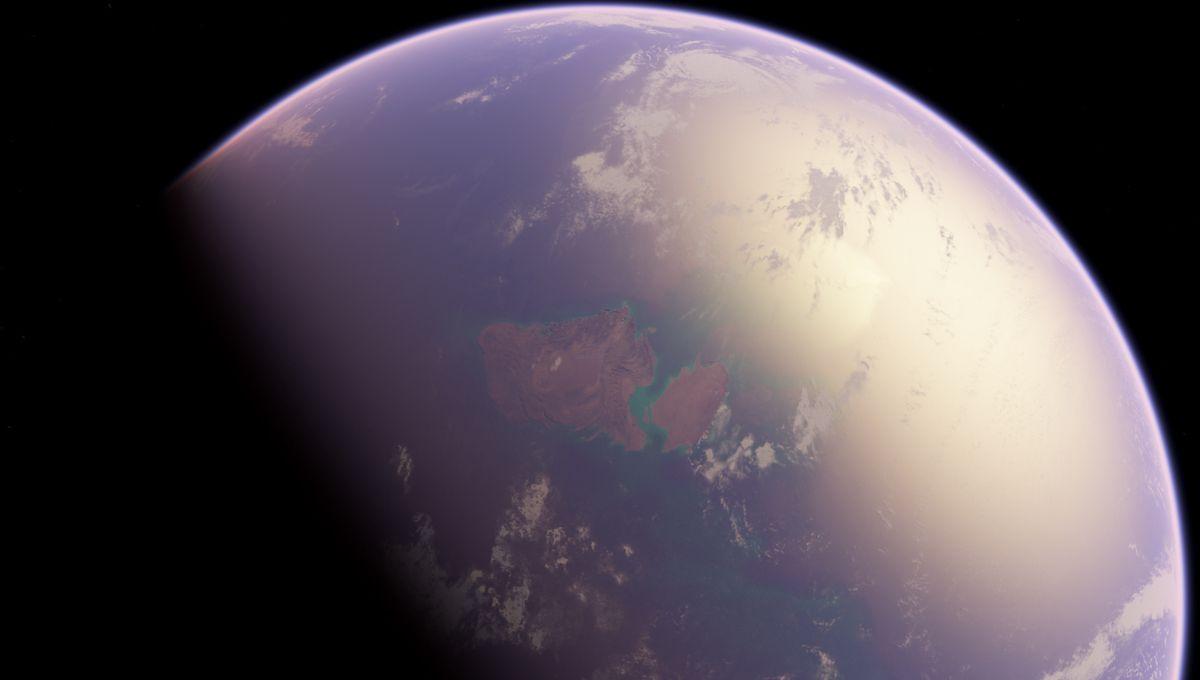
Why Planet Earth May Have Been Purple Over 2.4 Billion Years Ago
Viewed from space, modern Earth looks like a blue marble, decorated with swirls of wispy clouds and slabs of green and brown land. But in our home planet’s freshman years, it might not have been dominated by greenish-blues, but soft purple hues.
The rest of this article is behind a paywall. Please sign in or subscribe to access the full content. This is what’s known as the "Purple Earth Hypothesis", an idea first proposed by Professor Shiladitya DasSarma, molecular biologist from the University of Maryland, and Dr Edward Schwieterman, an astrobiologist from the University of California at Riverside. It centers around the idea that photosynthetic life on early Earth might not have been green, like most plants and algae today, but purple. If this is the case, Earth’s oceans could be dominated by tiny purple microorganisms, enriching the globe with a mauve tint. Most photosynthetic lifeforms on modern Earth, from the trees of the Amazon rainforest to the marine cyanobacteria that fill our oceans, are green because of chlorophyll. This pigment absorbs all wavelengths of light in the visible spectrum – except for green light – and converts it into energy through photosynthesis. However, green is a pretty unexpected color for a sun-soaking pigment to exclude. This vibrant color has a wavelength around 500 nanometers, which is one of the most energy-rich parts of the solar spectrum. So why do most plants ignore it? Why evolve to reflect such high-energy real estate instead of utilizing it? Before the rise of oxygen, when the atmosphere was thick with carbon dioxide and methane, many microorganisms in the ocean may have relied on a simpler pigment called retinal, according to the Purple Earth Hypothesis. Unlike chlorophyll, retinal absorbs green light and reflects purple. It’s still used by certain microbes today, most notably Halobacteria, salt-loving archaea with a purple membrane that thrive in low-oxygen environments. Because retinal is chemically simpler than chlorophyll, DasSarma and Schwieterman suggest it could have been one of the planet’s earlier light-harvesting molecules. Earth had relatively low levels of oxygen in its early history, but that’s not a problem for organisms that use retinal-based photosynthesis. And if early oceans were teeming with these retinal-rich microbes, the entire planet might have gently glowed with a lavender tint. Over time, however, evolution stumbled across new ways to harness sunlight. Retinal-rich microbes had claimed most of the green light in the spectrum, so other organisms hoping to survive via photosynthesis had to adapt to use what was left. Chlorophyll-based photosynthesis may have evolved to take advantage of the blue and red wavelengths that retinal didn't absorb, carving out its own niche in the crowded photochemical landscape. Then came green's time to shine. Around 2.4 billion years ago, during the Great Oxygenation Event, cyanobacteria equipped with chlorophyll began to dominate. These green microbes not only absorbed different parts of the light spectrum but also burped out oxygen as a by-product, a shift that transformed Earth’s atmosphere and paved the way for complex life. As chlorophyll-based life flourished, the balance of color flipped. The once-purple Earth gave way to the blueish-green one we know today. Retinal-based photosynthesis is no longer a dominant force on Earth, but it might still be elsewhere in the universe. When astronomers look out for other habitable worlds, it seems natural to look for signs of green, a spectral fingerprint of chlorophyll, the pigment that underpins nearly all life on our planet. However, the Purple Earth Hypothesis reminds us that life isn’t always synonymous with green. Under different conditions, purple could be just as likely a candidate. In fact, it's possible that the basis of life will be more attuned to orange, red, or a wavelength completely invisible to the human eye. Perhaps light won't even be a factor, and entire planetary ecosystems are built around another foundation other than photosynthesis.

 English
 Arabic
 French
 Spanish
 Portuguese
 Deutsch
 Turkish
 Dutch
Dutch
 Italiano
 Russian
 Romaian
 Portuguese (Brazil)