


Why Do Trains Not Have Seatbelts? It's Probably Not What You Think
Why Do Trains Not Have Seatbelts? It's Probably Not What You Think
If you've ever used public transport, you may be a little confused as to why trains are one of the only vehicles (looking at you, too, buses) that don't have seatbelts. Cars have seatbelts, planes have seatbelts, so why not trains?
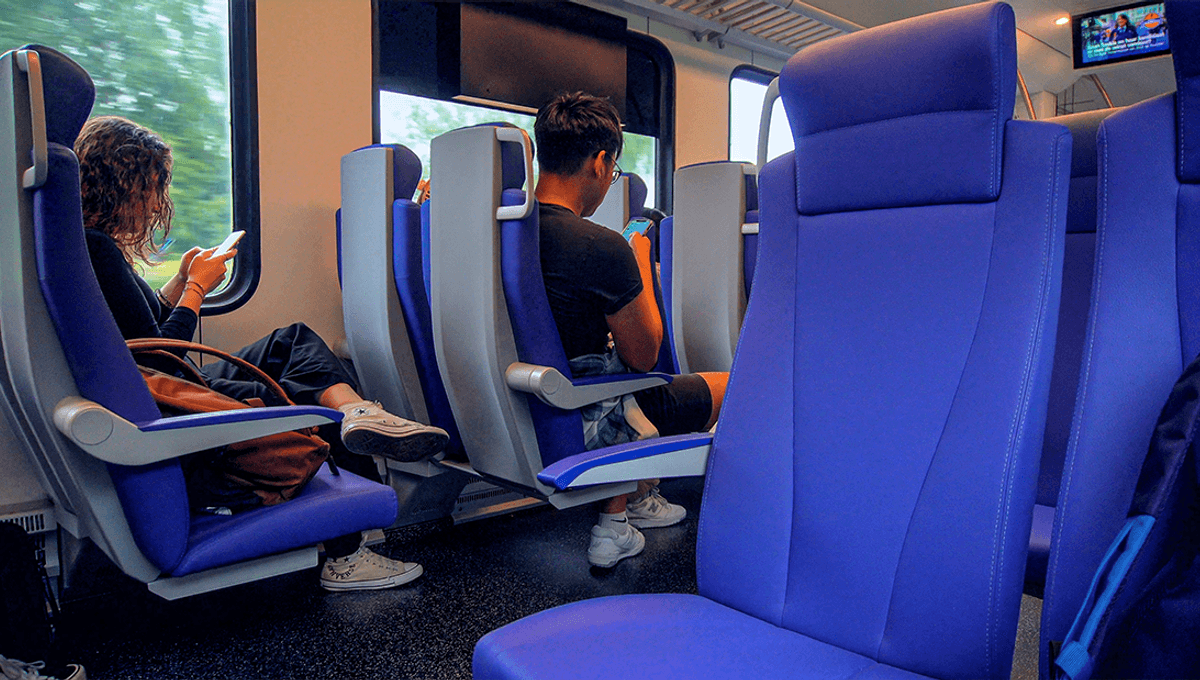
The rest of this article is behind a paywall. Please sign in or subscribe to access the full content. There are a few reasons, and not all of them are obvious. To start with, fitting seatbelts in trains would be an expensive endeavor, and train accidents (though sometimes devastating) are a rarity. "Work by the European Commission dating from 2019 suggested that the risk of death for a train passenger within the EU is around 0.09 fatalities per billion train kilometres," the Railway Safety Council explains, "nearly one third that for bus and coach passengers and around 28 times less than for car occupants." But it is not a simple matter of train companies deciding that it is not worth paying the money to prevent these deaths. Trains are designed to be as safe as possible for the passengers, and crashing while in one is different from crashing in a car. In a car, seatbelts can help prevent passengers, especially in the front, from being thrown outside the car or those in the back from hitting the seat in front. However, in trains, where some passengers are standing and some are seated, seatbelts can actually make the situation worse, as the unseatbelted become transformed into projectiles. There is no way to make every person on a train wear seatbelts. Instead, the layout of the train seats provides protection. "Crash data revealed that occupant impact with seats represents the main cause of secondary impact injuries. Seats, however, also provide the most efficient way to restrict the bodily movement and therefore, minimize the seriousness of any inflicted injuries," a rail passenger safety report explains. "Seat belts were considered. However, it has been determined that they do not provide the utmost in desired protection. This deduction was made taking into account that all passengers would not wear seat belts. In a unidirectional arrangement, passengers not wearing seat belts would become projectiles that would collide with the seat ahead of them." “Secondary impact velocities must be limited to minimize injuries to the crew and passengers as they are thrown from their seats during a collision,” the report added. “Minimizing body decelerations for passengers seems to be the most difficult aspect of improving on the current ability to limit injury during collisions. Seat belts do not seem to be practical.” Train companies and safety experts have looked into the possibility of installing three-point seatbelts, but found that the modification needed had mixed outcomes. "It was found that injury outcomes for passengers choosing to wear restraints were substantially improved. However, there was a slight general worsening of injury outcomes for passengers choosing not to wear restraints as they impacted the modified (stiffened) seat," the Railway Safety & Standards Board explains, adding that the injury outcomes were worse for those who hadn't restrained themselves, especially shorter women and adolescents. "Neck injury (Nij) in this group significantly increased to a level outside acceptable limits. It may be possible to reduce this feature if a new seat were designed which took account of this problem; however, the difficulties and implications that this represents should not be underestimated." If train companies were to install seatbelts and everyone remained seated and restrained, it could improve safety. But that is unlikely to happen, in part due to passenger and employee wants. "They have been considered for many years,” Steven R. Ditmeyer, a former director of research and research development at the US Federal Railroad Administration, told Global News in 2017. “Nowhere in the world are seatbelts used on trains. People want to ride the train to have the flexibility to get up and walk around and so on. The train crew members don’t want to be in the position of having to enforce the seatbelts.”

 English
 Arabic
 French
 Spanish
 Portuguese
 Deutsch
 Turkish
 Dutch
Dutch
 Italiano
 Russian
 Portuguese (Brazil)
 Greek
Greek