


World's Driest Hot Desert Just Burst Into A Rare And Fleeting Desert Bloom
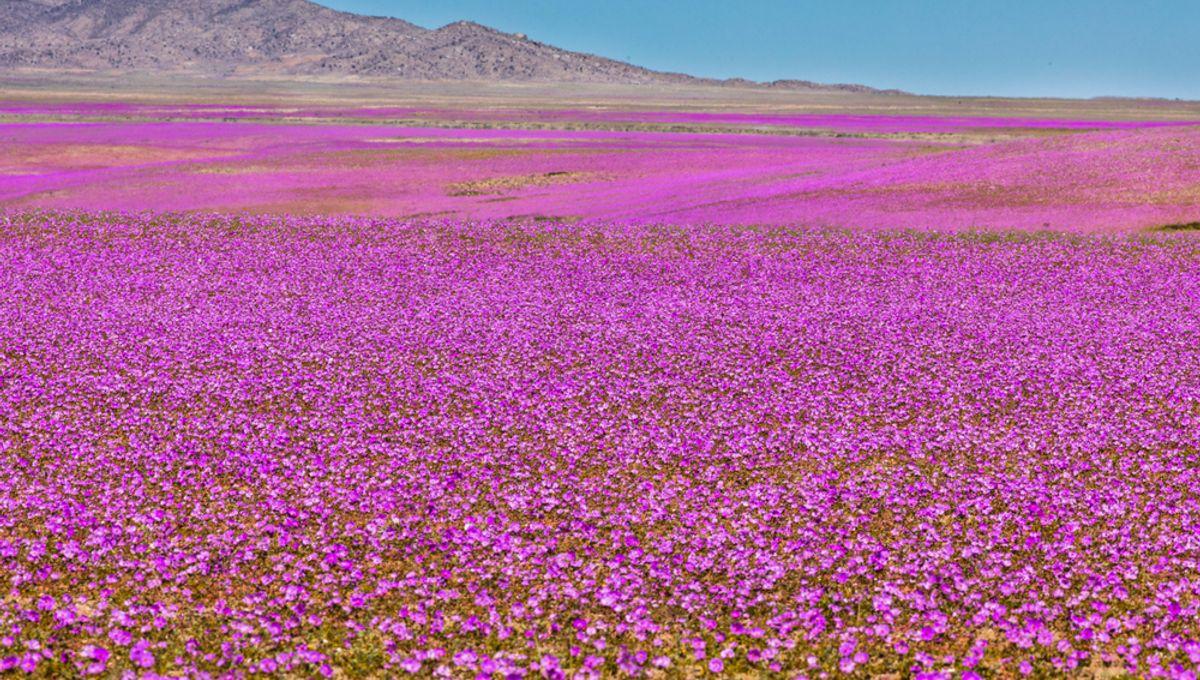
World's Driest Hot Desert Just Burst Into A Rare And Fleeting Desert Bloom
The Atacama Desert in Chile might be one of the driest places on the planet, but even this barren landscape can occasionally bloom into a sea of colorful flowers – and right now it's at its peak.
The rest of this article is behind a paywall. Please sign in or subscribe to access the full content. The desert bloom phenomenon sees a vast and vibrant carpet of flowers appear in the world’s driest nonpolar desert, triggered by a typically rare combination of the right temperature, amount of sunlight, and heavy rainfall. These rains tend to be tied to the El Niño-Southern Oscillation (ENSO), a climate pattern that can bring with it extreme weather. After unusual recent downpours – the Atacama has an average of just 2 millimeters (0.08 inches) of rain a year, but some high-elevation regions received up to 60 mm (2.3 inches) in July and August – a carpet of fuchsia-colored flowers now adorns the Llanos de Challe National Park. “This blooming coincides with El Niño currents, during which temperatures are warmer, resulting in more evaporation and, consequently, more rainfall. But not with La Niña current, which is colder,” said Ana María Mujica, a professor at the Pontifical Catholic University of Chile’s Faculty of Agriculture & Forestry, in an article exploring the phenomenon. “Over the past 40 years, about fifteen events have taken place,” Mujica added. Hitting all of the climate requirements for a superbloom all at once isn’t as easy as it sounds – hence why there’s been relatively few over four decades – and as a result, major blooms in the Atacama Desert normally only occur every five to seven years, between September and November (springtime in Chile). We say normally, because this phenomenon doesn’t exactly seem to be sticking to schedule as of late. There was a major bloom in 2015, followed by another in 2017. The next was in 2022, which was unusual because it happened during La Niña. Still, it’d be easy to assume that at least the timing element of the pattern had been restored, until realizing that we’re expecting yet another significant bloom only three years later. Even in between those years, narrower-ranging blooms have appeared, and not always at the expected time of year, either. Last year, for example, flowers popped up in the desert in July, which is the middle of winter in Chile. This bloom is expected to last until early November, when summer begins, although some hardy drought-resistant species may last until January. The sight of the Atacama Desert in full bloom is no doubt an amazing one – but if the last few events are anything to go by, it seems it’s worth keeping an eye on for reasons beyond pretty colors alone.

 English
 Arabic
 French
 Portuguese
 Deutsch
 Turkish
 Dutch
Dutch
 Italiano
 Russian
 Romaian
 Portuguese (Brazil)
 Greek
Greek