


Could Dogs Be Taught To Talk With Language? This Lab Wants To Find Out
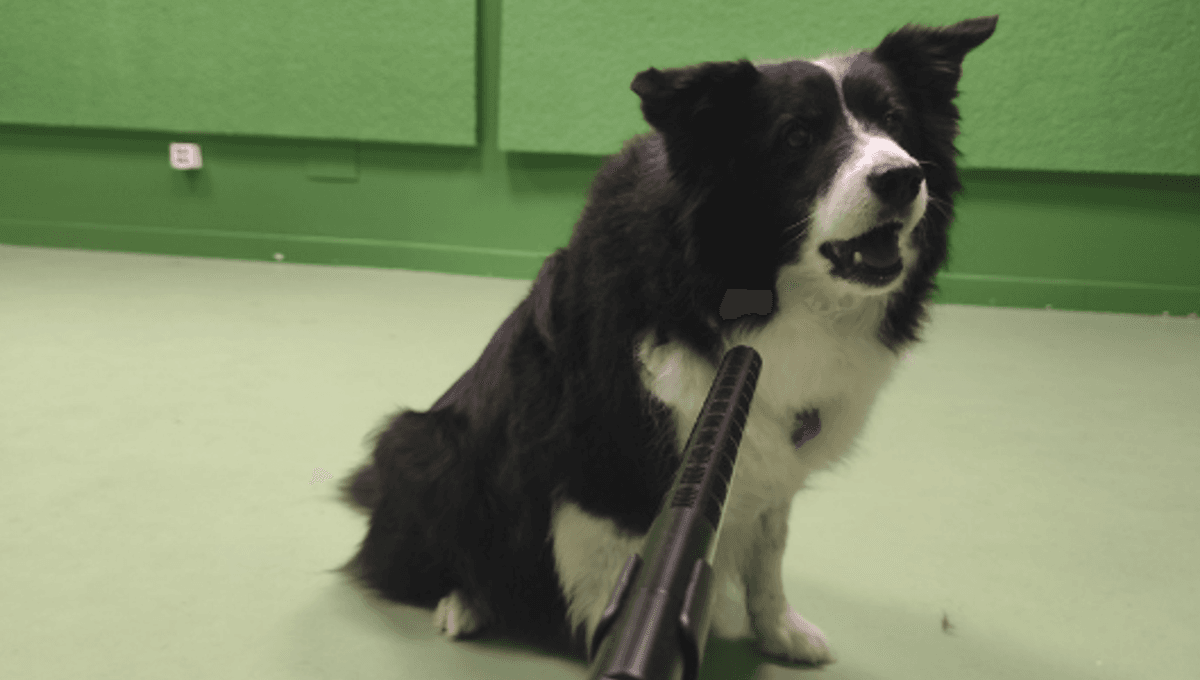
Could Dogs Be Taught To Talk With Language? This Lab Wants To Find Out
Wolves have been carefully (and often unconsciously) molded into docile dogs over thousands of years of domestication, many of their wild instincts softened into something more in tune with the way Homo sapiens tend to operate. Yet despite their many human-adjacent behaviors, "man's best friend" still lacks one defining feature of our species: language. Why is that?
The rest of this article is behind a paywall. Please sign in or subscribe to access the full content. Scientists at the wonderfully named BARKS Lab at Eötvös Loránd University in Hungary are continuing to look into the questions of whether domesticated dogs could ever develop the ability to talk and, if not, what skills they lack. At first glance, the idea of investigating whether dogs can talk might sound frivolous, if not downright silly, but the researchers insist there’s deep scientific worth in their study. They believe their work could shed light on how vocal communication evolved and what it takes for speech to emerge. “Because we cannot experimentally recreate the conditions under which human speech emerged, comparative models are essential. Studying how domestication shaped dogs’ communicative skills may help illuminate the early cognitive and neural steps toward speech-readiness in our own species,” Dr Tamás Faragó, leader of the BARK research group, said in a statement. “The real question is: are dogs really on the road to verbalisation? Which skills are necessary for speech production and comprehension abilities that the dog might possess, and which skills do dogs lack? We aimed to clarify what is known, what is overstated, and what remains to be explored through serious scientific inquiry,” added Dr Rita Lenkei, one of the lead authors. The study notes that speech is a seemingly complex process that requires “the orchestration of sophisticated neural and biomechanical processes.” In other words, you need the brain power and, just as crucially, the anatomical body parts to utter words physically. Dogs are very intelligent animals (when they want to be) and can clearly process audible cues. Nearly every household hound can recognize its own name, or perk up when it hears “walkies” or “food”. This shows they can link specific sounds to meanings, forming mental connections between words, objects, and actions. In essence, they seem to grasp a form of verbal understanding. Furthermore, dogs seem to be able to differentiate languages, register the tone of a vocalization, and recognize their owner or familiar persons based on voice only, suggesting their auditory comprehension is more nuanced than we might assume. But do they have the physical hardware to express language? Well, yeah, perhaps. The paper notes that dogs can master “dynamic larynx movements” that allow them to produce a “wide variety of formant frequencies” on command. It might not be as refined as the vocal chords of Homo sapiens, but the paper notes that it suggests “dogs could still exhibit sufficient vocal flexibility to produce speech-like sounds.” So, what’s stopping dogs from becoming skilled conversationalists? The answer might lie in the sociality of canines. One leading theory about why humans developed language is that we needed it for cooperation and coordinating complex group tasks. Dogs, however, are already masters of social coordination without words. Living in packs and reading subtle cues, they navigate complex relationships through body language, gaze, smell, and sound. Furthermore, dogs already communicate extremely effectively with humans without needing words. They may simply have no evolutionary reason to talk. Even if dogs possess some of the mental “software” and physical “hardware” for speech, the researchers warn that we shouldn’t try to make them talk, namely because of ethical concerns. Besides anything else, it could just be a bit creepy. If a prime function of language is to build bonds and foster cooperation, a speaking dog could be disastrous for the longstanding human-canine relationship. “Producing speech by dogs opens the door to a different – rather worrying – perspective, too: the uncanny valley,” the study authors write. “Just as non-humanoid robots should not communicate with speech as they would be perceived to be repellent, dogs should not either,” they conclude. The study is published in the journal Biologia Futura.

 English
 Arabic
 French
 Spanish
 Portuguese
 Deutsch
 Turkish
 Dutch
Dutch
 Italiano
 Russian
 Romaian
 Greek
Greek