


Rare Chance To See “Pink Meanie” Jellyfish With 20-Meter Tentacles Blooming Off Texas
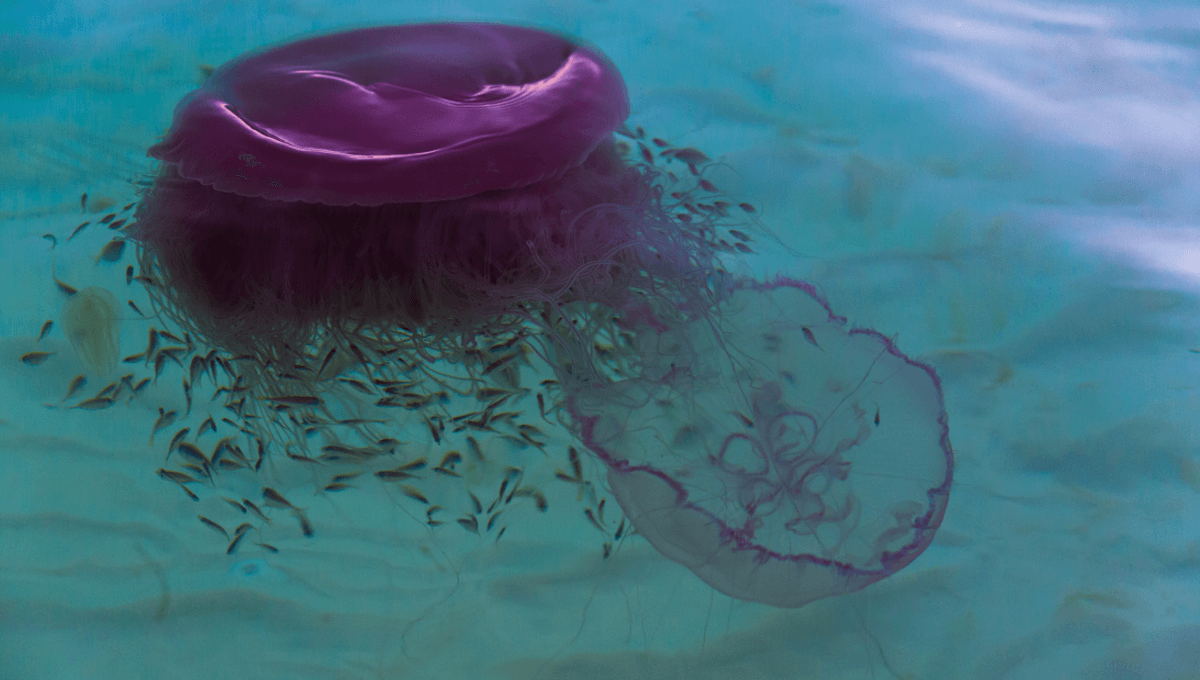
Big, Pink, And Mean: Texas, Don't Miss Your Chance To See A Rare Bloom Of Unusual Jellyfish
Texas is experiencing a superbloom of a very different variety, as smacks of “pink meanie” jellyfish have been spotted along its coastline. These vibrantly colored and predatory jellyfish are remarkable-looking creatures – and they can get huge.
The rest of this article is behind a paywall. Please sign in or subscribe to access the full content. “I'm excited today to talk to you about something I've been looking for for a year and that's called the pink meanie,” so says Jace Tunnell, director of community engagement at Texas A&M University-Corpus Christi’s Harte Research Institute, in a recent YouTube video. “It's a jellyfish that can get huge. I mean tentacles to 70 feet [21 meters] long and the thing can be 50 pounds [23 kilograms].” Tunnell tells us this while splooting on a beach in Texas, with one such pink meanie in his hand. You’ll see a lot of jellyfish fondling in the video, but it’s worth noting that Tunnell did get stung (albeit not badly), so for the general public, it’s a bloom we’d recommend appreciating with your eyes only. The pink meanie’s scientific name is Drymonema larsoni, and it’s relatively new to science. Named by the Smithsonian Institute National Museum of Natural History’s Keith Bayha, it exploded onto the scene in a rather dramatic fashion. “Pink meanies first started showing up in the northern Gulf of Mexico in the early 2000s and were recorded by Dr Monty Graham at DISL,” Bayha told the Dauphin Island Sea Lab (DISL) in 2022. “Dr. Graham sent me samples for DNA analysis when I was a graduate student at the University of Delaware.” “I tried to use them for a study I was doing on the Lion’s Mane Jellyfish, whose family the pink meanie previously belonged to, but they were too different. In that study, it became clear that Drymonema was a brand new family and very distinct from the Lion’s Mane Jellyfish.” It was formally described in a 2010 paper, and we’ve since gotten to know more about these ethereal blobs. As for why they’re blooming now, as late summer turns to early fall, it’s all to do with the pink meanie’s diet. As adults, these jellyfish exclusively feed on other jellyfish, with a particular penchant for moon jellyfish. That means an influx of moons will lead to a surplus of meanies, but when the weather cools and the water gets colder, the pink meanies will be gone again. So, if you’re in the Texas area and fancy feasting your eyes on a smack of rare jellyfish, get yourself down to the beach. Just remember, pink meanie is and pink meanie does (aka, no touchies). [H/T: Smithsonian]

 English
 Arabic
 French
 Portuguese
 Deutsch
 Turkish
 Dutch
Dutch
 Italiano
 Russian
 Romaian
 Portuguese (Brazil)
 Greek
Greek