


It's The Perfect Time Of Year To See Noctilucent Clouds In The Twilight Skies
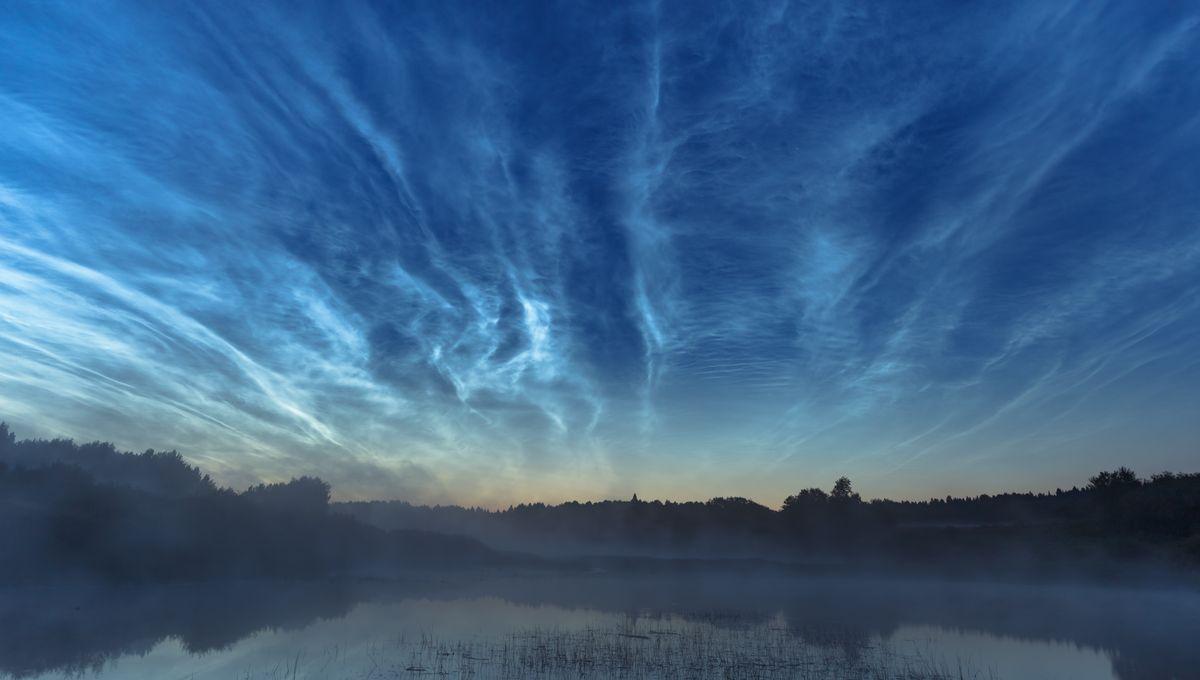
It's The Perfect Time To See Some Of The Rarest And Highest Clouds On Planet Earth
Noctilucent cloud season is upon us. If you’re in the Northern Hemisphere this summer, keep your head to the skies at sunset and you might be lucky enough to catch a sight of one of the rarest types of cloud on Earth.
Noctilucent clouds, or “night-shining” clouds, are described as thin, wispy clouds that glow with a beautiful blue or silvery hue. In the Northern Hemisphere, they can appear from the end of May until the beginning of August, with June and July being the prime time to observe them. They’re much rarer in the Southern Hemisphere, but they can be visible from the end of November to the beginning of February, with sightings most likely during December and January. They are some of the highest clouds in the atmosphere, drifting around 80 kilometers (50 miles) above Earth in the mesosphere, around 10 times higher than the region where most other weather clouds form. At this extreme altitude, air temperatures can be as low as -90˚C (-130˚F), and there is very little moisture. Tiny amounts of water vapor freeze onto microscopic particles of meteorite dust drifting in the mesosphere, creating delicate ice crystals that make up these rare clouds. A nice view of noctilucent clouds in Laboe on the coast of Germany. Conditions have to be just right for noctilucent clouds to be visible. They tend to only appear during the twilight hours, just an hour after sunset or an hour before sunrise. This is because they’re too thin to be seen in daylight, but they become nicely lit by the Sun's rays as it drops below the horizon. While most commonly seen near the poles, noctilucent clouds occasionally drift to lower latitudes, allowing sightings across parts of the US, Canada, and Europe. Ordinarily, the upper atmosphere is far too dry for clouds to form. However, major volcanic eruptions can change that by injecting large amounts of water vapor into these high altitudes, making noctilucent cloud formation possible. The first scientific observations of these majestic clouds were recorded in 1885, two years after the infamous eruption of Krakatoa in Indonesia. It appears that noctilucent clouds have become more common (or perhaps just more visible) over the past 140 years. Scientists have found there’s been a 40 percent increase in water vapor at high altitudes since 1871 because methane, a climate-warming greenhouse gas, reacts to produce water vapor in the stratosphere and above. As a result, noctilucent clouds have become significantly more visible since the 19th century. The appearance of the clouds varies from year to year and even over decades, influenced by changes in the atmosphere and the patterns of the solar cycle. The summer of 2022 proved exceptional for cloud viewing, so let’s hope 2025 doesn’t disappoint.

 English
 Arabic
 French
 Spanish
 Portuguese
 Deutsch
 Turkish
 Dutch
Dutch
 Italiano
 Romaian
 Portuguese (Brazil)
 Greek
Greek