


The Great Comet Of 1997 Was Visible To The Naked Eye For A Record 569 Days
The Great Comet Of 1997 Was Visible To The Naked Eye For A Record 569 Days
Later this month, on October 21 to be precise, comet C/2025 A6 (Lemmon) will make a close approach to the Earth. At a predicted magnitude of 3.9, the dramatically brightening comet should be visible to the naked eye as it rushes past.
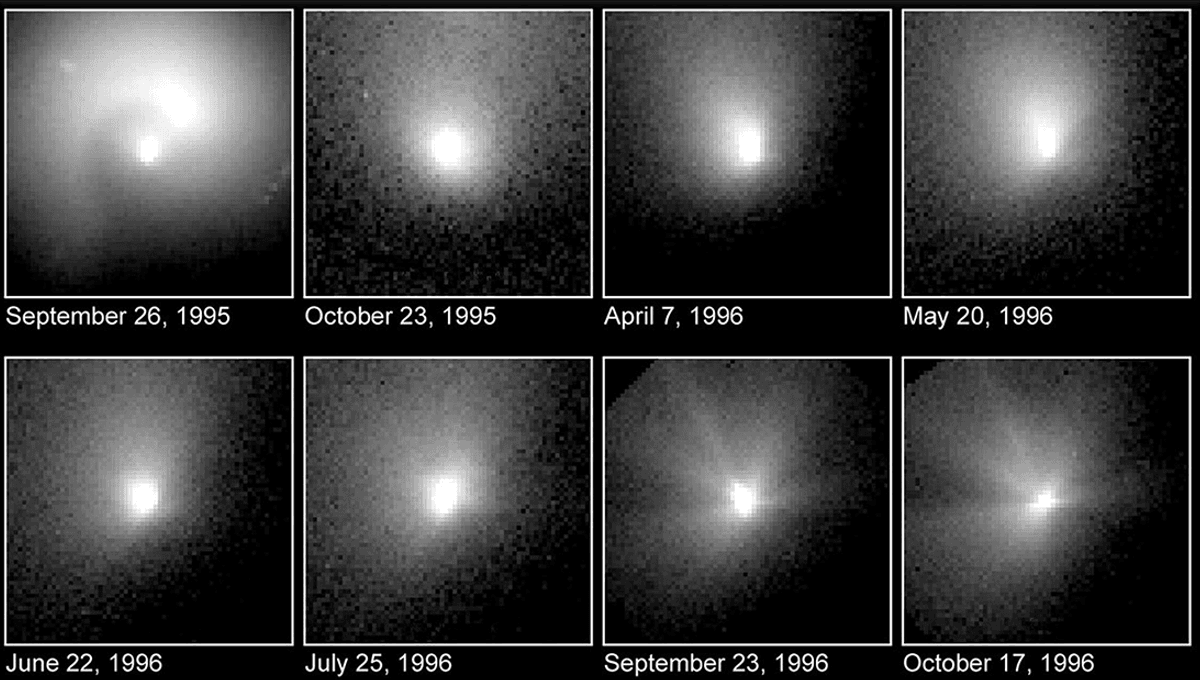
The rest of this article is behind a paywall. Please sign in or subscribe to access the full content. There will be other opportunities to view space objects this year, including C/2025 R2 (SWAN), which may also be bright enough to see without binoculars on October 19. But one of the most spectacular comets in recent history may have passed you by, due to you being too young or "not born yet". In 1997, the world witnessed a comet so great that it simply became known as "the great comet". On July 23, 1995, two US astronomers looked up at the sky and discovered the object independently of each other. Alan Hale, a professional astronomer, regularly searched the skies from his driveway in New Mexico, USA. On that night, he was merely waiting for a comet that was already known about, and trained his telescope on globular cluster Messier 70, in the constellation of Sagittarius. That, it turned out, was a pretty good stroke of luck. "As soon as I looked," Hale told Time, "I saw a fuzzy object nearby. It was strange, because I'd looked at M70 a couple of weeks earlier and the object hadn't been there." Hale checked his own sky atlas and the computer at the Central Bureau for Astronomical Telegrams at Harvard for any known comets in the area, finding none. A few hours later, he was pretty sure he had seen a comet, as it had moved in the sky. Meanwhile, around 644 kilometers (400 miles) away in Arizona, Thomas Bopp was looking through a friend's telescope and noticed an object near Messier 70. Checking star maps, like Hale, he found no objects in the area and decided to alert the Central Bureau for Astronomical Telegrams through a Western Union telegram. Unsurprisingly, Hale's own alert to the Bureau for the International Astronomical Union reached its destination much faster. "Nobody sends telegrams anymore," Brian Marsden, who ran the bureau, told National Geographic. "I mean, by the time that telegram got here, Alan Hale had already e-mailed us three times with updated coordinates." Nevertheless, the comet was named Hale–Bopp after the two astronomers who found it on the same night. "Also called the Great Comet of 1997, comet C/1995 O1 (Hale-Bopp) is a large comet with a nucleus measuring approximately 37 miles (60 kilometers) in diameter. This is about five times the size of the object hypothesized to have led to the demise of the dinosaurs. Due to its large size, this comet was visible to the naked eye for 18 months in 1996 and 1997," NASA explains of the object. "It takes about 2,534 years for Hale-Bopp to orbit the sun once. Hale-Bopp last reached perihelion (closest approach to the sun) on Apr. 1, 1997." Hale-Bopp became known as the "great comet" after the previous "great comet of 1811". That comet was visible to the naked eye for around 260 days, and was the record-holder until Hale-Bopp came into our part of the neighborhood. If you missed it, don't worry. You will get another chance, around 4380 CE.

 English
 Arabic
 Spanish
 Portuguese
 Deutsch
 Turkish
 Dutch
Dutch
 Italiano
 Russian
 Romaian
 Portuguese (Brazil)
 Greek
Greek