


Million-Year-Old Skull Pushes Back Homo Sapiens' Origins By 400,000 Years
Million-Year-Old Skull Reveals Homo Sapiens Are Nearly Twice As Old As We Thought
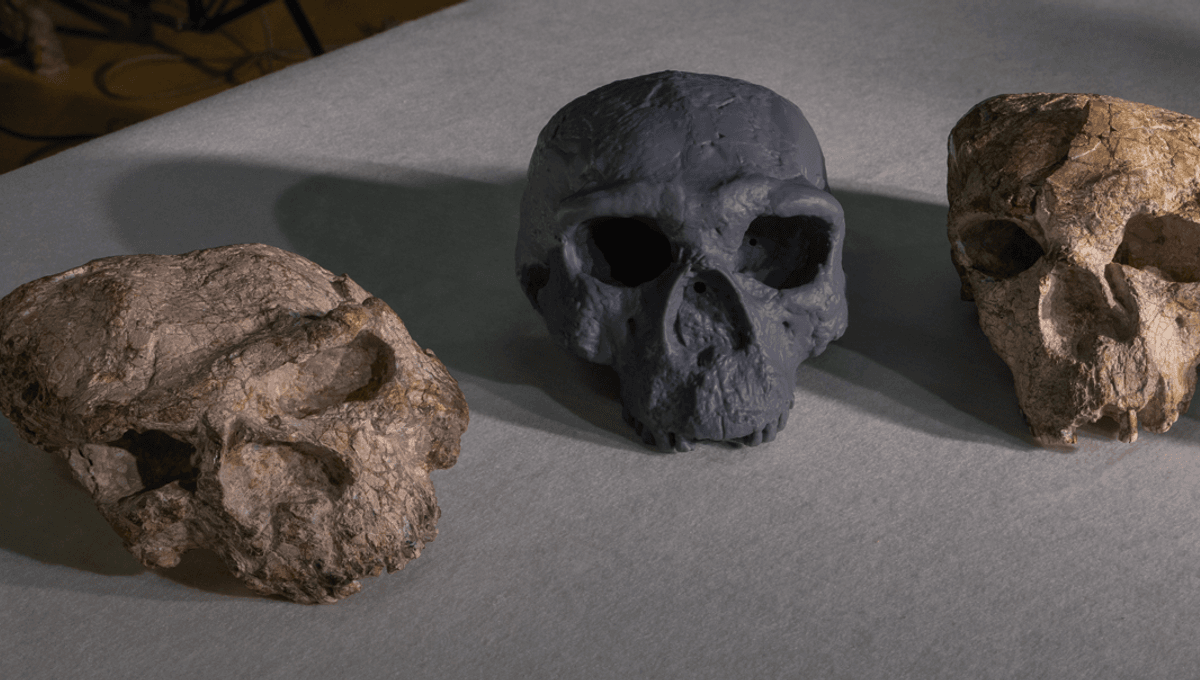
Until recently, it was thought that Homo sapiens and Neanderthals split off from their last common ancestor around 600,000 years ago, but a prehistoric skull from China has just shattered that narrative. Dated to a million years ago, the cranium belongs to an extinct human clade which encompasses the Denisovans, indicating that we had already branched off from our sister lineage prior to this point.
The rest of this article is behind a paywall. Please sign in or subscribe to access the full content. Discovered in Hubei Province in 1990, the so-called Yunxian 2 skull has been at the center of a taxonomic confusion for the past 35 years, largely because the specimen is badly crushed and therefore difficult to study. Due to its age and the shape of its braincase, though, some scholars had assumed that the cranium belonged to Homo erectus. However, using CT scanning and digital reconstruction techniques, the authors of a new study have managed to correct the skull’s distortions and build a complete model of the specimen. In doing so, they revealed that Yunxian 2 possesses a mosaic of features, some of which are typical of more primitive hominins like H. erectus while others are more aligned with Homo sapiens. Cross-referencing more than 500 of these morphological traits against 104 other human fossils, the researchers determined that Yunxian 2 belongs to the Homo longi clade, which includes a 145,000-year-old skull that was recently identified as a Denisovan. However, Yunxian 2 itself is not a Denisovan, but probably sits near the base of the lineage that gave rise to this enigmatic species. What’s more, while Denisovans and Neanderthals were previously thought to be sister lineages, the team’s analysis indicates that the Homo longi clade is in fact the sister group to the Homo sapiens clade. We really have to say we don't know where the common ancestor lived. Professor Chris Stringer “Because [Yunxian 2] is about a million years old, by definition, the Homo longi clade must be about a million years old at minimum,” said study author Professor Chris Stringer to IFLScience. “And that, in turn, implies that if sapiens and Neanderthals had already branched off, then their groups must be equally or even older in their origin.” In other words, the Homo sapiens group must have emerged more than a million years ago, which is around 400,000 years earlier than certain genomic models suggest. Overall, the researchers estimate that our clade originated about 1.02 million years ago, while the Homo longi group dates back to 1.2 million years ago. Interestingly, the Homo longi group also encompasses Homo antecessor, which is represented by 850,000-year-old fossils from Atapuerca in Spain. Geographically, then, early members of this clade are spread across the entire length of Eurasia, suggesting that the group may have emerged outside of Africa. “Many of us, for years, assumed that Africa was the place where the divergences of these groups occurred,” says Stringer. “But on the present analysis, the oldest members of the longi clade are antecessor in Spain and Yunxian in China, and then closely related is the sapiens clade, and branching before that is the neanderthalensis clade.” “So it raises the issue of, did the common ancestor of all those clades live outside of Africa?” he says. It’s widely accepted that Homo sapiens first emerged in Africa, although Stringer doesn’t rule out the possibility that our species may have descended from a hominin that re-entered the continent after branching off from our related lineages somewhere in Eurasia. The team now hope to clear up some of this uncertainty by analyzing other, equally old human fossils from Ethiopia, Eritrea, and the Sima de los Huesos in Spain. For the time being though, Stringer concedes that “we really have to say we don't know where the common ancestor lived.” The study is published in the journal Science.

 English
 Arabic
 French
 Spanish
 Portuguese
 Turkish
 Dutch
Dutch
 Italiano
 Russian
 Romaian
 Portuguese (Brazil)
 Greek
Greek