


In The 1820s, Eight Hours Of Sunlight Changed The History Of Science And Art Forever
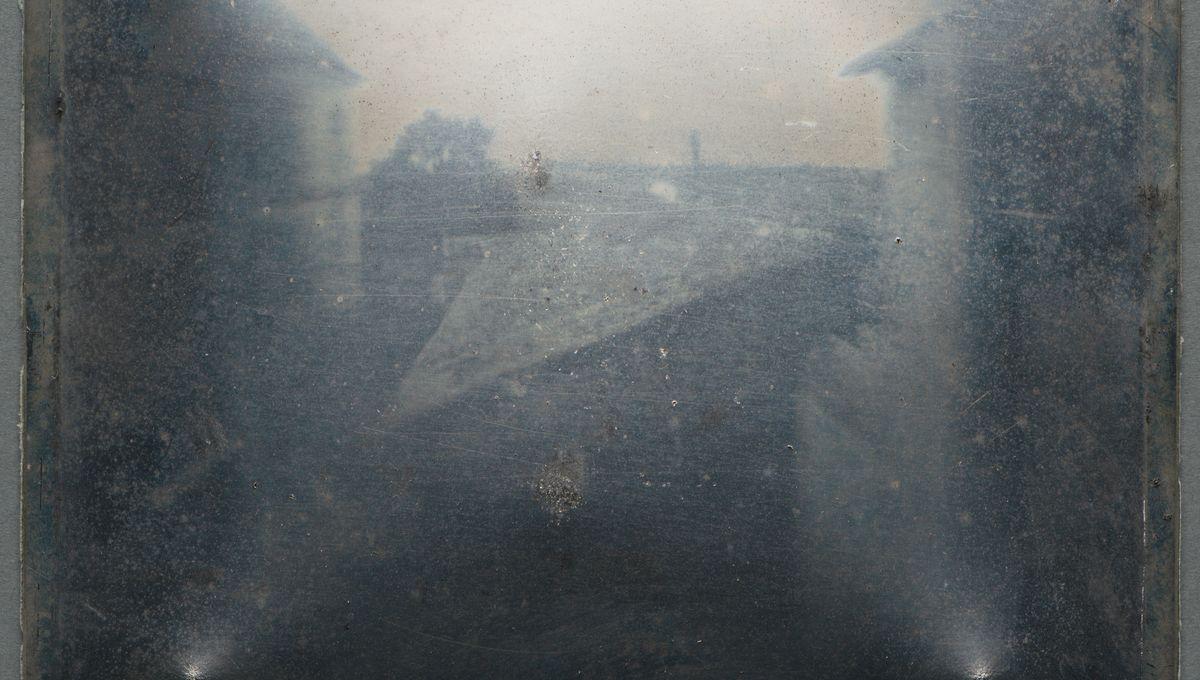
In The 1820s, Eight Hours Of Sunlight Changed The History Of Science And Art Forever
Two centuries ago, a French inventor gazed out of his window in Saint-Loup-de-Varennes and captured a defining moment in the history of science (not to mention art). As the sunlight poured down on the rooftops ahead, Nicéphore Niépce set up a peculiar contraption on his windowsill: a darkened box holding a pewter plate coated with a light-sensitive goo. Then he simply let it sit.
The rest of this article is behind a paywall. Please sign in or subscribe to access the full content. After opening a hole in the box and leaving the plate exposed to the outside world for eight hours, a ghostly image of the view in front slowly emerged. For the first time, light had etched a clear, permanent image onto a film. The result – titled View from the Window at Le Gras – is widely considered to be the world’s first surviving photograph. While Niépce did not consider himself much of an artist, the experiments he had developed to create this process were deeply creative. He coated the plate with bitumen of Judea, a tar-like substance that hardened when exposed to light. After the long exposure, he washed the plate with lavender oil and petroleum, rinsing away the unhardened areas to reveal the eerie outlines of rooftops, trees, and chimneys. The original plate used to create the first photograph, titled "View from the Window at Le Gras". Image credit: Nicéphore Niépce - Harry Ransom Center via Wikimedia Commons (Public Domain) The breakthrough came through his interest in the art of lithography, a printmaking technique that was enjoying a flight of popularity in early 19th-century France. Experimenting with imprints placed over light-sensitive varnishes, he began to think deeply about how light could be harnessed to capture visual information in its rawest and most vivid state. Niépce called his finished process “heliography”; "helios" meaning "Sun" in Greek and "graphy" stemming from the Latin word for "to write" or "to draw." In other words, the process of heliography was “drawing with the Sun.” It's not known exactly when Niépce captured his first image using this technique, but the miraculous technology first came to light (no pun intended) in 1826 when he showed his work to botanical illustrator Francis Bauer. Thoroughly impressed, his friend encouraged him to head to London to present this novel process to the scientific establishment in Britain. In 1827, Niépce crossed the English Channel on a trip to visit his mentally ill brother, taking with him six heliographical plates. He was hoping to show them off to the Royal Society, but the institution was “practically dysfunctional at the time” due to internal political squabbling. They showed little interest in his project, much to the dismay of some members, so Niépce returned to France without grasping any recognition. However, upon his return, he started exchanging ideas and collaborating with Louis Daguerre, a French artist who eventually pioneered the "daguerreotype process of photography." This process did manage to woo the Royal Society in 1839, by which time they had resolved their troubles, and the act of photography exploded in prominence. Tragically, Niépce had died in 1833, meaning he never saw his invention obtain the respect it deserved. Daguerre and Niépce now share the title of photography’s founding fathers, yet it took many decades for Niépce’s contribution to be fully acknowledged, as is often the way for bold pioneers. While writing about a statue of Niépce in his hometown Châlon-sur-Sáne, one writer put it like this: “The sculptor worked for nothing, animated by no motive more selfish than the desire to express in lasting bronze his respect for a great man's memory." "If every human being who has had occasion to be grateful to the discoverer of photography had contributed to his work the sculptor might have been royally remunerated, and the statue, instead of bronze, might have been of silver and gold.”,_Niépce_1827_—_HRC_2020_(cropped).jpg "The original plate used to create the first photograph, titled \"View from the Window at Le Gras\".")

 English
 Arabic
 French
 Spanish
 Portuguese
 Deutsch
 Turkish
 Dutch
Dutch
 Italiano
 Romaian
 Portuguese (Brazil)
 Greek
Greek