


Critically Endangered Upemba Lechwe Officially Photographed For The First Time
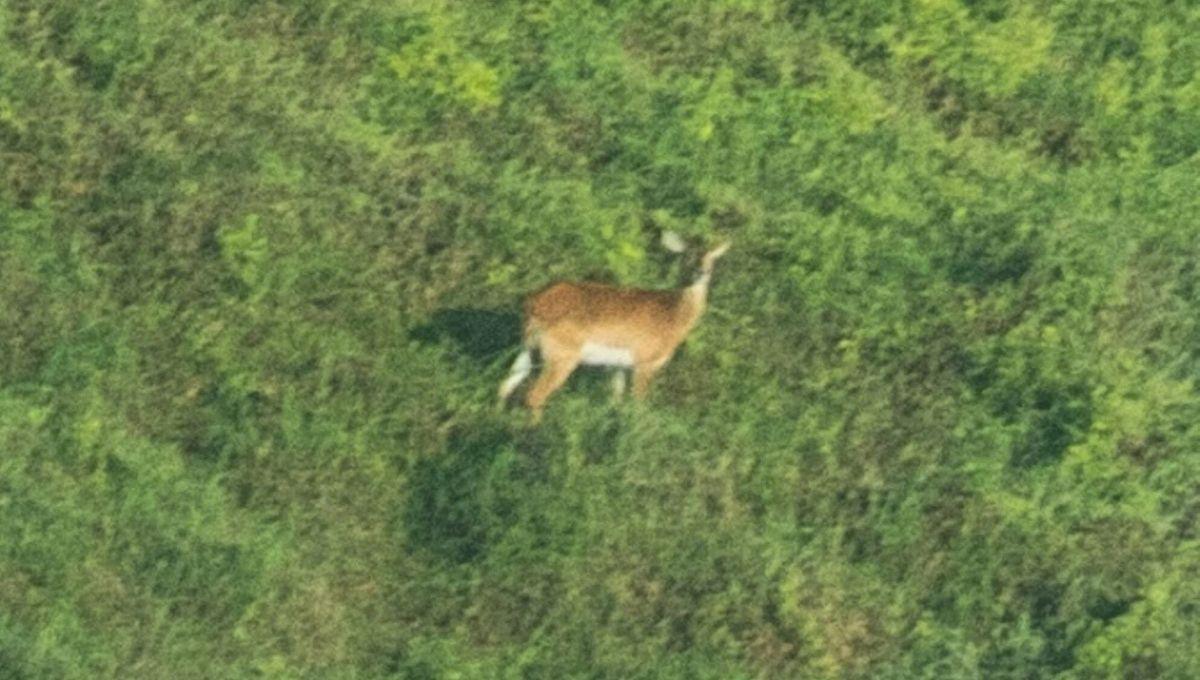
One Of The World’s Rarest Large Mammals Has Just Been Photographed For The First Time
For the first time ever, researchers have published a photograph of a living Upemba lechwe (Kobus anselli), a rarely spotted species of antelope that a new survey suggests is on the brink of extinction.
The photo was captured during an aerial survey of the Kamalondo Depression, a large region of sunken land in the south of the Democratic Republic of the Congo, and the only place on the planet where the Upemba lechwe is thought to live. “It was in the morning of the second day, that a single individual stopped for just a few seconds – long enough for me to press the trigger – before running off like the other individuals we have seen,” lead author Manuel Weber, of Upemba National Park’s Department of Research and Biomonitoring, told the Guardian. What Weber managed to capture is believed to be the first published photographic record of a living member of the species since it was first described back in 2005. Before then, the Upemba lechwe was hiding in plain sight – the museum specimens used to describe it were collected all the way back in the 1920s and 40s. The survey of the species conducted by Weber and colleagues is also the first carried out in over 50 years – and the results don’t bode well for the future. “This is a species on the very brink,” said Weber, in a statement. While the IUCN currently estimates that there are somewhere between 600 to 1,000 mature Upemba lechwe, the survey recorded just 10 individuals. Using that figure, the authors estimate that the number of Upemba lechwe remaining in the area is instead likely fewer than 100. “This species faces imminent extinction,” write the authors. Why? Because of poaching. Back in the early 1970s, aerial surveys suggested that anywhere between 5,000 to 20,000 lechwe could be found in the Kamalondo Depression. However, in the 1980s, measures designed to protect the antelopes in Upemba National Park, which is found within the depression, declined. The authors report that, as a result, lechwe numbers rapidly declined, while poaching for their meat became prolific. To stop the species from being wiped out entirely, Weber and colleagues call for protective measures to be reinstated immediately. “The fact that they’re still hanging on at all is extraordinary, but without urgent protection, they’ll vanish,” said Weber. It’s hoped that this new photo will bring attention to the plight of the species, and spur on rapid conservation action. “We hope this image becomes a rallying cry,” Weber added. “Because this may be our only chance to save this species.” The study is published in the African Journal of Ecology.

 English
 Arabic
 French
 Spanish
 Portuguese
 Deutsch
 Turkish
 Dutch
Dutch
 Italiano
 Russian
 Romaian
 Portuguese (Brazil)