




The animal world is full of complex reproduction and courtship strategies, from those that must fight to secure a mate to those that might not even survive the process. Under the ocean waves, seahorses have developed a pretty interesting technique for making more seahorses that’s entirely their own.
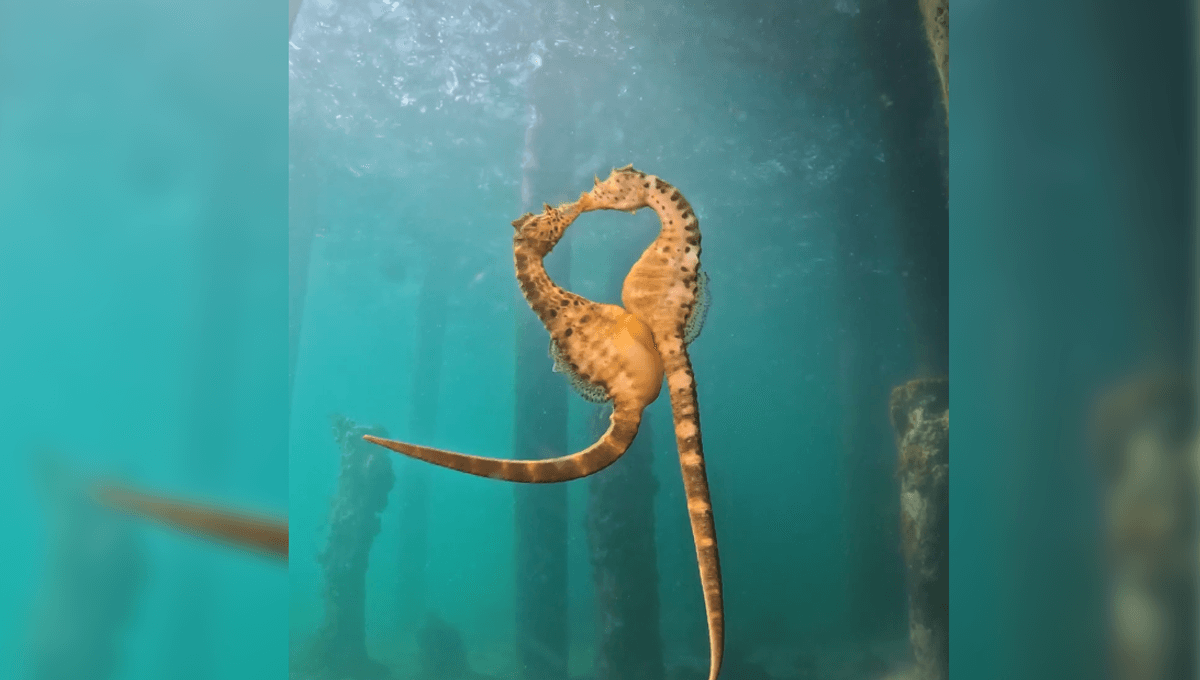
Emily May was diving near Rye Pier in Australia when she came across two big-belly seahorses (Hippocampus abdominalis) joined together, one female and one male. At first, the female appeared to swim away from the male, but the pair quickly re-joined and the female began to pass her eggs to the male – although to the untrained eye, it looks like they could just be having a cheeky smooch. May wrote on Instagram: “The female (on the right) positioned herself on top of the male’s brood pouch and transferred her eggs. This behavior is really unique, as seahorses are the only known animal who have a male pregnancy. It is also super rare to see, so I felt so privileged to witness it.” Big-belly seahorses, also known as pot-bellied seahorses, live in the waters surrounding Australia and New Zealand, where they're the largest seahorses in the region, reaching around 18 centimeters (7 inches) in length. The males have the larger, more extended bellies, from which the species gets its name. They're also strong swimmers and can swim several hundred meters over a single day, powered by a diet of mainly small crustaceans, such as shrimp. Their method of reproduction is known as ovoviviparous, meaning the female will deposit unfertilized eggs into the brood pouch of the male. The male will then fertilize and take care of the eggs within the pouch for around 24 to 30 days. After the eggs have hatched inside the pouch, the young then emerge, looking like miniature versions of their parents. The IUCN suggests that the brood made during this recent encounter could be made up of around 240 to just under 300 individuals, though groups as large as 1,116 have also been reported in captivity.


 English
 Arabic
 French
 Spanish
 Portuguese
 Deutsch
 Turkish
 Dutch
Dutch
 Italiano
 Russian
 Portuguese (Brazil)
 Greek
Greek