


20 Brutal Truths Nietzsche Knew Before the World Was Ready

0
3K

20 Brutal Truths Nietzsche Knew Before the World Was Ready - History Collection

15. The Understanding of Time

20 Brutal Truths Nietzsche Knew Before the World Was Ready
Image Source: Pexels.

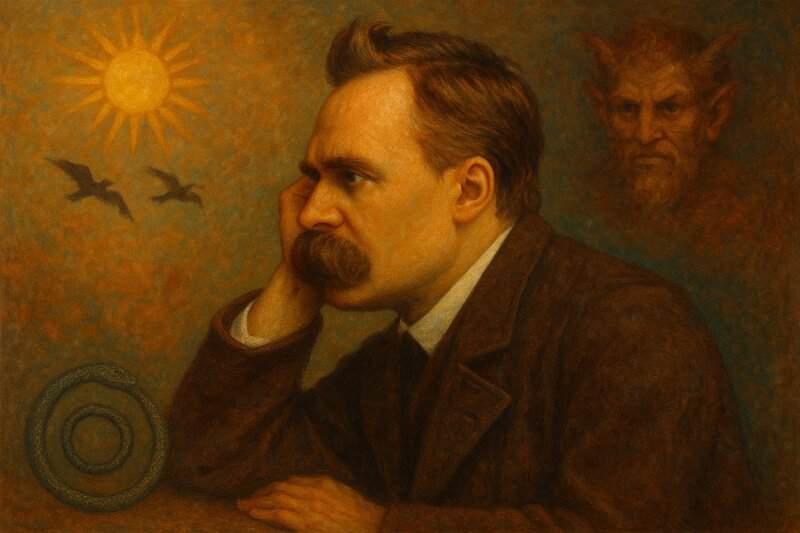
Nietzsche’s perspective on time challenged conventional linear notions, proposing a more cyclical understanding through concepts like eternal recurrence. He viewed time as an endless loop, where moments repeat infinitely, urging a conscious embrace of each experience. Modern philosophical debates continue to explore time’s complexities, delving into theories like time perception and the nature of temporal experience. Nietzsche’s ideas resonate with contemporary discussions about the subjective nature of time, encouraging us to reflect on how our perception of its passage influences our decisions and understanding of life itself.

16. The Nature of Reality

20 Brutal Truths Nietzsche Knew Before the World Was Ready
Image Source: Big Think.

Nietzsche posited that reality is subjective, shaped by individual perceptions and interpretations rather than objective truths. This view aligns with contemporary philosophical discussions on the nature of reality, where perspectives from phenomenology and existentialism highlight the role of consciousness in constructing our world. Scientific explorations, such as those in quantum mechanics, further challenge our understanding of reality, suggesting it is more fluid and dynamic than previously conceived. Nietzsche’s perspective invites us to question the solidity of our perceptions, acknowledging the complex interplay between observer and observed.

17. The Importance of Perspective

20 Brutal Truths Nietzsche Knew Before the World Was Ready
Nietzsche’s haus. Image Source: TripAdvisor.

Nietzsche emphasized that perspective is crucial in understanding truth, suggesting that our views are inherently subjective and multifaceted. He argued that by embracing multiple perspectives, we gain a richer and more nuanced comprehension of reality. Current psychological research, including studies on cognitive biases and perception, supports this notion, revealing how diverse viewpoints can lead to more balanced decision-making. Concepts like perspective-taking highlight the benefits of seeing the world through others’ eyes to enhance empathy and understanding. Nietzsche’s insight encourages openness and adaptability, fostering a more holistic approach to truth and knowledge.

18. The Critique of Language

20 Brutal Truths Nietzsche Knew Before the World Was Ready
Image Source: American Affairs Journal.

Nietzsche critiqued language as an imperfect tool that limits our understanding of reality, arguing that words can never fully capture the richness of experience. He believed that language simplifies complex ideas, creating a barrier to true comprehension. This critique finds resonance in modern linguistic theories, such as those advanced by structuralism and post-structuralism, which explore how language shapes thought and perception. Concepts like the linguistic relativity hypothesis suggest that language influences our cognitive processes, echoing Nietzsche’s concerns about its limiting nature. His insights remind us to remain aware of language’s constraints in our quest for understanding.

19. The Challenge of Self-Knowledge

20 Brutal Truths Nietzsche Knew Before the World Was Ready
Image Source: Pexels.

Nietzsche believed that achieving true self-knowledge is a formidable but essential endeavor. He argued that self-awareness requires honest introspection and the courage to confront uncomfortable truths about oneself. Modern self-exploration practices, such as mindfulness meditation and journaling, aim to facilitate this journey by helping individuals uncover deeper layers of their psyche. These practices highlight the importance of understanding one’s motivations, desires, and fears, aligning with Nietzsche’s call for profound self-discovery. By embracing the challenge of self-knowledge, we can achieve greater clarity and authenticity in our lives.

20. The Call to Creativity

20 Brutal Truths Nietzsche Knew Before the World Was Ready
Image Source: The Crop.

Nietzsche saw creativity as a fundamental human drive, essential for self-expression and cultural evolution. He believed that creativity allows individuals to transcend the ordinary and contribute meaningfully to society. Today, this notion is evident in the flourishing creative industries, where innovation and imagination fuel progress in art, technology, and business. Fields like digital media and design underscore the power of creativity to shape the future and solve complex problems. Nietzsche’s call to creativity inspires us to tap into our innate potential, fostering a dynamic and vibrant existence that continually pushes the boundaries of possibility.

.article-content-img img { width: 100% }

Site içinde arama yapın
Kategoriler
Read More
Oyunlar
Intel's credit rating just got nerfed, as AMD gaming CPU competition bites
Intel's credit rating just got nerfed, as AMD gaming CPU competition bites As an Amazon...
By Test Blogger6 2025-08-06 15:00:13 0 2K
Other
Evaluating the Size and Scale of the Industrial Cyber Security Market
  The Industrial Cyber Security Market size continues to expand as industries digitize and...
By Sssd Ddssa 2025-11-03 03:32:19 0 1K
Technology
This Lenovo tablet is just as good as any iPad and its now $160 off
Get the Lenovo Legion Tab Gen 3 for $160 off SAVE...
By Test Blogger7 2025-11-07 17:00:39 0 796
Oyunlar
League of Legends TCG Riftbound lowers Legends of Runeterra's "really high mental ceiling" so that everyone can play, Riot says
League of Legends TCG Riftbound lowers Legends of Runeterra's "really high mental ceiling" so...
By Test Blogger6 2025-10-30 12:00:18 0 884
Technology
The best Cyber Monday drone deals: Score new lows on DJI drones before a potential ban
Best Cyber Monday drone deals 2025: DJI, Holy Stone, and more top brands...
By Test Blogger7 2025-12-01 12:00:43 0 499