



ALLTHATSINTERESTING.COM
33 Vintage Images Of The First Explorations Into The Arctic
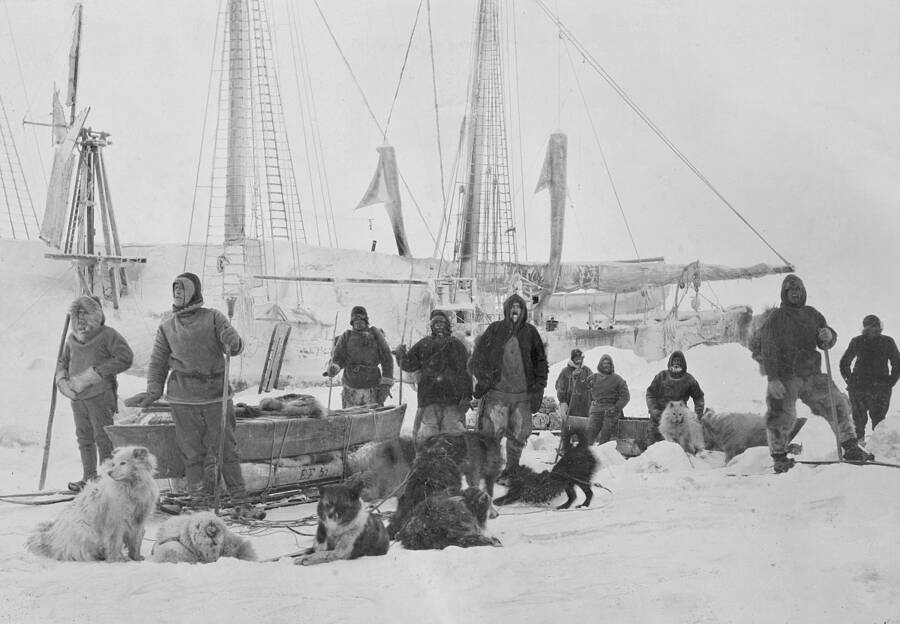
Click here to view slideshowSeeing the North Pole and exploring the surrounding Arctic waters have been the desired goals of many adventurers throughout history.Whether it was to navigate the Northwest Passage, or to simply map out the uncharted landscape, it took a long time for humanity to finally walk on the northernmost point in the world. Many ambitious navigators did not reach their goals, with some expeditions ending in utter tragedy.See some striking photos from early Arctic expeditions in the gallery above, then read on to learn about the history of Arctic exploration.The First Trips To The Arctic CircleWikimedia CommonsNorwegian explorer Fridtjof Nansen and his crew attempting to reach the North Pole in 1895.The history of Arctic expeditions is extensive, especially since various groups of Indigenous people have lived near the region since ancient times, but some believe that the first outsiders to see the far north may have come from ancient Greece. It's been suggested that the merchant Pytheas might have reached the Arctic Circle during a voyage around 330 B.C.E.The unconfirmed report suggests that Pytheas set sail in search of the source of tin. Based on his accounts, he made it past the British Isles. Pytheas eventually reached a landmass that he called Thule, which some believe was Norway. However, others speculate that Thule was Iceland. Sailing beyond Thule, he described a sea "where neither earth, water, nor air exist separately, but a sort of concretion of all these, resembling a sea-lung."But it's unclear whether Pytheas actually made it to the Arctic. Later geographers, like Strabo, believed the explorer fabricated much of his journey. It wasn't until the Vikings entered the picture that the record of early Arctic exploration continued in earnest. Norsemen settled in Iceland, which sits just below the Arctic Circle, around 874 C.E. The Vikings continued their Arctic explorations when Gunnbjrn Ulfsson got blown off course on his way to Iceland in the 10th century. He's credited as being the first European to encounter the Greenland coast. Erik the Red established a settlement in Greenland around 985, and the Vikings stayed there for about 400 years. By the 15th century, the Vikings had left Greenland (for unknown reasons), but other explorers were still continuing to sail north. The Pomors people in particular became known for their journeys to the Arctic region, which eventually included Svalbard.Arctic Expeditions During The Age Of DiscoveryWikimedia CommonsMatthew Henson, a Black American explorer who said he reached the North Pole in 1909.After European settlers arrived in the Americas, more explorers headed out to traverse the landscape of the "New World." Settlement in the Americas also led to the establishment of new trade routes across the seas. Leaders across Europe also wanted to find a passage between the Atlantic and Pacific Oceans along the Arctic Ocean, hoping to ease voyages to Asia. So, a centuries-long mission to complete the Northwest Passage began. It seemingly started with the Italian explorer John Cabot. He set out to discover the passage in 1497 and failed (though he did reach the coast of Newfoundland). In 1553, English explorer Hugh Willoughby made it to Kola Peninsula, on the brink of the Arctic, while seeking the Northeast Passage.Beginning in 1576, English navigator Martin Frobisher took three trips in search of the Northwest Passage. He did not succeed. So England continued to send out navigators in a fervent effort to traverse the passage.In the 1580s, the English navigator John Davis also set out for the Northwest Passage. While he was also unable to locate it, he did chart out significant new territory in the North American Arctic region.The next notable attempt wouldn't come until 1610, when Henry Hudson tried establishing the route. His efforts famously failed, but he did find what's now known as Hudson Bay. Unfortunately for Hudson, his crew mutinied against him and abandoned him, leaving him adrift in a small boat.By the 1700s, Russia was sending out many voyages to explore the Bering Strait, which separates Asia and North America at their closest point. (Semyon Dezhnyov was the first European to sail through the strait in 1648.) Throughout the 18th century, explorers inched closer to breaching the Arctic's northernmost waters, but real progress wouldn't come until later. The Flurry Of Arctic Expeditions In The 1800sWikimedia CommonsA posed photo of Fridtjof Nansen and Frederick Jackson meeting in Cape Flora in 1896.English explorer William Scoresby kicked off the 19th century's Arctic craze when he became the new record holder for reaching the northernmost point yet on Earth in 1806. Expeditions in the first half of the century included many more attempts to successfully navigate the Northwest Passage.But in 1827, British Admiral William Edward Parry and his crew put together the first formal expedition to reach the North Pole. While they ultimately failed, they did set a new northernmost record of 8245 N. Another leap of progress was made on June 1, 1831. British naval officer James Clark Ross identified the location of the North Magnetic Pole while on an expedition on the Victory to find the Northwest Passage. As the century went on, more and more expeditions were organized with the explicit goal of exploring the northernmost places in the Arctic. Sadly, some of these expeditions ended in tragedy and horror, like the doomed Franklin expedition, which began in 1845 and eventually saw all 129 men on the British ships HMS Terror and HMS Erebus perish while searching for the Northwest Passage. (Over a century later, some of the crew members' icy corpses would be discovered on a remote Canadian island.)Wikimedia CommonsA depiction of the HMS Terror, part of the doomed Franklin expedition. In 1876, another British-run expedition once again broke the record for reaching the northernmost point yet. Around this time, the United States also joined the fray. In 1879, the U.S. sent out the USS Jeannette on an expedition to reach the North Pole via the Bering Strait. But by 1881, the ship was stuck in the ice. It was eventually crushed, and most of the crew died. In 1893, a Norwegian expedition began with the goal of reaching the North Pole. The head of the mission, Fridtjof Nansen, tried a unique method. He purposely got his vessel, the Fram, stuck in the Arctic Ocean sea ice in an attempt to drift to the North Pole. In the end, this method didn't work. Then, in 1897, Swedish explorers Salomon August Andre, Nils Strindberg, and Knut Frnkel tried to fly a hydrogen balloon from Svalbard to the North Pole. But the balloon crashed near Kvitya, and all three crew members later died. Who Was The First To Reach The North Pole?Wikimedia CommonsNorwegian adventurer Roald Amundsen was the first man to successfully navigate the Northwest Passage, and some think he was also the first to see the North Pole during another Arctic expedition.At the beginning of the 20th century, people started getting closer to the North Pole, but they still had trouble reaching it. Meanwhile, Norwegian explorer Roald Amundsen became the first person to successfully complete the Northwest Passage during a voyage that lasted from 1903 to 1906. (He also later became the second to traverse the Northeast Passage.)With the Northwest Passage finally conquered, many Arctic explorers set their sights firmly on the North Pole. By 1909, two competing American explorers, Frederick Cook and Robert Peary, were both claiming that they were the first to reach the top of the world.Given that Cook eventually garnered an infamous reputation as a fraudster and was actually convicted of mail fraud in connection with his oil business many doubt that his claim was true. Peary's claim has been far more historically accepted, but his account hasn't escaped skepticism.Wikimedia CommonsRobert Peary is sometimes credited with reaching the North Pole first.Some think that Peary got close to the North Pole, but didn't quite reach it. Others think he did reach it, but another member of his crew, the Black American explorer Matthew Henson, was the one who actually set foot there first. Henson himself was quoted as saying, "I think I'm the first man to sit on top of the world." It's also worth noting that Peary and Henson were accompanied by Inuit guides who could've hypothetically gotten there first.What experts are fairly confident about is that Roald Amundsen was part of the first crew to fly over the North Pole in 1926, meaning that he could've been the first to lay eyes on it, if Peary's crew had fallen short of their goal. Then, in 1948, a group of Soviet scientists led by Aleksandr Kuznetsov became the first undisputed crew to actually set foot on the North Pole.Today, curious explorers still traverse the treacherous Arctic conditions to see the North Pole. The journey remains challenging, but icebreaker ships make the voyage a little easier for modern adventurers.After reading about the history of Arctic expeditions, discover 33 vintage photos of Antarctica's frozen hellscape. Then, learn about the mysterious death of Arctic explorer Charles Francis Hall.The post 33 Vintage Images Of The First Explorations Into The Arctic appeared first on All That's Interesting.
0 Комментарии
0 Поделились
0 Просмотры








 English
 Arabic
 French
 Spanish
 Portuguese
 Deutsch
 Turkish
 Dutch
Dutch
 Italiano
 Romaian
 Portuguese (Brazil)
 Greek
Greek