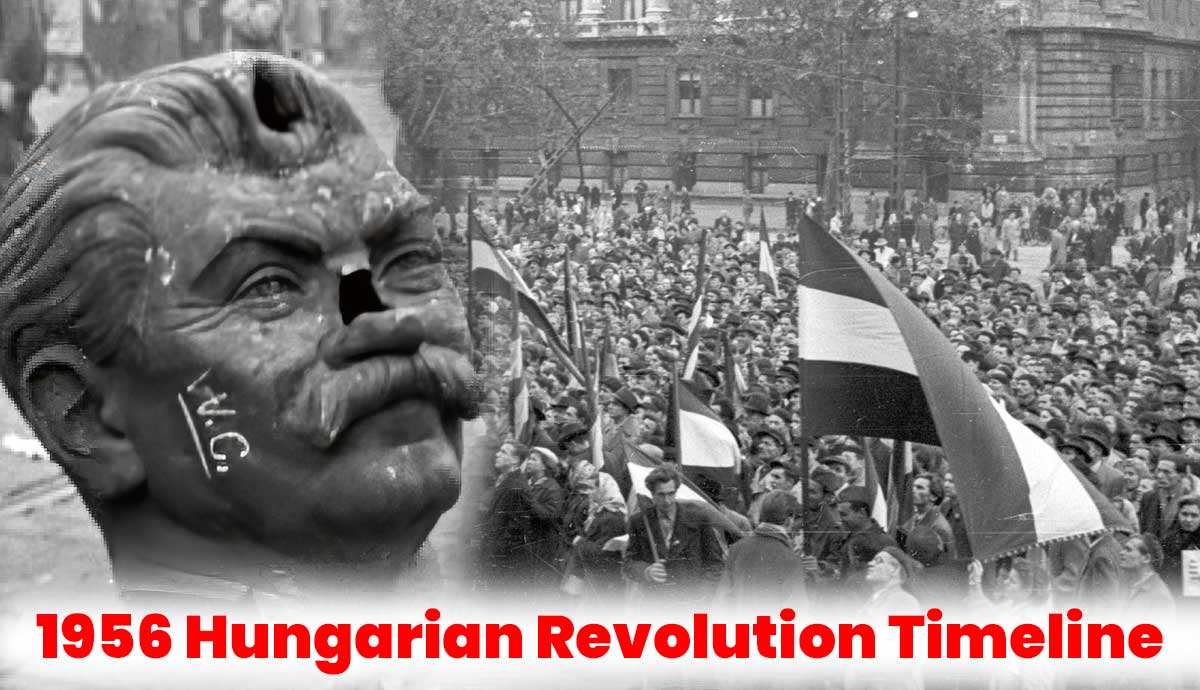
The 12 Days of the 1956 Hungarian Revolution: A Timeline
Student protesters in Budapest led 200,000 people in a demonstration on October 23, 1956. They were protesting the communist regime and demanding changes. They felt hopeful and patriotic. However, the police got nervous because hastily planned and spontaneous protests can threaten the governments power, especially when the movement is popular. The revolution began after the secret police shot and killed several unarmed protesters. University and high school students teamed up with the industrial workers of Budapest, the Hungarian military, and even the Police Chief to fight for their freedom. Read on for a play-by-play of the 1956 Hungarian Revolution timeline.1. October 23, 1956Hungarian Parliament in Budapest, 2016. Source: Wikimedia Commons/Flickr/Jorge FranganilloOn October 23, 1956, roughly 20,000 university students began protesting in the streets of Budapest in the late afternoon. They had only planned the demonstration the night before in a lecture hall of the Technical University of Budapest, but it gained momentum quickly. Protesters told people on the streets: If youre a Hungarian, join us! and chanted patriotic and anti-Soviet slogans, enticing people to join.The Soviets opted to reappoint Imre Nagy as prime minister, which was one of the students wishes, so that they could avoid further violence. But they sent in Soviet troops anyway to stop the revolution.The series of events leading to the 1956 Hungarian Revolution included students being tricked, civil disorder, property destruction, a few speeches, students being detained, and the secret police killing several unarmed protesters.After the shooting, protesters began rioting, and the Hungarian military was sent in to end the violence. But when they arrived and saw dead students on the ground, they threw their hats on the ground and joined the revolution. Military commanders like Colonel Lszl Zolomy, Lieutenant-Colonel Janos Solymosi, and Budapests Police Chief, Sndor Kopcsi, helped supply the necessary weapons to the revolutionaries. They even had a handful of tanks and acquired more during the warfare.More than 26,000 civilians and 2,000 military fought with the resistance, including most of the 15,000 industrial employees of Budapest. The factory workers also opened an undercover arms factory and distributed at least 1,000 rifles to the fighters.2. October 24Stalins statue toppled, 1956. Source: Wikimedia Commons; with Freedom fighters on a tank on Pozsonyi Street, Budapest, 1956. Source: Wikimedia Commons/Fortepan/Pesti SrcOn October 24, the Hungarian radio began repeating a recorded message condemning the revolutionaries, calling them fascist, reactionary, counter-revolutionary, and troublemakers. That did little to sway the public away from the uprising, as anti-Soviet sentiment had been brewing for a decade leading up to the revolution.Most freedom fighters were in their late teens or early twenties, but there were a handful of older revolutionaries and even a few children as young as eleven or twelve. Although most of the warfare occurred in Budapest, large protests and riots took place in Debrecen, Miskolc, Cegld, Lovas, Balinka, Szombathely, Gyr, and several smaller cities and villages. Hungarians also went on a general strike, which spread throughout the country and lasted for months.On the morning of October 24, the revolutionaries won the first battle at the Budapest Radio building, which boosted morale. Several groups formed, creating strongholds for themselves around the city, where they barricaded themselves in and formulated plans.The Soviets were sent in to crush the revolution but were not prepared for the guerrilla warfare they would face. Freedom fighters gathered firearms from dead bodies (both Hungarian and Soviet), threw Molotov cocktails, and disabled tanks. They also had the advantage of knowing their city better than the Soviet invaders.An aerial view of the Corvin Cinema, 2015. Source: Wikimedia Commons; with a Flag with a hole in front of Corvin Cinema, October 1956. Source: Wikimedia Commons/The American Hungarian FederationThere were four major bases where the fighters convened: Szna Square, Bross Square, Tompa Street, Corvin Cinema, and the adjoining Corvin Passage. The Cinema (pictured above) was in an impeccable location, as it was on a loop and therefore could be easily blockaded. The Corvin Group acquired a dozen tanks and surrounded the entrance and exit to their stronghold. They had unlimited access to a fuel pump and to secret passageways below the cinema which connected to other streets throughout the city. Those tunnels allowed them to sneak around the city, pop out to attack a Soviet tank, and disappear quickly.On top of that, the Kilin Barracks was located across the street. The four-story and 30,000 square meter building became another stronghold for the fighters. Roughly 900 military conscripts were housed there. They allowed the freedom fighters in and supplied them with a small stock of weapons. That worried the Soviets and Colonel Pl Malter was sent in to take control. However, he joined the revolution as well because it became clear to him that those fighting for their freedom were not bandits, but loyal sons of Hungary (Sebestyen).3. October 25: The Bloody ThursdayA protest in Kossuth Lajos square, the site of the Bloody Thursday massacre, Budapest, 1956. Source: Wikimedia Commons/Fortepan/Nagy GyulaBy the morning of October 25, the Soviets had sent in a small army of at least 34,000 troops with 1,350 tanks. However, they had not begun fighting with their boots on the ground and they could not navigate the small streets and tight corners in Budapest. As a result, the freedom fighters were in the lead.Several thousands unarmed and peaceful protesters rallied outside of the Ministry of Agriculture and the Parliament, and up to 1,000 of them were killed. The secret police, or AVH, were purposefully stationed on the roofs with sharpshooters and machine guns, and they were likely the first to shoot. Then, the tanks began firing from at least two points on the ground. Since the protesters were packed in and surrounded, they tried getting into the Ministry of Agriculture for shelter but found that the police were firing from within the building as well.Budapest, 2019. Source: Wikimedia Commons/Jacob HaunWitnesses later testified that they fired on the crowd for half an hour, killing between 800 and 1,000 people and wounding hundreds more. The survivors fled, but some hid and watched as the Soviets and the Hungarian military worked together to dispose of the bodies. The bodies were driven over by tanks and bulldozed, then stacked in trucks and driven away to the cemetery, where they were buried in a mass grave.Published estimates of the number of people killed on Bloody Thursday range from 20 to 1,000, but the best estimate is between 800 and 1,000. The mass shooting was ordered by Ivan Serov, the head of the Russian KGB. The Soviets tried to hide rather than publicize the truth about their actions. Even the Hungarian government would not speak about the massacre for decades even as they walked by the bullet holes in the walls of the Ministry of Agriculture.After the massacre, many survivors went to the nearest group of fighters and armed themselves with weapons. The resistance went on the offense.4. October 27 and 28A poster of Imre Nagy, Krzysztof Ducki, 1989. Source: Museum of Fine Arts/Hungarian National Gallery, BudapestBy October 27, over 325 Hungarian civilians had died in the fighting, excluding the massacre of 800-1,000 people. Citizens pitched in where they could; they brought food, carried messages, tended to the wounded, and welcomed the fighters into their homes for a rest or a tactical position.Imre Nagy met with Soviet emissaries. They resolved to dissolve the AVH but keep Soviet troops in Hungary. They also offered the freedom fighters amnesty to end the revolution.On the morning of October 28, over 50 Russian tanks moved into place with the goal of destroying the revolutionaries bases. Nagy was against this, as it would have destroyed civilian homes. He threatened to resign, which may have caused more violence. A ceasefire agreement was eventually reached.5. October 29The fighting died down during the ceasefire, and people started going back to their normal lives. Kopcsi, the Police Chief, wanted Bla Kirly to be the new commander of the National Guard they were creating. Kirly was a former Major-General and had just been released from a prison sentence after being falsely convicted of being a spy, a commonality in the Soviet Union and its satellite states. He was in the hospital recovering from surgery when the revolution began, but he snuck out to join the revolutionary army.An important moment was when freedom fighters discovered hoards of files the secret police had on citizensthey destroyed a lot of files, but they could not get them all. People found files on themselves, their families, and friends, learning the identities of the informants.6. October 30: The Republic Square MassacreProtesters with the body of AVH personnel, Budapest, 1956. Source: Wikimedia CommonsPeople noticed that the Communist Party headquarters was receiving a special delivery of meat, so the fighters marched to the building and demanded to know why the communists were still getting favoritism. Food insecurity was a huge grievance for Hungarians, as the communists had always received more abundant and quality food. Inside, they recognized AVH officers, and a fight broke out. The secret police had been disbanded, per the ceasefire deal, but the fact that they were still receiving special treatment enraged the revolutionaries.A shootout ensued between the freedom fighters and the AVH. The unarmed personnel in the building called for help, and the military sent in five tanks to defend the communists headquarters. Two got lost, and when the other three arrived they saw one of the revolutionaries tanks already firing upon the building. The three tanks assumed they were supposed to be firing at the building, so they began shooting, too. Nearly every window had been shattered and holes showed straight through to the other side before they realized the blunder.Meanwhile, the freedom fighters had been holding hostages inside the building during the battle, but one man escaped and was shot outside as he surrendered. The siege lasted three hours and twenty-three secret police, and several civilians were killed; some were executed and others beaten to death. Hungarians hated the AVH, who had waged psychological and physical warfare on the country for over a decade.The Soviets decided not to maintain the ceasefire. Instead, they created a plan to invade again. Soviet tanks had just begun leaving Budapest, but soon they returned in a larger number. Troops were mobilized along the borders as well.7. October 31Teenaged Freedom Fighters, Budapest, by Jack Metzger, 1956. Source: Wikimedia Commons/ETH-Bibliothek Bildarchiv, ZurichSoviet statesman Anastas Mikoyan had spent a week in Hungary assessing the situation and reporting back to the Kremlin. As he and his partner left on October 31, Nagy asked why Soviet tanks were seen moving back into place. Mikoyan lied, saying it was not an invasion and there was nothing to worry about. Once in Moscow again, Mikoyan tried in vain to change the Soviets decision to invade.It was the calm before the storm as Hungarians celebrated that night with parties and dancing in the streets amidst the rubble. They believed they had won the revolution and the Soviets would no longer oppress them.8. November 1On November 1, Nagy announced that Hungary was leaving the Warsaw Pact, which was a long-term goal of the revolution. By withdrawing, the Hungarians would be able to receive international help in the event of a Soviet invasion. The Soviets were momentarily hesitant to continue with the invasion in light of Hungarys self-proclaimed neutrality.Nikita Khrushchev flew to other Eastern Bloc countries and met with communist leaders to discuss the situation. For the most part, they pushed him to invade and crush the Hungarian resistance to prevent other countries from getting the notion to rebel. The Soviets believed they could invade without intervention from the West because the UN and US were preoccupied with the Suez Canal Crisis.9. November 2The Soviets decided to appoint Jnos Kdr as the Hungarian Prime Minister to replace Nagy because Kdr proved he was loyal to them. He had recorded a hopeful message that played on the radio the night before, claiming that the freedom fighters had achieved success. Then he fled, headed for Moscow.10. November 3Hungarian Revolution Memorial, Budapest, 2020. Source: Wikimedia CommonsAt the Kremlin, Kdr was being prepared to establish a new government in Hungaryeverything would still be controlled by the Soviets, even the speech he was meant to give to his people.In Budapest, the Soviets and Hungarians negotiated all day but to little avail. Kirly smelled the deception, but Malter and Nagy could not. Malter, the Hungarian military leader, was invited to a late-night meeting with the Soviets in the industrial district. Several people, including his wife, warned him that it could be a trap, but he went anyway, and was arrested, along with several other attendees.11. November 4Corpses in front of Jzsef and Pl streets, Budapest, 1956. Source: Wikimedia Commons/Fortepan/Nagy GyulaOn November 4, 2,500 tanks and 150,000 troops surrounded Budapest to restore the peace. Up to 60,000 more troops were on standby, and 20,000 more guarded the Hungary-Austria border to prevent military aid from entering. International help never came to Hungary, and the troops were not concerned with thousands of refugees fleeing across the border for the first few weeks.The assault began at 4 in the morning. Hungarian troops were severely outnumbered, and most of the freedom fighters had already abandoned the fight on October 28, when the ceasefire was called. Small pockets of fighters kept battling the Soviets for nearly one week.The Soviets razed entire streets searching for a few rebels in hiding. Buildings were demolished, civilians were caught in the crossfire, and fighters were executed when caught. Moscow announced that they had succeeded in stomping out the resistance, and the AVH came out of hiding to arrest, shoot, and even hang the freedom fighters they caught.12. November 4 11Freedom Is Not Free: Hungarian Revolution Memorial, 2017. Source: Wikimedia CommonsBetween November 4 and 11, a few thousand freedom fighters fought the vast Soviet army with minimal supplies, no leadership, and no communication. They resisted as long as possible, knowing it was a losing battle. They created new tactics to trap and fool Soviet tanks, and young kids sacrificed themselves to distract the Soviets. They managed to take down several tanks, kill a few hundred troops, and wound more than 1,000 soldiers.The Soviets executed fighters, including the children, and killed civilians, Red Cross workers, and targeted ambulances.On Csepel island, the industrial district of Budapest, the resistance held out until November 11. The 15,000 industrial employees should have been the backbone of the communist regime, the district was even called Red Csepel, but they turned on the Soviets. They did not surrender, because that meant death, but they swam across the river and escaped.Official reports say that between 2,000 and 3,000 Hungarians died, with up to 20,000 more wounded and only 700 Soviet fatalities. However, survivors of the revolution later testified that more than 30,000 Hungarians were wounded or killed and up to 8,000 Soviets died. They believed that between 160 and 480 Russian tanks were destroyed, as well. Up to 50,000 people were arrested or imprisoned for participating in the revolution.References List:Sebestyen, Victor. (2006). Twelve Days: The Story of the 1956 Hungarian Revolution. Pantheon Books.








 English
 Arabic
 French
 Spanish
 Portuguese
 Deutsch
 Turkish
 Dutch
Dutch
 Italiano
 Russian
 Romaian
 Portuguese (Brazil)