


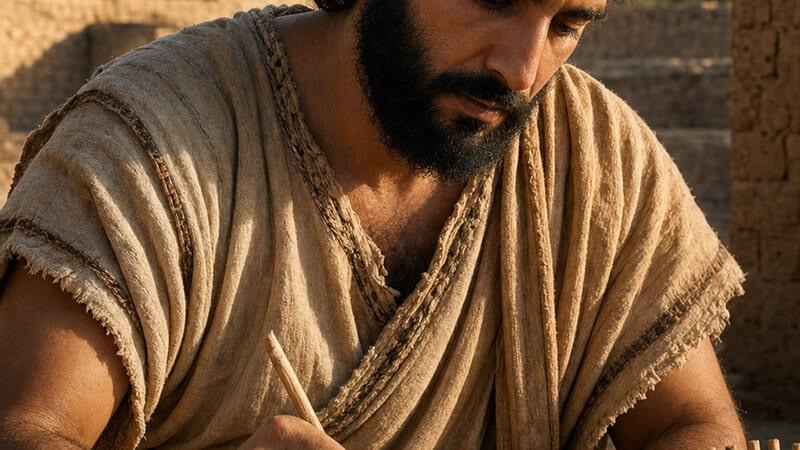

Somewhere beside the Euphrates, around 2700 BCE, a scribe pressed a sharpened reed into a palm-sized slab of wet clay and began recording a story about a catastrophic flood — a story so old it makes the Book of Genesis look like recent news. He had no idea his words would outlast every king, every empire, and every city his civilization would ever build. He was just doing his job. And most of us still cannot say the name of his world correctly.
How to Pronounce “Mesopotamia” — and Why It Matters
Most English speakers drift toward something like “mess-oh-poh-TAY-mee-uh,” blurring the opening syllables into a soft muddle. The standard English pronunciation is /ˌmes.ə.pəˈteɪ.mi.ə/ — six distinct syllables: mes · uh · puh · TAY · mee · uh, with primary stress falling hard on the fourth syllable, TAY. A secondary stress sits lightly on the first syllable, mes, giving the word a rolling, two-peak rhythm rather than a flat drawl.
Breaking it down further helps. The first syllable, mes, rhymes with “less.” The second, uh, is a barely voiced schwa — the same neutral vowel sound in the first syllable of “about.” The third, puh, is equally light and unstressed. Then the word opens up into TAY, held with full weight, before settling into the gentle close of mee · uh. The whole thing scans almost like a slow drumbeat: quiet, quiet, quiet, LOUD, quiet, quiet.
You can hear this modeled by native speakers at the Cambridge Dictionary’s Mesopotamia pronunciation guide, which provides both British and American English audio. For a sense of how the word sounds in natural, unrehearsed speech — lectures, documentaries, interviews — YouGlish offers hundreds of recorded examples of Mesopotamia pronounced in real English contexts. Listening to both is worthwhile: the Cambridge recordings give you a clean target; YouGlish shows you how that target shifts in practice.
One common stumble is over-stressing the second syllable — saying “mess-OH-puh-TAY-mee-uh” rather than keeping it as a true schwa. Another is clipping the ending to “mess-uh-puh-TAY-mya,” collapsing the final two syllables into one. Both errors are understandable; English regularly swallows unstressed syllables. But the full six-syllable form is worth the small effort. If we can’t say the name right, it’s worth asking what else about this civilization we’ve been getting wrong — or simply missing altogether. It turns out the answer is quite a lot.
What Is Mesopotamia? Geography, Definition, and Deep Time

The word itself is ancient Greek: meso, meaning middle, and potamos, meaning river. “Land between the rivers.” The rivers in question are the Tigris and the Euphrates, which rise in the mountains of modern Turkey and flow southeast through what is now mostly Iraq, emptying into the Persian Gulf. The flat, ferociously hot corridor they define — subject to unpredictable seasonal flooding — is one of the most consequential strips of land in human history.
Settled farming communities appeared here around 6000 BCE. By roughly 4000 to 3500 BCE, something unprecedented was happening: genuine cities. Uruk, Eridu, Nippur — these were not large villages but complex urban centers with monumental architecture, specialized labor, long-distance trade networks, and populations numbering in the tens of thousands. No civilization on record urbanized earlier. The history of Mesopotamia, properly understood, begins here, at the very root of the urban experiment.
What makes the achievement remarkable is what the region lacked. The Mesopotamian floodplain had almost no stone, no timber, and no significant metal deposits. The people who built the ancient world’s most sophisticated civilization were working, almost literally, with mud. They fired bricks from river clay, reinforced walls with bundled reeds, and engineered irrigation canals to push the river’s fertility outward across the surrounding desert. Ingenuity was not optional — it was the only resource they possessed in abundance.
The peoples who inhabited this land shifted across four thousand years of recorded history. The Sumerians came first, establishing the foundational culture. The Akkadians followed, consolidating the ancient world’s first recognized empire under Sargon of Akkad around 2334 BCE. The Babylonians and Assyrians came after, each inheriting and extending what they found, arguing over it, conquering it, and writing it all down.
The Invention Factory: Writing, Wheels, Beer, and the Architecture of Time

When people list Mesopotamia’s inventions, they often lead with the wheel, and fairly so. The wheel appears in the archaeological record around 3500 BCE, first as a potter’s wheel — a horizontal spinning disk for shaping clay — before someone made the conceptual leap of turning it vertical and attaching it to a cart. That reorientation permanently changed the physics of human transport. But the wheel, impressive as it is, may not be the most consequential thing Mesopotamia gave the world.
Writing is. Cuneiform script — from the Latin for “wedge-shaped” — emerged around 3200 BCE in Uruk. Its original purpose was almost brutally mundane: tracking grain deliveries and livestock counts. Bureaucracy, not poetry, invented the written word. A temple administrator needed a reliable way to record who had delivered how much barley, and the solution was a reed stylus pressed into clay at angles that produced distinctive wedge-shaped marks. From that accounting system, over centuries, grew literature, law, mathematics, and history itself.
Then there is beer. A Sumerian poem dating to roughly 1800 BCE, known as the Hymn to Ninkasi — Ninkasi being the goddess of brewing — is effectively the oldest surviving beer recipe, describing in careful detail the fermentation of barley into a thick, richly flavored drink. Workers on the great ziggurat building projects were partly paid in daily beer rations. The ancient Mesopotamian economy ran, in part, on fermented grain.
The list of Mesopotamian contributions that should reframe how you understand the ancient world goes further still. The division of an hour into sixty minutes and a circle into 360 degrees comes directly from Sumerian and Babylonian mathematics, which operated on a base-60 numerical system. The earliest known maps, the lunar calendar, and sophisticated irrigation engineering that fed millions across an otherwise hostile landscape — all of it traces back to this river valley. Every time you glance at a clock, you are reading Mesopotamian mathematics.
The Code of Hammurabi: Justice Carved in Stone

Around 1754 BCE, the Babylonian king Hammurabi commissioned one of the most remarkable objects in human history: a column of polished black diorite, roughly seven and a half feet tall, inscribed with 282 laws governing virtually every aspect of Babylonian life. This is the Code of Hammurabi, the most complete ancient legal code ever discovered, and it is considerably more sophisticated than its reputation for “an eye for an eye” suggests.
The specific laws are vivid and sometimes startling. If a builder constructs a house that collapses and kills the owner, the builder is to be executed. The logic is severe, but it is logic — codified accountability in place of arbitrary revenge. Elsewhere the code sets minimum wage standards for hired workers, establishes protections for widows and orphans, regulates interest rates on loans, and requires that accusations be supported by evidence before punishment is imposed. The requirement of proof before penalty — something close to a presumption of innocence — is there, embedded in stone, nearly four millennia ago.
The stele itself has a remarkable afterlife. It was carried off as war spoils to the city of Susa, in what is now Iran, sometime around the twelfth century BCE, where it remained for approximately three thousand years before French archaeologists excavated it in 1901. It now stands in the Louvre in Paris — a Mesopotamian artifact that required a colonial expedition and an Atlantic crossing to become widely known in the Western world.
The Flood Myth Older Than Noah: Gilgamesh and the First Literature

The Epic of Gilgamesh is the oldest surviving work of literature on Earth. Composed in some form around 2100 BCE and recorded in its fullest version around 1200 BCE across twelve clay tablets, it tells the story of a king of Uruk — believed to be based on a historical ruler who lived around 2700 BCE — who sets out with his companion Enkidu to achieve glory and ultimately immortality, loses his friend to death, and confronts the reality that he cannot escape the same fate.
Embedded within the epic is a flood narrative that will feel immediately familiar to anyone raised on the Hebrew Bible. A god warns a man named Utnapishtim that a catastrophic deluge is coming. He is instructed to build a boat, seal it with pitch, and load it with every species of living creature. He survives the flood, releases a dove to test whether the waters have receded, and is ultimately granted immortality by the gods. The structural and thematic parallels to the story of Noah are not coincidental — biblical scholars broadly agree that the Hebrew flood narrative shares roots with the Mesopotamian tradition, which predates the biblical text by at least several centuries.
But the flood story is almost a subplot. What makes Gilgamesh endure is its emotional honesty. When Enkidu dies, Gilgamesh’s grief is raw and physical — he sits with the body for days, refuses to accept what has happened, and rages against mortality in a way that feels entirely recognizable to anyone who has lost someone they loved. This was written four thousand years ago. The terror of death and the consolation of friendship were already the great subjects of human storytelling, pressed into clay beside a river that still flows today.
Ancient Civilization Facts That Complicate Simple Narratives

Mesopotamia had formal schools. The edubba, or “tablet house,” trained professional scribes from childhood, and surviving clay tablets include students’ practice work — some showing the same cuneiform sign repeated hundreds of times, the impressions growing increasingly sloppy toward the bottom of the tablet, in a pattern immediately recognizable to any teacher who has ever assigned a repetitive exercise.
Babylonian physicians compiled a diagnostic handbook around 1050 BCE listing hundreds of medical conditions, describing symptoms and recommended treatments with an observational rigor that stands alongside — but is distinct from — the magical remedies the same texts also prescribe. The mixture of empirical observation and supernatural explanation looks strange to modern eyes, but the empirical observation is genuinely present: systematic, written down, and centuries earlier than what ancient Greece is typically credited with originating.
Women in early Sumerian society could own property, operate businesses, and testify in legal proceedings — rights that would erode under later Babylonian law but that complicate any uniform story about ancient gender roles. The ancient world was not a monolithic patriarchy; it was, like every civilization since, a set of contradictions in slow and uneven negotiation with themselves.
And Mesopotamia did not end with a dramatic collapse. There was no single burning city, no clean terminus. The Persians absorbed the region in 539 BCE, the Greeks came after them, then the Parthians. The last known cuneiform tablet was inscribed in 75 CE — when the Roman Empire was already well established, the Colosseum under construction, and Christianity in its earliest decades. The oldest writing system in the world survived into the era we call modern history.
Why Saying the Name Correctly Is Worth the Effort
Getting mes-uh-puh-TAY-mee-uh right is a small act, but small acts accumulate into habits of attention. This is the civilization that gave us the framework of modern life — law courts and contracts, clocks and calendars, cities and schools, and stories about floods and friendship and the grief of losing someone you love. Every legal document you sign carries, in its underlying logic, the structure of Hammurabi’s stele. Every hour you schedule carries Sumerian mathematics. Every flood story you have ever heard answers, somewhere upstream, back to a scribe beside the Euphrates.
That scribe’s tablet survived not because anyone preserved it carefully or built a controlled archive around it, but because clay fired by time becomes nearly indestructible. Parchment rots. Digital files corrupt. But a Mesopotamian bureaucrat’s inventory of grain deliveries, pressed into river mud and left to dry, can outlast four and a half millennia without difficulty. The oldest civilization in the recorded world did not simply give us history. It gave us the tools to record history — writing, mathematics, the discipline of putting things down so they endure. In a very real sense, it gave us the means to know ourselves at all. The least we can do is learn to say its name.

 Arabic
 French
 Spanish
 Portuguese
 Deutsch
 Turkish
 Dutch
Dutch
 Italiano
 Russian
 Romaian
 Portuguese (Brazil)
 Greek
Greek