


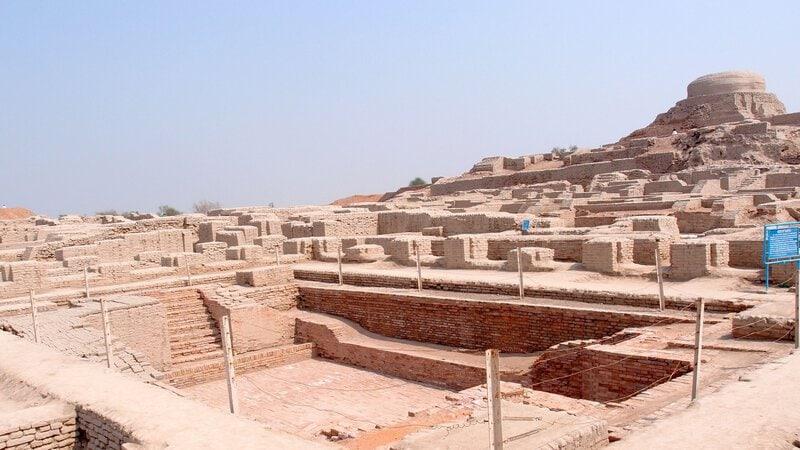

Imagine walking through a city of 40,000 people where every house has a toilet, every street runs above a covered sewer, and the whole grid was laid out by engineers who had never heard of Rome, Greece, or the Persian Empire. This was everyday life in the Indus Valley Civilisation—and the more archaeologists dig, the more remarkable it becomes.
Stretching across roughly 1.5 million square kilometres of what is now Pakistan, India, and Afghanistan, the Harappan civilisation flourished between approximately 2600 and 1900 BCE at its urban peak, yet its roots run back to at least 7000 BCE. It raised cities that rivalled anything in the ancient world, traded across open ocean, and then quietly faded—leaving a script no one can read, cities no ruler has been found to have governed, and questions that archaeologists are still working to answer. What follows is a close look at ten of the most striking and consequasive things that evidence has so far revealed.
1. Mohenjo-Daro’s Flush Toilets and Covered Sewers—Built Around 2500 BCE

Long before the Victorian engineer Joseph Bazalgette drew his blueprints for London’s sewer network in the 1860s, residents of Mohenjo-Daro were already using brick-lined toilet chutes that carried waste into covered street drains running beneath the city’s main thoroughfares. This was not a crude pit or an open ditch—it was engineered infrastructure, with removable brick inspection covers at regular intervals so workers could climb in, clear blockages, and maintain the channels below.
Tens of thousands of residents used this network simultaneously. Every excavated house in the city’s residential quarters connects to the same underground grid, which means the system required city-wide planning from the outset, not incremental improvisation. The sheer ambition of it—coordinating drainage across an entire urban area, ensuring uniform connectivity—speaks to a civic culture that treated public sanitation as a collective obligation long before the concept had a name.
2. A Civilisation Spanning More Territory Than Ancient Egypt and Mesopotamia Combined

When most people picture the great civilisations of the Bronze Age, they think of the Nile or the Tigris and Euphrates. Yet at its peak, the Harappan civilisation dwarfed both in geographic extent, covering roughly 1.5 million square kilometres from the foothills of the Himalayas in the north to the shore of the Arabian Sea in the south. More than 1,000 settlements have been identified within this territory, ranging from small farming villages to fully planned cities.
What makes this scale genuinely puzzling is the consistency. Cities separated by hundreds of kilometres—Harappa in the north, Mohenjo-Daro in the south—were laid out on near-identical grid plans, used the same standardised brick dimensions, and followed the same urban conventions. Some coordinating force enforced these standards across enormous distances, yet archaeologists have never found the palace, the throne, or the administrator who gave the orders.
3. The World’s Earliest Known Standardised Weights and Measures

A merchant loading a cart in Harappa and a buyer unloading goods at a coastal trading post hundreds of kilometres away could trust that a stone weight in one city meant exactly the same quantity in another. Harappan traders used a precise binary system—weights of 1, 2, 4, 8, 16, 32 units and beyond, carved from chert—that was so uniform across the entire civilisation that early archaeologists suspected they must all have been manufactured in a single central workshop.
Standardised weights require more than good craftsmanship. They require trust, enforcement, and a shared civic framework capable of functioning across large distances and many communities. That this system operated for centuries without any identified royal decree or central authority figure makes it one of the most intellectually striking puzzles in Harappan civilisation history. The weights are also among the earliest evidence anywhere of a society imposing metrological standards as a matter of policy rather than local custom.
4. A Script Used for Centuries That No One on Earth Can Read Today

Thousands of small stamp seals, copper tablets, and pottery shards carry the marks of the Indus Valley script—neat rows of signs pressed into clay or stone by people who clearly expected to be understood. Nobody alive today can read a single word of it. Despite decades of effort by linguists, archaeologists, and cryptographers, the script remains undeciphered. It contains roughly 400 to 600 distinct signs and sits awkwardly between a pictographic and a more abstract system, resisting straightforward comparison to any known writing.
The practical consequences of that silence are enormous. As experts examining the Indus Valley script have noted, virtually everything we know about the civilisation—their religion, their laws, their history as they themselves understood it—comes entirely from the objects they left behind. The people spoke, wrote, and recorded, but their own words remain locked away, waiting for a key that may never come. A bilingual inscription equivalent to the Rosetta Stone has not been found, and there is no guarantee one exists.
5. Cities with No Detectable Palaces, Armies, or Ruling Elite

Stand in ancient Memphis and you cannot miss the logic of power: the pharaoh’s monuments tower over everything else. Walk through the ruins of a Sumerian city and the ziggurat announces priestly authority from halfway across the plain. Walk through Mohenjo-Daro or Harappa and you find something entirely different—no throne room, no war memorial, no royal burial ground packed with retainers and treasure. Housing across different neighbourhoods was notably uniform in scale and quality, with no mansions rising above the roofline to signal that someone owned the city.
After more than a century of excavation at Harappan sites, archaeologists have found no weapons caches, no iconography of a supreme ruler, and no evidence of organised military conquest imposed on other settlements. Whether this reflects a genuinely more egalitarian social structure, a form of governance built around councils or merchant assemblies rather than kings, or simply a ruling class that expressed its authority in ways archaeology cannot yet detect, remains one of the most actively debated questions in the study of the ancient Indus world.
6. The Great Bath of Mohenjo-Daro—A Public Tank Built While the Pyramids Were Still Being Finished

Around 2600 BCE—while Egyptian workers were still laying the upper courses of the Great Pyramid at Giza—builders at Mohenjo-Daro were waterproofing a large public tank using a technique that would not be widely replicated for millennia. The Great Bath measures approximately 12 metres long, 7 metres wide, and 2.4 metres deep. Its floor and walls were constructed from bricks laid in a herringbone pattern and then sealed with natural bitumen to make the entire structure watertight. Steps descend into it from both ends, and a corbelled drain allowed it to be emptied and cleaned.
No one knows with certainty what took place inside it. The most widely held interpretation is that it served ritual purification—a ceremonial bathing space whose spiritual logic anticipates the sacred tanks still attached to Hindu temples across South Asia today. If that reading is correct, it is arguably the world’s earliest purpose-built public ceremonial pool. The engineering that kept it from leaking for decades of use was, by any measure, quietly brilliant. The structure also sits within a larger complex of buildings that some researchers interpret as a civic or religious precinct, though that too remains debated.
7. Roots Stretching Back to 7000 BCE—Far Older Than the Civilisation Label Implies

The formal label “Indus Valley Civilisation” typically starts the clock around 3300 BCE, when urban centres began to coalesce. That date obscures a much deeper story. At Mehrgarh, a site in what is now Balochistan, farmers were cultivating wheat and barley and keeping domesticated cattle as early as 7000 BCE, making it one of the earliest farming communities yet identified in South Asia.
The knowledge those Mehrgarh villagers accumulated over thousands of years—how to store surplus grain, how to manage reliable livestock, how to organise a community around agriculture—formed the foundation on which the great Harappan cities were eventually built. Mehrgarh also produced some of the earliest known evidence of dentistry: drilled molar teeth dated to around 7000-5500 BCE, suggesting a level of specialised medical knowledge that predates the urban phase by millennia. Trace the cultural thread from Mehrgarh to Mohenjo-Daro and you are looking at roughly 6,000 years of continuous development in a single region—one of the longest unbroken cultural arcs of any ancient civilisation on record.
8. Long-Distance Sea Trade Reaching Mesopotamia—4,500 Years Ago

Harappan carnelian beads have been excavated from the royal graves of Ur. Lapis lazuli ornaments worked in the Indus style have turned up in Sumerian cities in modern Iraq. Cotton textiles—a material Mesopotamians could not produce themselves—arrived by ship from the east. By around 2300 BCE, the Harappan trading network had extended to the Persian Gulf and into the river cities of Mesopotamia, sustained by merchants and sailors who navigated the Arabian Sea centuries before most cultures attempted sustained open-ocean voyaging.
The reach of this trade left traces at both ends. A Harappan outpost has been identified at Shortugai in northern Afghanistan, roughly 1,000 kilometres from the Indus heartland, apparently established to secure the supply of lapis lazuli flowing out of the mountains there. In Mesopotamian cuneiform tablets, a trading partner called “Meluhha” is mentioned repeatedly as a source of luxury goods; historians widely accept this as the Sumerian designation for the Indus Valley region, though the identification is not universally settled. Either way, the material evidence of exchange is unambiguous.
9. Drought, Not Invasion, Almost Certainly Ended the Cities

For much of the twentieth century, the collapse of Harappan urban centres around 1900-1700 BCE was attributed to an invasion by horse-riding peoples from Central Asia. That theory has not survived scrutiny. Skeletal evidence once cited to support a violent end has been reanalysed and found inconclusive. More decisively, isotope analysis of ancient soil and sediment cores now points to a different and slower culprit: a prolonged weakening of the South Asian monsoon, beginning around 2200 BCE, that drained rivers, failed crops, and made the densely populated cities of the Indus plain impossible to sustain.
Research into how climate shaped the civilisation’s end shows that populations did not flee invaders—they drifted gradually eastward toward the more reliable rainfall of the Ganges plain, with cities shrinking and then quietly emptying over generations rather than falling in a single catastrophe. The civilisation ruralised; its urban tradition faded as the water that had always underwritten it became fatally unreliable. A fuller account of the climate factors behind the civilisation’s decline draws on multiple independent lines of geological and archaeological evidence that now point in the same direction.
10. Cotton Cultivated and Dyed in the Indus Valley—Millennia Before Europe Knew the Crop Existed

The earliest evidence of cotton cultivation and weaving anywhere in the world does not come from the American South or colonial India—it comes from Mehrgarh and Mohenjo-Daro, dated to around 3000-2500 BCE. Textile fragments recovered from Mohenjo-Daro show not just weaving but deliberate dyeing: madder, a red pigment derived from plant roots, was used to colour the cloth. Madder remains a staple of traditional South Asian textile production to this day, an unbroken thread connecting ancient practice to living craft.
When Alexander the Great’s army reached India around 327 BCE and his soldiers encountered cotton for the first time, they were marvelling at a crop that Harappan weavers had already mastered roughly 2,000 years earlier. European writers would spend centuries calling it “vegetable wool,” genuinely uncertain how a plant could produce something so fine and soft. The people of the Indus Valley had long since moved from cultivation to weaving to dyeing—and apparently found nothing surprising about any of it.
The Indus Valley Civilisation built its cities methodically, left no boastful inscriptions, and has still not told us its own name for itself. Yet the sophistication of what it achieved—from continent-scale urban planning and ocean-going trade to the world’s earliest standardised weights and the oldest known cotton textiles—places it among the most consequential and least fully understood societies the ancient world ever produced. As excavation and scientific analysis continue at sites across Pakistan, India, and Afghanistan, the picture will almost certainly keep changing. What seems unlikely to change is the scale of the achievement itself.

 English
 French
 Spanish
 Portuguese
 Deutsch
 Turkish
 Dutch
Dutch
 Italiano
 Russian
 Romaian
 Portuguese (Brazil)
 Greek
Greek